🎵 Dulcimer Fret Spacing Calculator
Calculate precise fret placement for mountain & lap dulcimers using equal temperament math
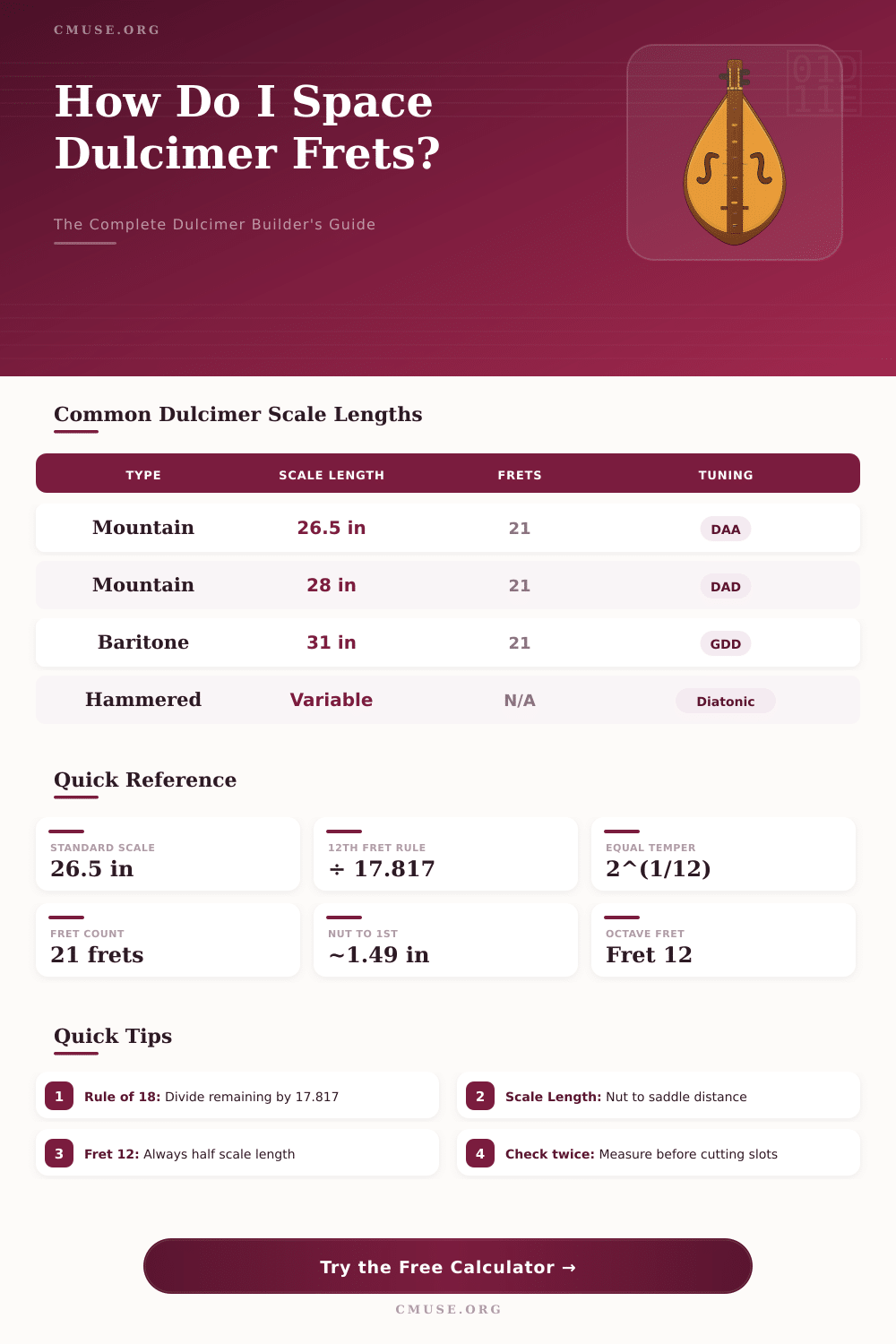
| Dulcimer Type | Scale Length | Scale (cm) | Common Tuning | Fret Count | Notes |
|---|---|---|---|---|---|
| Mountain Standard | 26.5 in | 67.3 cm | DAA / DAD | 21 | Most common |
| Mountain Long | 28 in | 71.1 cm | DAD | 21 | Fuller tone |
| Mountain Long | 29 in | 73.7 cm | DAD / CGG | 21 | Extended range |
| Baritone | 31 in | 78.7 cm | GDD / AEE | 21 | Deep resonance |
| Short Scale | 25 in | 63.5 cm | DAA | 21 | Smaller body |
| Children's | 24 in | 61.0 cm | DAA | 18 | Beginner friendly |
| Bass Dulcimer | 34 in | 86.4 cm | GDD | 18 | Deep bass |
| Fret # | Ratio from Nut | % of Scale | 26.5" Position | 28" Position | Note (from D) |
|---|---|---|---|---|---|
| 1 | 0.94387 | 5.61% | 1.487 in | 1.570 in | D# / Eb |
| 2 | 0.89090 | 10.91% | 2.890 in | 3.055 in | E |
| 3 | 0.84090 | 15.91% | 4.216 in | 4.456 in | F |
| 4 | 0.79370 | 20.63% | 5.467 in | 5.776 in | F# / Gb |
| 5 | 0.74915 | 25.08% | 6.646 in | 7.022 in | G |
| 6 | 0.70711 | 29.29% | 7.762 in | 8.201 in | G# / Ab |
| 7 | 0.66742 | 33.26% | 8.814 in | 9.312 in | A |
| 8 | 0.62996 | 37.00% | 9.806 in | 10.359 in | A# / Bb |
| 9 | 0.59460 | 40.54% | 10.737 in | 11.341 in | B |
| 10 | 0.56123 | 43.88% | 11.617 in | 12.275 in | C |
| 11 | 0.52973 | 47.03% | 12.442 in | 13.147 in | C# / Db |
| 12 | 0.50000 | 50.00% | 13.250 in | 14.000 in | D (Octave) |
| Tuning | Bass / Mid / Melody | Key | Style | Best Scale |
|---|---|---|---|---|
| DAA | D2 / A3 / A3 | D Major | Traditional Appalachian | 26.5" |
| DAD | D2 / A3 / D4 | D Major | Versatile, Modal | 26.5–28" |
| DGD | D2 / G3 / D4 | G Major | Celtic / Folk | 27–28" |
| CGG | C2 / G3 / G3 | C / G | Old-Time | 27–29" |
| DAC | D2 / A3 / C4 | D Modal | Minor / Dorian | 26.5" |
| GDD | G2 / D3 / D3 | G / D | Baritone | 31" |
| EAA | E2 / A3 / A3 | A Major | Crossover | 26.5–28" |
The spacing of frets on a dulcimer can seem a bit scary at first but really it is not this mysterious because when you understand the basic idea. Learning where exactly the frets lay on the fretboard quickly becomes something natural for you.
The main way to count the Dulcimer Fret Spacing on any fretted instrument is the length of the scale, that sometimes called vibrating length. On most fretted instruments, it simply is the distance from the nut to the bridge. You can enter that value in a calculator in inches or in millimeters, depending on what you feel comfortable with.
How Dulcimer Frets Are Spaced
Even so, dulcimer work a bit differently than guitars, because they are diatonic instead of chromatic, so they simply skip certain frets. Here is one of the main features that makes them different.
Finding exactly where the frets lay is one of the trickiest parts during building of a dulcimer. Luckily, there are helpful charts that show the positions of frets for almost every possible length of scale, from eight inches to thirty-two inches, split in steps of eight inches. Every position of a fret is shown in three different ways: the distance from the prior fret, the place from teh nut and the distance from the bridge.
Many builders trust an old formula. Divide the length of the string by 17.81715385, and that will give you the distance from the nut to the first fret. It has been around a long time and works well as a base to start.
To build a diatonic fretboard for a dulcimer, commonly one starts with a chromatic template, then drops some frets to reach the diatonic scale. The frets that one skips are the 1st, 3rd, 6th, 8th, 10th, 13th, 15th, 18th, 20th and 22nd. Like this the spacing naturally forms major keys directly on the fretboard.
If you add an optional extra fret, then you can play mixolydian mode from the nut, and it gives also another major start at the third fret.
Most builders add frets at the 6½ and 13½ (that last one is won octave higher). Those two positions already became standard on modern dulcimer. In my experience, adding frets at 1½ and 6½ really improves the playability.
Some books about dulcimer from the 2000s also use the positions 1½, 8½ and 15½.
Here it gets confusing; the fret 6½ sits right between the 6th and 7th frets. Those half-number frets commonly confuse folks during calculation, and you can quickly get lost in the weeds. There is yet one more thing: you will notice some quirks in the Dulcimer Fret Spacing around those half frets.
For instance, the space between the 13th and 14th fret can seem noticeably narrower than between the 15th and 16th.
The math for the Dulcimer Fret Spacing does not really depend on the type of instrument, but the full length neck and the diatonic arrangement of dulcimer do make it unique. If you play a lot on your dulcimer, you can adjust the nut slightly, the usual gaps are between 0.010 and 0.025 inches, which is small compared to mistakes in frets. The grooves forthe strings should have quite a big width at the first fret and smaller at the seventh fret.