🎻 Violin Size & String Calculator
Find the right violin size, scale length, string gauges, and tuning frequencies for any player
⚙️ Calculator Inputs
✅ Your Violin Calculation Results
📏 Violin Size by Arm Length
🎵 String Frequencies by Tuning Standard
| String | Note | 440 Hz (Hz) | 432 Hz (Hz) | 415 Hz (Hz) | 442 Hz (Hz) |
|---|---|---|---|---|---|
| E String | E5 | 659.3 | 647.3 | 622.3 | 662.2 |
| A String | A4 | 440.0 | 432.0 | 415.0 | 442.0 |
| D String | D4 | 293.7 | 288.0 | 276.7 | 294.7 |
| G String | G3 | 196.0 | 192.3 | 184.7 | 196.7 |
📏 Violin Dimensions by Size
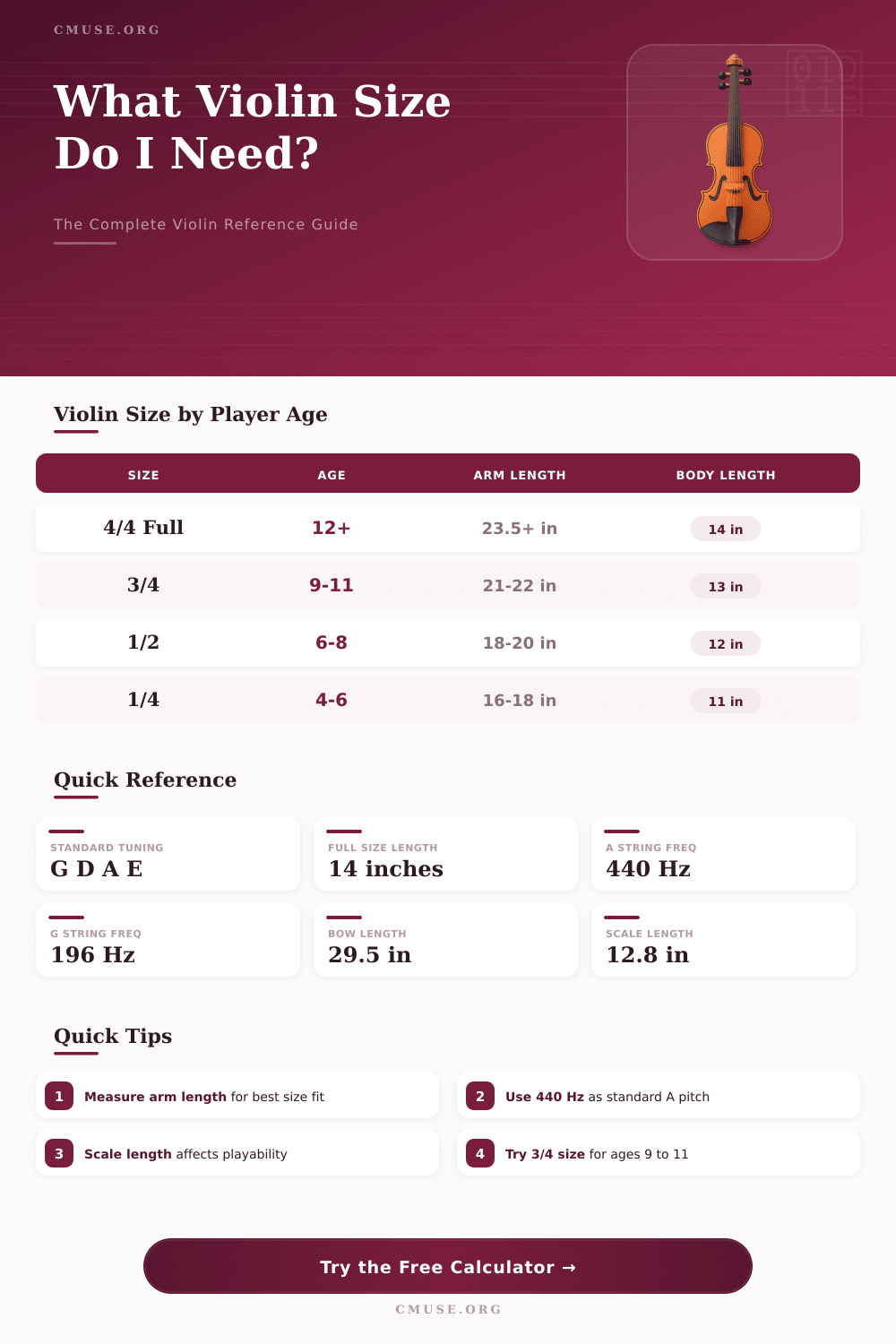
| Size | Body Length (in) | Scale Length (in) | Body Length (cm) | Scale Length (cm) | Bow Length (in) |
|---|---|---|---|---|---|
| 4/4 Full | 14.0 | 12.8 | 35.6 | 32.5 | 29.5 |
| 3/4 | 13.0 | 11.9 | 33.0 | 30.2 | 27.5 |
| 1/2 | 12.0 | 11.0 | 30.5 | 27.9 | 25.6 |
| 1/4 | 11.0 | 10.0 | 27.9 | 25.4 | 23.2 |
| 1/8 | 9.5 | 8.9 | 24.1 | 22.6 | 21.5 |
| 1/16 | 9.0 | 8.3 | 22.9 | 21.1 | 19.7 |
🧵 String Tension by Gauge & Type
| String Type | Light Tension (lbs) | Medium Tension (lbs) | Heavy Tension (lbs) | Best For |
|---|---|---|---|---|
| Steel Core | 11-13 | 13-15 | 15-18 | Fiddle, Electric |
| Synthetic Core | 9-11 | 11-13 | 13-16 | Classical, General |
| Gut Core | 7-9 | 9-11 | 11-14 | Baroque, Period |
| Perlon Core | 10-12 | 12-14 | 14-16 | Student, Intermediate |
| Nylon Core | 8-10 | 10-12 | 12-14 | Beginner, Student |
| Silver Wound | 10-12 | 12-14 | 14-17 | Low strings (G, D) |
🎶 Common Violin Projects & Specifications
| Player Type | Recommended Size | Scale Length | String Type | Tuning |
|---|---|---|---|---|
| Toddler (3-4 yrs) | 1/16 | 8.3 in / 21.1 cm | Nylon | 440 Hz |
| Young Child (5-6 yrs) | 1/8 | 8.9 in / 22.6 cm | Nylon | 440 Hz |
| Child (7-8 yrs) | 1/4 | 10.0 in / 25.4 cm | Synthetic | 440 Hz |
| Pre-Teen (9-10 yrs) | 1/2 | 11.0 in / 27.9 cm | Synthetic | 440 Hz |
| Teen (11-13 yrs) | 3/4 | 11.9 in / 30.2 cm | Synthetic/Steel | 440 Hz |
| Adult / Professional | 4/4 | 12.8 in / 32.5 cm | Synthetic/Gut | 440 or 442 |
| Baroque Player | 4/4 | 12.8 in / 32.5 cm | Gut | 415 Hz |
| Fiddle Player | 4/4 | 12.8 in / 32.5 cm | Steel | 440 Hz |
The violin is also sometimes called the violino. It is made from wood and is the tiniest in the group of violins. Because of its size it gives the highest sound between the commonly used instruments of that family.
There are even more little instruments alike to the violin, as the violino piccolo or the pochette, but they are almost never used.
About the Violin
In a usual orchestra the violins split into two sections: the first and the second. The lead player of the first violins also serves as the concertmaster. Like this the violin is a truly key part in any orchestral arrangement.
Because the violin does not have frets, the musician must lay fingers exactly on the fingerboard to ensure that every note sounds correctly in the melody. Here is one of the reasons that it is so sensitive. Learning violin alone, without help of a teacher, is almost not possible, at least for the basics.
Private courses are a good idea for anyone that seriously wants to master it. Some keys answer very well for the violin, for instance G, D and A. Playing in them feels natural on the insturment, especially during solo play. Techniques as double stops, open strings and harmonics work very well in practice.
When the bow slips across the strings, they first stick to the bow and later release, when the friction beats. This process repeats again and again, thus the sound is born. It differs much from picking a guitar string, that simply vibrates at its natural frequencies.
Before, strings for violin were made from catgut. That is a kind of material done from fibers of the walls of animal intestines. So, yes, they were truly done from animal bellies.
More curious, such strings are yet produced today.
The viola and violin look so much alike, that one can see them almost identical for the most part. The word “violin family” is more write according to technique, but it sounds a bit hard to say always.
Violins cover all grades, from school model to professional instruments. Marks as Fiddlerman, Holstein, Scott Cao, Yamaha and Stagg Strings are well known. Other names include Franz Hoffmann, Carlo Lamberti and John Cheng.
Electric violins are also sold at marks as Yamaha, NS Design and Ponticelli. A starting violin, like the Cremona, can serve around five years, before the fingerboard splits from the neck; that is a simple and cheap repair. After that, a tip to an intermediate instrument seemsnatural.
Playing violin can lower the tension, which gives nice benefit for workers. Even so it needs much time to learn to create good violin sound. Children sometimes succeed, where adults struggle, because they do not know how bad they sound at first.