🎵 Ukulele Fret Spacing Calculator
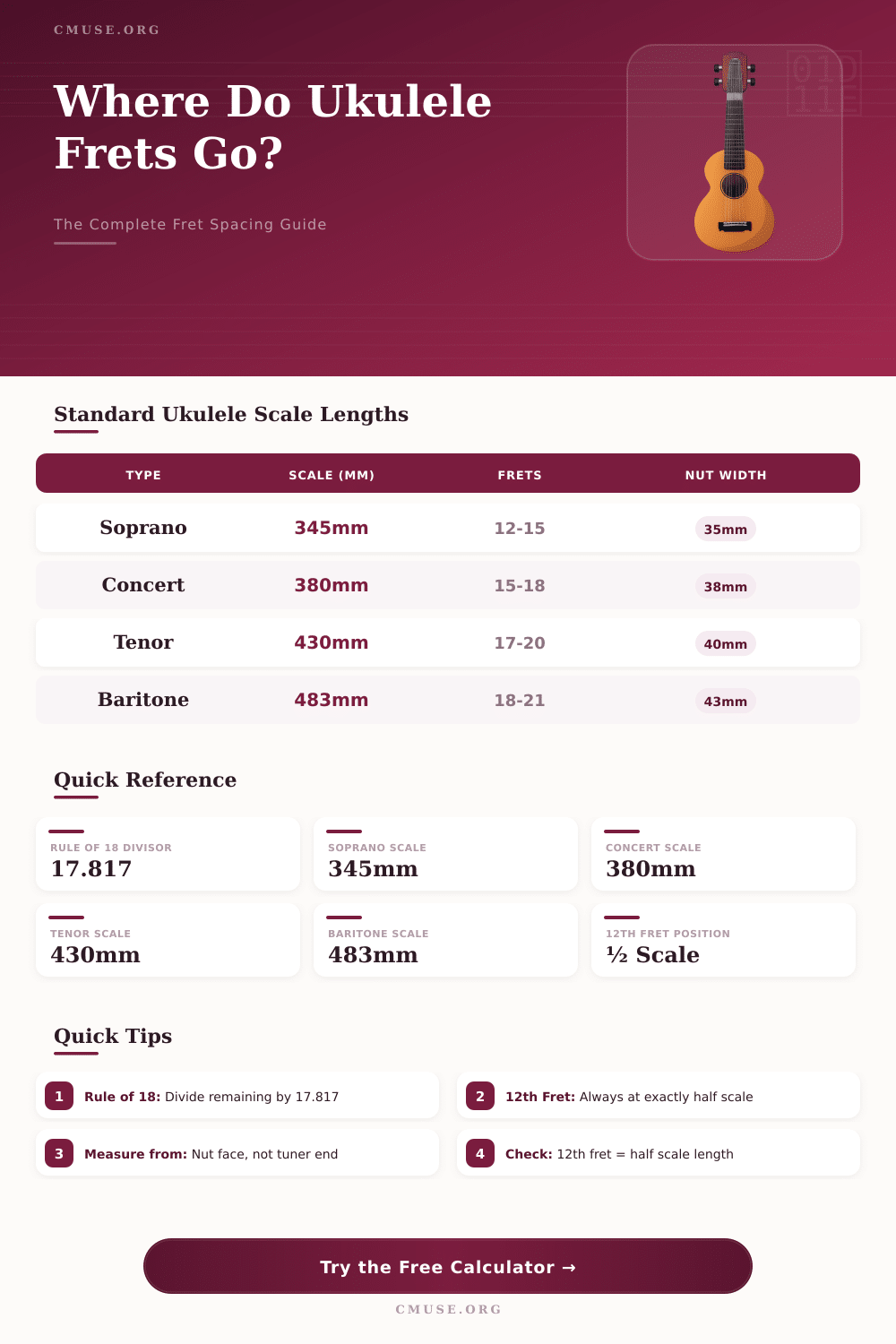
Calculate precise fret positions for any ukulele scale length using the Rule of 18 (17.817)
| Fret # | From Nut (mm) | From Nut (in) | Fret Spacing (mm) | Note (G Tuning) |
|---|---|---|---|---|
| 1 | 19.36 | 0.762 | 19.36 | G# |
| 2 | 37.64 | 1.482 | 18.28 | A |
| 3 | 54.90 | 2.161 | 17.27 | A# |
| 4 | 71.20 | 2.803 | 16.29 | B |
| 5 | 86.58 | 3.409 | 15.38 | C |
| 6 | 101.10 | 3.980 | 14.53 | C# |
| 7 | 114.80 | 4.520 | 13.70 | D |
| 8 | 127.73 | 5.029 | 12.93 | D# |
| 9 | 139.94 | 5.510 | 12.21 | E |
| 10 | 151.46 | 5.963 | 11.52 | F |
| 11 | 162.35 | 6.392 | 10.89 | F# |
| 12 | 172.50 | 6.791 | 10.27 | G (Octave) |
| 13 | 182.18 | 7.172 | 9.68 | G# |
| 14 | 191.32 | 7.532 | 9.14 | A |
| 15 | 199.95 | 7.872 | 8.63 | A# |
| Ukulele Type | Scale (mm) | Scale (in) | Fret 1 (mm) | 12th Fret (mm) | Nut Width (mm) |
|---|---|---|---|---|---|
| Soprano | 345 | 13.58 | 19.36 | 172.5 | 35 |
| Concert | 380 | 14.96 | 21.32 | 190.0 | 38 |
| Tenor | 430 | 16.93 | 24.13 | 215.0 | 40 |
| Baritone | 483 | 19.02 | 27.10 | 241.5 | 43 |
| Bass Ukulele | 510 | 20.08 | 28.62 | 255.0 | 45 |
| Fret # | Multiplier | % of Scale | Remaining Scale % |
|---|---|---|---|
| 1 | 0.05613 | 5.61% | 94.39% |
| 2 | 0.10893 | 10.89% | 89.11% |
| 3 | 0.15894 | 15.89% | 84.11% |
| 4 | 0.20630 | 20.63% | 79.37% |
| 5 | 0.25109 | 25.11% | 74.89% |
| 6 | 0.29340 | 29.34% | 70.66% |
| 7 | 0.33333 | 33.33% | 66.67% |
| 8 | 0.37004 | 37.00% | 63.00% |
| 9 | 0.40566 | 40.57% | 59.43% |
| 10 | 0.43944 | 43.94% | 56.06% |
| 11 | 0.47143 | 47.14% | 52.86% |
| 12 | 0.50000 | 50.00% | 50.00% |
The distance between the frets on a ukulele directly relates to what one calls scale length. It is the centre of the string, counted from the nut to the bridge. This defines the working length of the string.
The positions of frets base on this value because they are portions of that total distance.
How Fret Spacing Works on a Ukulele
Ukuleles come in various sizes, and each has its own scale length. The order from most small to biggest are: soprano, concert, tenor, then baritone. On soprano the frets stand more closely than on concert, and on concert they are more tight than on tenor.
Long scale results in more Ukulele Fret Spacing. The most visible difference shows at frets one to eight. Higher frets do spread a bit more on big models, but up here the cause more crowding the gap seems too narrow.
Between standard ukulele sizes, the tenor owns the longest scale and the most roomy body, what gives it richer and full sound. That longer scale also means more frets and more spaced gaps between them. Usually it brings also broader distance at the bridge and nut, what works well for playing with fingers.
Interestingly, if one lays a capo on a 20-inch baritone scale at the fifth fret, one receives almost identical Ukulele Fret Spacing as on a 17-inch tneor.
The baritone ukulele has a scale length of around 19 to 20 inches. That still stays much more small than a full size acoustic guitar, that normally reaches around 25 inches. Hence the Ukulele Fret Spacing on a baritone ukulele are a bit narrower then on guitar.
Counting where exactly the frets lay is among the most careful steps during building of a ukulele. Guides exist with precise charts that show fret spots for every scale length of 8 to 32 inches, with steps each 8 inches. Online one finds fret calculators that help to set the right places on the fretboard.
Some of them even allow to save the template as PDF, to print it on regular paper. Later one can glue the paper to the fretboard and cut along the marks.
First making a paper template is a wise idea. Mark it, check the centres, and then copy everything to the real fretboard. Many early Hawaiian ukuleles used a scale of only 13 inches, so there are no strict rules about scale length.
The twelfth fret sits exactly at the half of the scale length. But if one does not adjust for the tension of the strings, problems with tuning can happen. Note mistakes, especially on frets one to seven, can cause too sharp sounds, and that trouble drops as players climb the neck.
Ideal distance is between 2 and 2.5 millimeters between the twelfth fret and the bottom part of the string. Also the gaps between frets grow a bit as theneck widens toward the body, because commonly the neck is a bit narrow beside the head.