🎼 Bamboo Flute Calculator
Calculate tube length, tone hole positions, bore diameter & tuning for any key
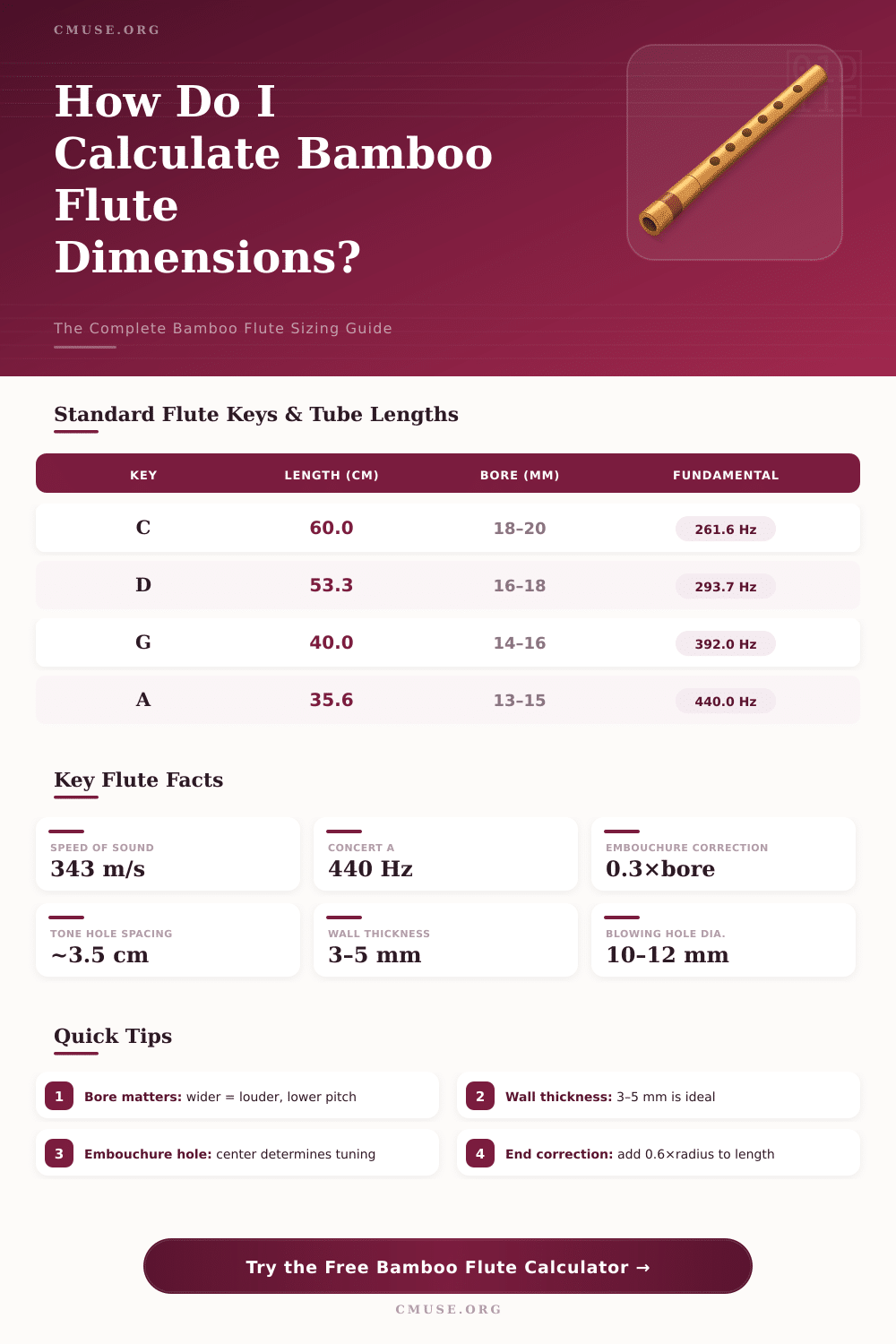
| Key (Note) | Frequency (Hz) | Ideal Length (cm) | Ideal Length (in) |
|---|---|---|---|
| B3 | 246.9 Hz | 69.5 cm | 27.4 in |
| C4 | 261.6 Hz | 65.6 cm | 25.8 in |
| D4 | 293.7 Hz | 58.4 cm | 23.0 in |
| E4 | 329.6 Hz | 52.0 cm | 20.5 in |
| F4 | 349.2 Hz | 49.1 cm | 19.3 in |
| G4 | 392.0 Hz | 43.7 cm | 17.2 in |
| A4 | 440.0 Hz | 38.9 cm | 15.3 in |
| B4 | 493.9 Hz | 34.6 cm | 13.6 in |
| C5 | 523.3 Hz | 32.7 cm | 12.9 in |
| D5 | 587.3 Hz | 29.1 cm | 11.5 in |
| Scale Interval | Semitones Up | % from Open End | Approx. Position (D flute) |
|---|---|---|---|
| Open (fundamental) | 0 | 0% (open end) | All holes open |
| Hole 1 (bottom) | +2 | ~11–13% from end | ~6.5 cm from end |
| Hole 2 | +4 | ~20–23% from end | ~12 cm from end |
| Hole 3 | +5 | ~26–29% from end | ~15.5 cm from end |
| Hole 4 | +7 | ~35–38% from end | ~20.5 cm from end |
| Hole 5 | +9 | ~44–47% from end | ~25.5 cm from end |
| Hole 6 (top) | +11 | ~52–56% from end | ~30 cm from end |
| Embouchure hole | N/A | ~75–80% from end | ~43 cm from end |
| Bore Diameter | Flute Type | Tone Character | Best For |
|---|---|---|---|
| 10–13 mm | Soprano / Piccolo | Bright, cutting | High melody, folk |
| 13–16 mm | Folk / Bansuri | Warm, airy | Indian classical, world |
| 16–20 mm | Concert / Standard | Full, resonant | Western classical, studio |
| 20–24 mm | Alto / Bass | Deep, mellow | Ensemble, meditation |
| 24–30 mm | Contrabass | Very deep, earthy | Orchestral bass register |
| Wall Thickness | Category | Effect on Tone | Effect on Tuning |
|---|---|---|---|
| 1–2 mm | Very thin | Bright, less sustain | Slightly sharp tendency |
| 2–3 mm | Thin | Clear, immediate | Near-accurate |
| 3–5 mm | Standard ✓ | Balanced, warm | Most accurate |
| 5–7 mm | Thick | Dark, mellow | Slightly flat tendency |
| 7+ mm | Very thick | Heavy, damped | Compensate with length |
The bamboo flute is an ancient musical tool that started in Asia. One finds flutes in historic documents and in arts since the Zhou dynasty. The most old written records show that the Chinese used the kuan (instrument from bark), and the xiao flute blown by the end, commonly done from bamboo, already before 12th until 11th centuries BC.
The bansuri are old bamboo flute blown by the side, coming from the Indian subcontinent. It belongs to the wind instruments, done from bamboo or materials like metal. One plays it in several folk songs of India, Sri Lanka and Nepal.
Bamboo Flute: History, Types, Playing and Care
Professional bansuri flutes one does by hand from the best dry bamboo, and one sets them perfectly by means of help of expert musicians. Indian bamboo flutes come with different amounts of holes. For instance, one kind has six holes for fingers and is called bansuri, while another has seven.
Bamboo grows in many areas of the world. Its strong, hollow form works well for making simple and nice instruments. It is enough to measure, cut and shape to have a nice and cheap wind instrument from wood.
Thanks to its fast growth, hollow shape and broad spread, one used bamboo for insturments in various cultures.
Metallic flute sounds sharp and high. The bamboo flute variant gives gentler sound, with deeper tone. Some bamboo flutes one does from pieces of Tonkin bamboo, grown in China.
Each of them tunes to a base and is fit to produce one-half until two octaves. One uses also black bamboo and silverstripe bamboo. The silverstripe bamboo has a natural narrowing in the interior, which helps for good sound in the scale.
For size, little hands answer to flute in D or E-centre. Big hands favour A- or B-bass. C-natural centre or C-sharp centre is a good average choice.
Very big bass flutes can pass one inches in interior. This range goes from 26 until more then 36 inches, with play from the tone B below. Because of their huge length, the biggest samples have only four finger holes.
The most common side-blown bamboo flutes own six finger holes and one accent.
Bamboo flutes one plays flat instead of up and down, style close to the western flute. The elbows stay away from the body, best resting on the sides. Do not blow too hard as it is useful for reaching the high octave on the bansuri.
That quickly tires the player, and keeping the sound is even more hard than on metallic flute. Bamboo cracks easily because of changes of moisture, so one must oil the flute in many climates. Dryness, small changes of temperature in the bamboo and tiredness of the player during breath are mainreasons of where bamboo flute seems hard to play over time.