🪈 Native American Flute Hole Calculator
Calculate precise finger hole placement, sizing, and spacing for any NAF key or bore diameter
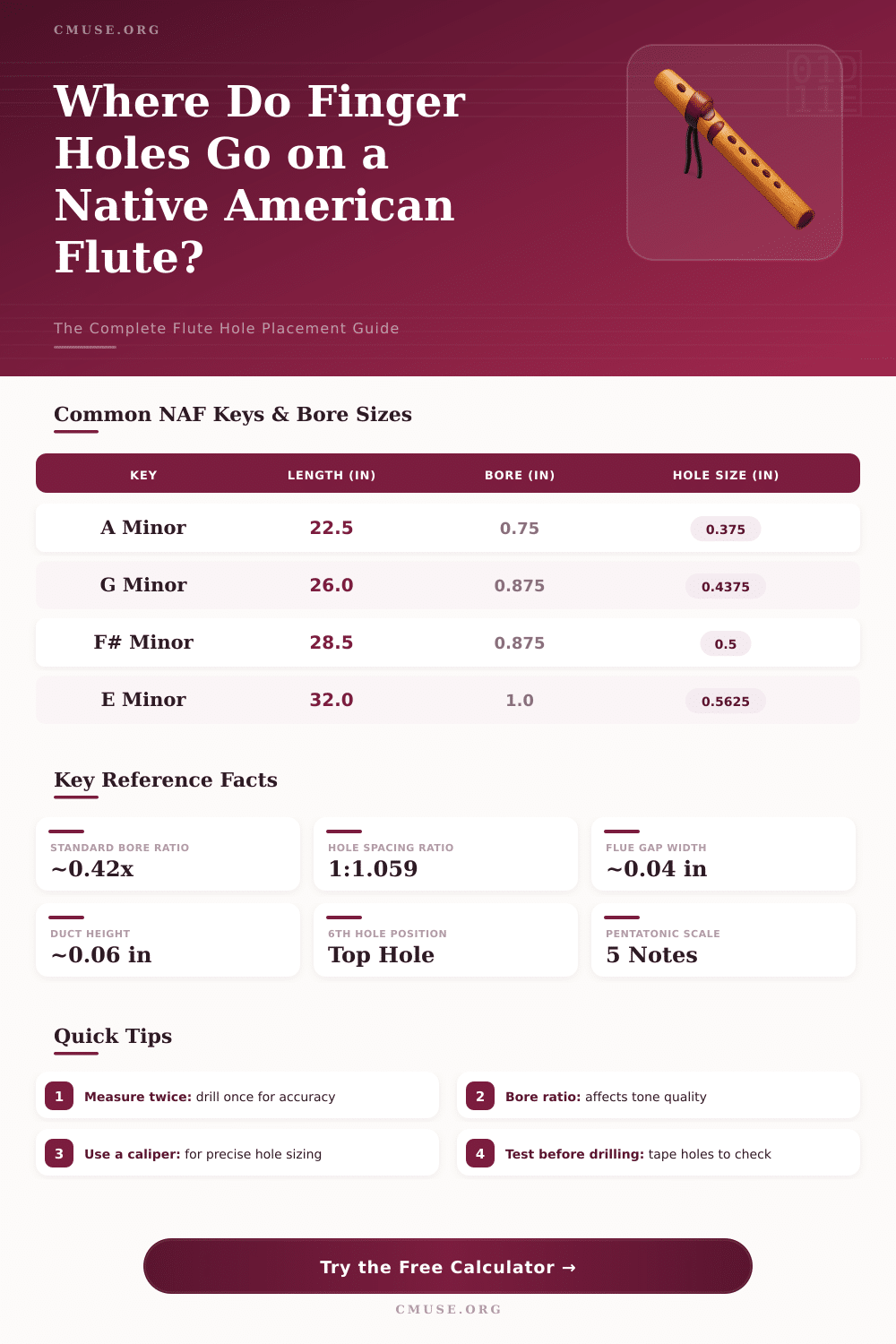
| Key | Flute Length (in) | Flute Length (cm) | Bore Dia (in) | Bore Dia (cm) | Approx. TSM (in) | Hole Size (in) |
|---|---|---|---|---|---|---|
| A Minor | 22.5 | 57.2 | 0.75 | 1.91 | 13.5 | 0.375 |
| G Minor | 26.0 | 66.0 | 0.875 | 2.22 | 15.6 | 0.4375 |
| F# Minor | 28.5 | 72.4 | 0.875 | 2.22 | 17.1 | 0.5 |
| E Minor | 32.0 | 81.3 | 1.0 | 2.54 | 19.2 | 0.5625 |
| D Minor | 36.0 | 91.4 | 1.125 | 2.86 | 21.6 | 0.5625 |
| C Minor | 40.0 | 101.6 | 1.25 | 3.18 | 24.0 | 0.625 |
| B Minor | 44.0 | 111.8 | 1.375 | 3.49 | 26.4 | 0.6875 |
| A Minor Bass | 48.0 | 121.9 | 1.5 | 3.81 | 28.8 | 0.75 |
| Scale / Mode | Interval Pattern | Ratio Between Holes | Notes in Scale | Standard NAF? |
|---|---|---|---|---|
| Pentatonic Minor | W-mW-W-mW-W | ~1.122 | 5 | Yes ✓ |
| Natural Minor | W-H-W-W-H-W-W | ~1.059 | 7 | Yes ✓ |
| Major (Ionian) | W-W-H-W-W-W-H | ~1.059 | 7 | No |
| Dorian | W-H-W-W-W-H-W | ~1.059 | 7 | No |
| Mixolydian | W-W-H-W-W-H-W | ~1.059 | 7 | No |
| Bore Diameter (in) | Bore Diameter (cm) | Min Hole Dia (in) | Max Hole Dia (in) | Drill Bit Size |
|---|---|---|---|---|
| 0.625 | 1.59 | 0.3125 | 0.375 | 5/16" or 3/8" |
| 0.75 | 1.91 | 0.375 | 0.4375 | 3/8" or 7/16" |
| 0.875 | 2.22 | 0.4375 | 0.5 | 7/16" or 1/2" |
| 1.0 | 2.54 | 0.5 | 0.5625 | 1/2" or 9/16" |
| 1.125 | 2.86 | 0.5625 | 0.625 | 9/16" or 5/8" |
| 1.25 | 3.18 | 0.625 | 0.6875 | 5/8" or 11/16" |
| 1.375 | 3.49 | 0.6875 | 0.75 | 11/16" or 3/4" |
| 1.5 | 3.81 | 0.75 | 0.8125 | 3/4" or 13/16" |
| Key | TSM to Hole 1 (in) | Hole 1 to 2 (in) | Hole 2 to 3 (in) | Hole 3 to 4 (in) | Hole 5 to 6 (in) | |
|---|---|---|---|---|---|---|
| A Minor | 3.20 | 1.35 | 1.20 | 1.35 | 1.20 | 1.35 |
| G Minor | 3.70 | 1.56 | 1.39 | 1.56 | 1.39 | 1.56 |
| F# Minor | 4.06 | 1.71 | 1.52 | 1.71 | 1.52 | 1.71 |
| E Minor | 4.57 | 1.92 | 1.71 | 1.92 | 1.71 | 1.92 |
| D Minor | 5.14 | 2.16 | 1.92 | 2.16 | 1.92 | 2.16 |
The True Sound Maker (TSM) is the splitting edge inside the slow air chamber. Its distance from the mouthpiece end determines the pitch of all tone holes. Always measure to the leading edge of the TSM, not the slow air chamber opening. A difference of even 1mm can shift your flute sharp or flat by several cents.
Before drilling any tone holes, use masking tape to cover test positions and hum-test each hole location. The bore diameter to hole diameter ratio should be approximately 0.5 (hole = 50% of bore). Oval holes provide more intonation adjustment range than round holes and are preferred by many professional NAF makers.
Finding the right distance between holes on a Native American Flute genuinely is one of the most important steps for genuinely building something playable. Everything comes down to one spot: where one lays those finger holes and how big they are. Get the spacing right and the flute comfortably sits in your hands.
Many builders start with a rough percentage guess. The upper hole usually sits around one third of the way down during the bottom hole sits somewhere almost at two thirds. The other holes arrange themselves between those two places.
Where to Put Finger Holes on a Native American Flute
That said, this more serves as a visual guide than strict rule.
One method that I saw work well consist in laying the upper hole at around 70% of the length of the tube, later spacing the others about one inch as you descend. Another method some makers swear by: one uses the width of his own thumb as distance between the sound holes. Those basic rules give you a solid start although you will have to later fix things.
The size of the hands changes everything here. Depending on who will play the flute, the spaces between holes in a group of three usually sits somewhere between 1.1 and 1.4 inches. The narrowest distance that you would want is around 0.8 inches.
Interesting is, that the traditional design of a Native American Flute tends to space Hole quite a lot equally along the length, nothing like a guitar neck, where the frets become closer when one climbs.
The diameter and length of your sound chamber, along with those finger holes, really decide what notes you will get and how well everything will sound. Also the finger holes matter. Bigger holes do genuinely quickly match flutes, although depending on the players fingers that could cause a bit of trouble.
Most builders choose the easy path with five holes, telling players simply close the forth hole from the bottom. Some count the other way from up and say to cover the third hole. Here is the advantage of six-hole flutes; the spacing between notes stays the same, which allows you to learn a song on one six-hole flute and play it on any other later.
The pitch maybe will change, but the melody transfers.
There are genuinely calculators and tools, designed specially for this. For instance, Flutopedia is an encyclopedia dedicated to the instrument. Folks gathered size data from many different sources and combined them.
Do not forget the vent holes, sometimes called tuning holes or directional holes… That form part of the whole design. You can also add an internal plate in the sound chamber as a help for shaping thework.
Finding those holes placed exactly without doubt requires effort and testing, but starting with those guidelines gives you a firm base for building your first Native American Flute.