🎵 PVC Flute Hole Calculator
Calculate precise finger hole positions, spacing & sizes for any PVC pipe flute in any key
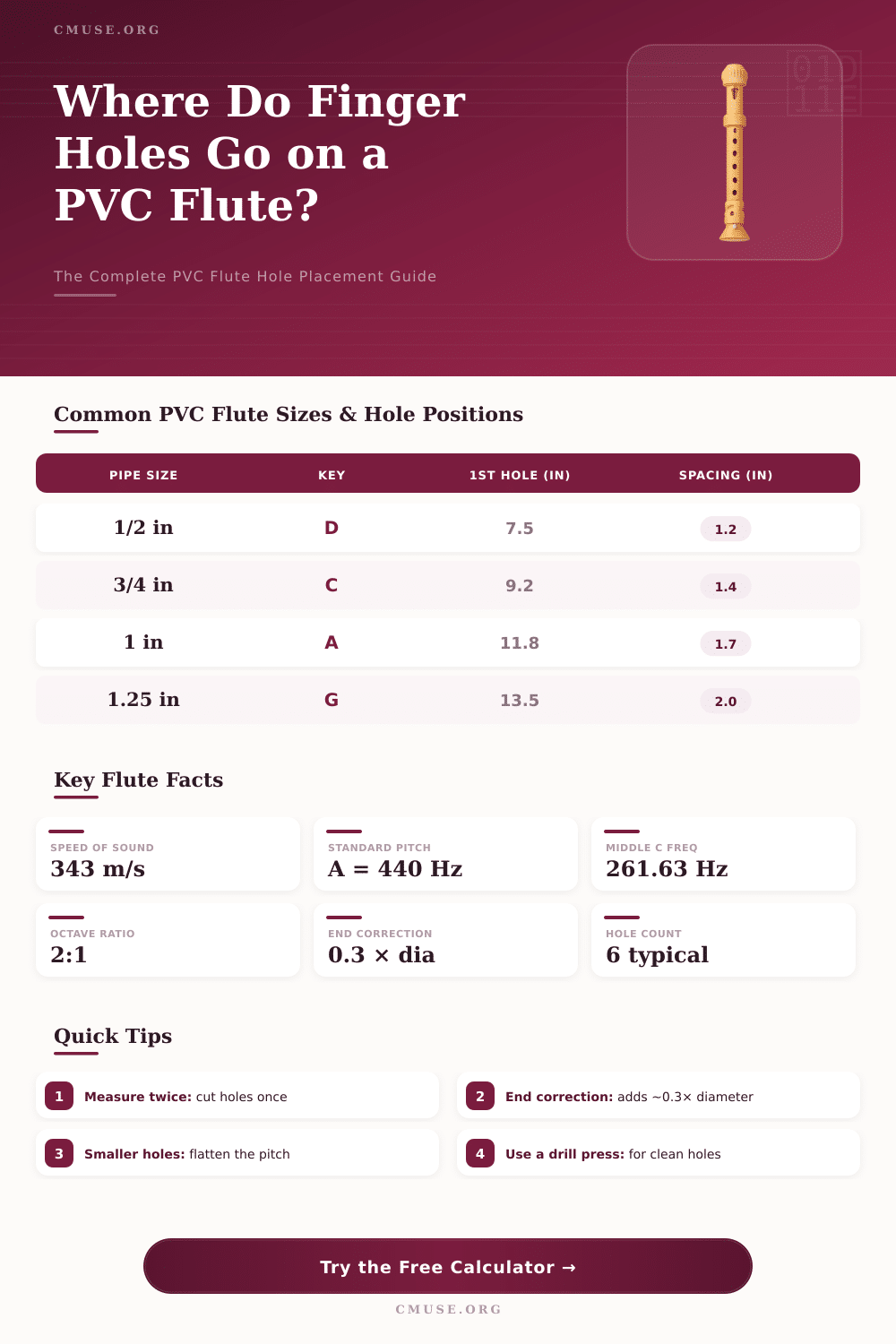
| Nominal Size | Outer Dia (in) | Inner Dia (in) | Wall Thickness (in) | OD (mm) | ID (mm) | Typical Key Range |
|---|---|---|---|---|---|---|
| 1/4 inch | 0.540 | 0.364 | 0.088 | 13.72 | 9.25 | High (F5–G5) |
| 3/8 inch | 0.675 | 0.493 | 0.091 | 17.15 | 12.52 | E4–G4 |
| 1/2 inch | 0.840 | 0.622 | 0.109 | 21.34 | 15.80 | D4–E4 |
| 3/4 inch | 1.050 | 0.824 | 0.113 | 26.67 | 20.93 | B3–C4 |
| 1 inch | 1.315 | 1.049 | 0.133 | 33.40 | 26.64 | A3–B3 |
| 1.25 inch | 1.660 | 1.380 | 0.140 | 42.16 | 35.05 | G3–A3 |
| 1.5 inch | 1.900 | 1.610 | 0.145 | 48.26 | 40.89 | F3–G3 |
| 2 inch | 2.375 | 2.067 | 0.154 | 60.33 | 52.50 | D3–E3 |
| Scale / Mode | Hole 1 | Hole 2 | Hole 3 | Hole 4 | Hole 5 | Hole 6 |
|---|---|---|---|---|---|---|
| Major (Ionian) | +2 | +4 | +5 | +7 | +9 | +11 |
| Natural Minor | +2 | +3 | +5 | +7 | +8 | +10 |
| Pentatonic Major | +2 | +4 | +7 | +9 | +12 | +14 |
| Pentatonic Minor | +3 | +5 | +7 | +10 | +12 | +15 |
| Dorian | +2 | +3 | +5 | +7 | +9 | +10 |
| Mixolydian | +2 | +4 | +5 | +7 | +9 | +10 |
| Pipe OD | Min Hole Dia (in) | Recommended Hole (in) | Max Hole Dia (in) | Drill Bit Size | Notes |
|---|---|---|---|---|---|
| 1/2 inch | 0.25 | 0.375 | 0.5 | 3/8 inch | Snug for small fingers |
| 3/4 inch | 0.3125 | 0.4375 | 0.5625 | 7/16 inch | Standard adult size |
| 1 inch | 0.375 | 0.5 | 0.625 | 1/2 inch | Good tone projection |
| 1.25 inch | 0.4375 | 0.5625 | 0.6875 | 9/16 inch | Deep, rich tone |
| 1.5 inch | 0.5 | 0.625 | 0.75 | 5/8 inch | Bass flute register |
| 2 inch | 0.5625 | 0.6875 | 0.875 | 11/16 inch | Sub-bass register |
| Key | Frequency (Hz) | Total Length (in) | Total Length (cm) | 1/2 in Pipe | 3/4 in Pipe | 1 in Pipe |
|---|---|---|---|---|---|---|
| G4 | 392.0 | ~8.7 | ~22.1 | Suitable | — | — |
| E4 | 329.6 | ~10.4 | ~26.4 | Suitable | Suitable | — |
| D4 | 293.7 | ~11.6 | ~29.5 | Suitable | Suitable | — |
| C4 | 261.6 | ~13.1 | ~33.3 | — | Suitable | Suitable |
| B3 | 246.9 | ~13.8 | ~35.1 | — | Suitable | Suitable |
| A3 | 220.0 | ~15.5 | ~39.4 | — | — | Suitable |
| G3 | 196.0 | ~17.4 | ~44.2 | — | — | Suitable |
| F3 | 174.6 | ~19.5 | ~49.6 | — | — | Suitable |
Open-hole flute, sometimes called French model, carry open holes in five of its lids. Those lids are made up of the G#, G, F, E and D lids. The player closes them directly with their fingers.
That differs from closed-hole flute, where all lids are fully closed. In closed-hole flute some lids touch directly the holes under them, while others connect by means of rods to more distant holes.
Open-Hole or Closed-Hole Flute? Simple Guide
The PVC Flute Hole openings in the lids help to control the right position of the fingers. It truly matters to reach good hand position. Without good finger placement, the holes will not close well.
If the closing is not quite tight, the sound becomes weak or squeaky. It requires a bit of practice at first, but anyone can learn to play flute on an open-hole instrument. Plugs are available for placing in the holes, which simply converts the open flute to closed-hole while the player develops thier playing style.
Open holes give big advantage: better control of the pitch. They allow the player to freely adjust the tone in ways that closed holes simply can not. When the player slips to low pitch and does not yet fully control the mouth shape, one can open one of those holes to raise the tone.
Such tricks work in classical music and in every kind of flute playing. Open holes also mean advanced techniques like microtones, witch is notes between the usual and multiphonics.
The makers of flute factories decided that open holes must be standard on professional flutes during the last half century. Even so, playing at very high level on closed-hole flute stays fully possible. One can order advanced closed flutes.
Nice sound does not depend on whether the holes are open or closed. Some professional flute players even plug the holes on their open flutes.
For beginners it is best to start with closed-hole flute. When the mouth shape settles and matures, which usually happens after two to four years, one can switch to an intermediate open-hole flute without problems. Then it helps to try several options to find the best fit.
Most players use an intermediate flute during the rest of their life. A closed-hole Yamaha beginner flute costs around nine hundred to a thousand dollars, while the open-hole version is around five hundred dollarsmore expensive.
Weight can also matter. Too much pressure on the F-, E- and D-lids to close the holes can cause tension. Plugs in those three lids help the fingers learn to relax and use less force.