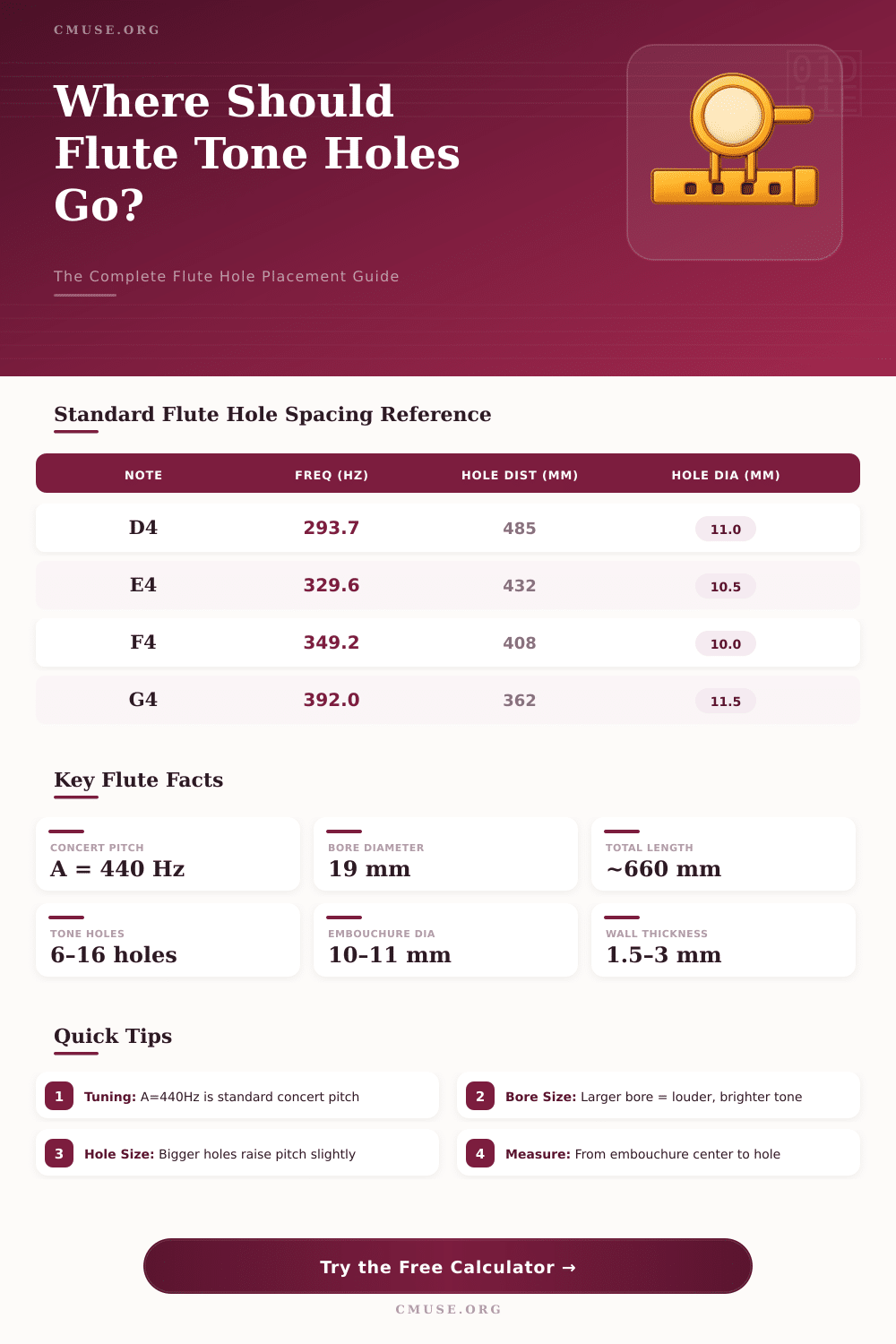
🎵 Flute Hole Calculator
Calculate precise tone hole placement, spacing & diameter for any flute tuning
| Note | Freq (440Hz) | Freq (432Hz) | Wavelength (cm) | Tube Length (mm) |
|---|---|---|---|---|
| C4 (Middle C) | 261.6 Hz | 256.9 Hz | 131.9 | 659 |
| D4 | 293.7 Hz | 288.3 Hz | 117.5 | 587 |
| E4 | 329.6 Hz | 323.6 Hz | 104.7 | 523 |
| F4 | 349.2 Hz | 342.9 Hz | 98.8 | 494 |
| G4 | 392.0 Hz | 384.9 Hz | 88.0 | 440 |
| A4 | 440.0 Hz | 432.0 Hz | 78.4 | 392 |
| B4 | 493.9 Hz | 484.9 Hz | 69.8 | 349 |
| C5 | 523.3 Hz | 513.7 Hz | 65.9 | 330 |
| D5 | 587.3 Hz | 576.7 Hz | 58.7 | 294 |
| E5 | 659.3 Hz | 647.3 Hz | 52.4 | 262 |
Hole Dia
Hole Dia
Hole Dia
Hole Dia
| Flute Key | Total Length (mm) | 1st Hole (mm) | Hole Spacing (mm) | Bore (mm) |
|---|---|---|---|---|
| C4 | 630–660 | ~490 | 28–35 | 19 |
| D4 | 555–590 | ~435 | 25–32 | 18–19 |
| E4 | 490–525 | ~385 | 22–28 | 17–18 |
| F4 | 460–495 | ~362 | 21–27 | 16–18 |
| G4 | 410–445 | ~322 | 19–25 | 16–17 |
| A4 | 365–395 | ~288 | 17–22 | 15–16 |
| D5 (Piccolo) | 275–300 | ~218 | 13–17 | 11–13 |
| Flute Type | Key | Bore (mm) | Length (mm) | Holes |
|---|---|---|---|---|
| Concert (Western) | C4 | 19 | 660 | 16 (keyed) |
| Piccolo | C5 | 11 | 310 | 8–10 (keyed) |
| Alto Flute | G3 | 25 | 820 | 16 (keyed) |
| Bass Flute | C3 | 35 | 1300 | 16 (keyed) |
| Irish Tin Whistle D | D4 | 12 | 575 | 6 |
| Native American | varies | 18–22 | 480–600 | 5–6 |
| Folk Flute (D) | D4 | 18 | 580 | 6 |
| Pan Flute | G4 | 16 | varies | N/A (open pipes) |
The spacing of holes in flute belongs to those themes that seems easy but gets hardly solvable. On the instrument, the openings are placed almost equally along the whole length, what entirely differs from the positions of frets on a guitar string for the first octave. It is important to understand this difference when one builds or learns about flutes.
Math rules exist for finding the places of holes in flute. Different kinds of flutes need separate rules. If one quickly searches “calculator for flute holes“, will show at least ten websites that give the results.
How Flute Holes Are Spaced
For instance, FluteMate allows to enter the whole length of the flute in centimetres, and later the distances for all flute hole spots show up on their own.
The placing of holes depends on several factors. It relies on the wavelength of the wanted frequency, the diameter of the inner tube, the size of the flute hole itself and that of the chimney. The chimney can match the thickness of the wall or be broader, when the holes are angled.
Also the size and place of other holes with lower tones matter. A rough guide says that each half tone matches to around 5,613 % of the whole length. Like this, if a cut at 10 inches below gives one note, then a flute hole at 10,56 inches produces a tone one half tone more below.
One can lay bigger holes more ahead of the mouth hole, while smaller ones go more closely. This shows that one can change the size of a flute hole and its position, without that changing the note itself. The size of flute holes obviously affects the sound.
At some flutes, all openings have same diameter, what can make it hard to play many scales from western music. Even so at recorders and other woodwinds, equally big holes still allow to well play melody.
To ease the playing of big flutes, one can shorten the reach of fingers by means of blending of big and small holes in every hand layout. Hence the distances between flute holes not always follow linear progress from the base too the key note. The measures between holes are taken center to center.
For instance, one flute uses 9,5 mm of diameter for all openings, with spaces of 38 mm between two holes, 17 mm between the next two and later 28 mm and 29 mm for the rest. This shows irregularity that is entirely usual. One handmade flute has only 4,6 mm between the centers of the two most bottom holes, while many factory models use smallerspacing for the bottom hand.
While tuning, the notes of flute can be compared with those of a piano, tuning fork or other tuner. Making the size of a flute hole smaller can also shorten the spacing between openings, what helps to create a more comfortable flute. Using big holes is especially useful for high notes.
At some flutes, the spacing of holes is too broad, what slows the playing at good speed.