🎹 Calculator Synthesizer
Compute oscillator frequencies, LFO rates, filter cutoffs, ADSR timings & more for your synth setup
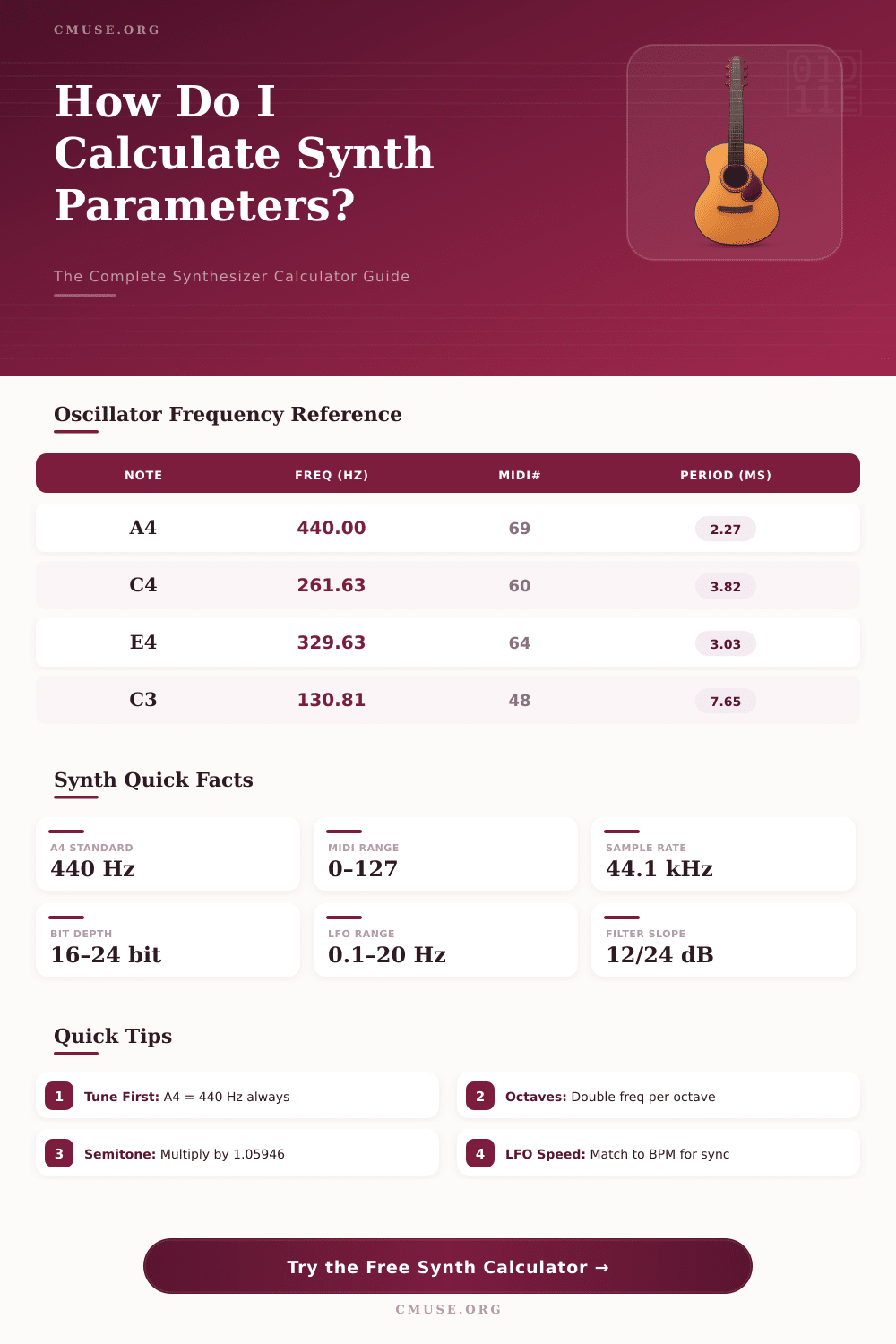
| Note | MIDI # | Freq (Hz) | Period (ms) | Wavelength (cm) |
|---|---|---|---|---|
| C2 | 36 | 65.41 | 15.29 | 527.5 |
| C3 | 48 | 130.81 | 7.65 | 263.7 |
| C4 (Middle C) | 60 | 261.63 | 3.82 | 131.9 |
| A4 (Concert) | 69 | 440.00 | 2.27 | 78.4 |
| C5 | 72 | 523.25 | 1.91 | 65.9 |
| A5 | 81 | 880.00 | 1.14 | 39.2 |
| C6 | 84 | 1046.50 | 0.96 | 33.0 |
| A6 | 93 | 1760.00 | 0.57 | 19.6 |
| BPM | Quarter Note (Hz) | Eighth Note (Hz) | Half Note (Hz) | Period (ms) |
|---|---|---|---|---|
| 80 BPM | 1.333 Hz | 2.667 Hz | 0.667 Hz | 750 ms |
| 100 BPM | 1.667 Hz | 3.333 Hz | 0.833 Hz | 600 ms |
| 120 BPM | 2.000 Hz | 4.000 Hz | 1.000 Hz | 500 ms |
| 128 BPM | 2.133 Hz | 4.267 Hz | 1.067 Hz | 469 ms |
| 140 BPM | 2.333 Hz | 4.667 Hz | 1.167 Hz | 429 ms |
| 160 BPM | 2.667 Hz | 5.333 Hz | 1.333 Hz | 375 ms |
| Filter Type | Slope | Resonance | Self-Oscillate | Character |
|---|---|---|---|---|
| Moog Ladder | 24 dB/oct | Very High | Yes | Warm, Fat |
| Transistor Ladder | 24 dB/oct | High | Yes | Punchy |
| State Variable (SVF) | 12 dB/oct | Moderate | Yes | Flexible |
| MS-20 HP/LP | 12 dB/oct | Very High | Yes | Aggressive |
| Digital SVF | 12–24 dB/oct | Variable | Depends | Clean |
| Analog LP 2-pole | 12 dB/oct | Moderate | No | Smooth |
| Project | Base Freq | LFO Rate | Attack | Filter Cutoff |
|---|---|---|---|---|
| Home Studio Pad | 261.63 Hz | 0.5 Hz | 800 ms | 800 Hz |
| Practice Room Lead | 440.00 Hz | 5.0 Hz | 10 ms | 3000 Hz |
| Stage Bass | 65.41 Hz | 2.0 Hz | 5 ms | 500 Hz |
| DJ Booth Stab | 130.81 Hz | 8.0 Hz | 2 ms | 2000 Hz |
| Recording Booth Arp | 523.25 Hz | 4.0 Hz | 1 ms | 5000 Hz |
| Modular Ambient | 87.31 Hz | 0.1 Hz | 2000 ms | 400 Hz |
Electronic synthesizers are made up of devices that create sounds by means of electrical modes. They operate mainly by means of the creation of waveforms, whether using subtractive synthesis, additive synthesis or frequency modulation, to form audio signals. In short words, deal about computer tools that intend to produce and control sounds, and one finds them everywhere, since recording studios until stages of live concerts.
There are three main kinds: analog digital or hybrids of the two.
What Are Electronic Synthesizers?
The range of synthesizer models here genuinely surprises. One has classic analog devices, that stand beside digital versions with computer management, purely software synthesizers and everything between. Most of them receive signals through MIDI-messages or control edges, later they convert that into live sound.
What scope of sounds is it possible to produce? Almost without limits, genuinely said.
Modern synthesizers mix sample-based elements, so little bits of real instruments, with waveform generators and filters, that control the thickness and evolution of the sound, making it louder or quiet. It genuinely impresses, if one thinks. The point is, that analog synthesizers have that warm character, that is almost impossible to copy by means of programs.
Whether analog or digital, none of them requires a computer to operate. For many folks those physical, manual controls are attractive, there is somthing special in turning knobs and pressing buttons instead of clicking by means of a mouse.
Right now on the market appear some remarkable devices. The OP-Z operates as an ultra-portable 16-track sequencer and synthesizer in one body, that allows both sample-based and synthetic creation of sounds. The Stylophone Stylosette simplifies to a pocket-sized synthesizer in cassette form, that means too play melody right away by means of its touch keyboard and built-in speaker.
Also polyphonic analog synthesizers exist, one sample has 49 keys, 8 voices for polyphony, BBD-effect for depth, arpeggiator, MIDI-connection, 200 presets and 400 user memories, everything with half weighted keys and aftertouch-sensitivity.
The Engine Synth goes in an entirely other way. It forms an analog electromechanical synthesizer, that uses real engines as a sound source. That truly is an original method.
For basics, choose a synthesizer with a good range of sounds to help explore the possibilities. It includes piano, organ, strings, wind instruments, synthesizer pads and built-in effects, what gives space for experiments and discovery. The used market commonly offers good deals, and used devices mostly keep value more than cheap new ones.
Experience in keyboards easily passes to synthesizers, because most use alike layouts. Many factory programmed synthesizers allow to change sounds to something near, but not perfect. Weighted keys matter a lot, they deliver more dynamic range and moresensitive touch.
Even in classical music synthesizers found place; Wendy Carlos famously made Switched-On Bach and the music of Clockwork Orange entirely by means of electronic synthesizers.