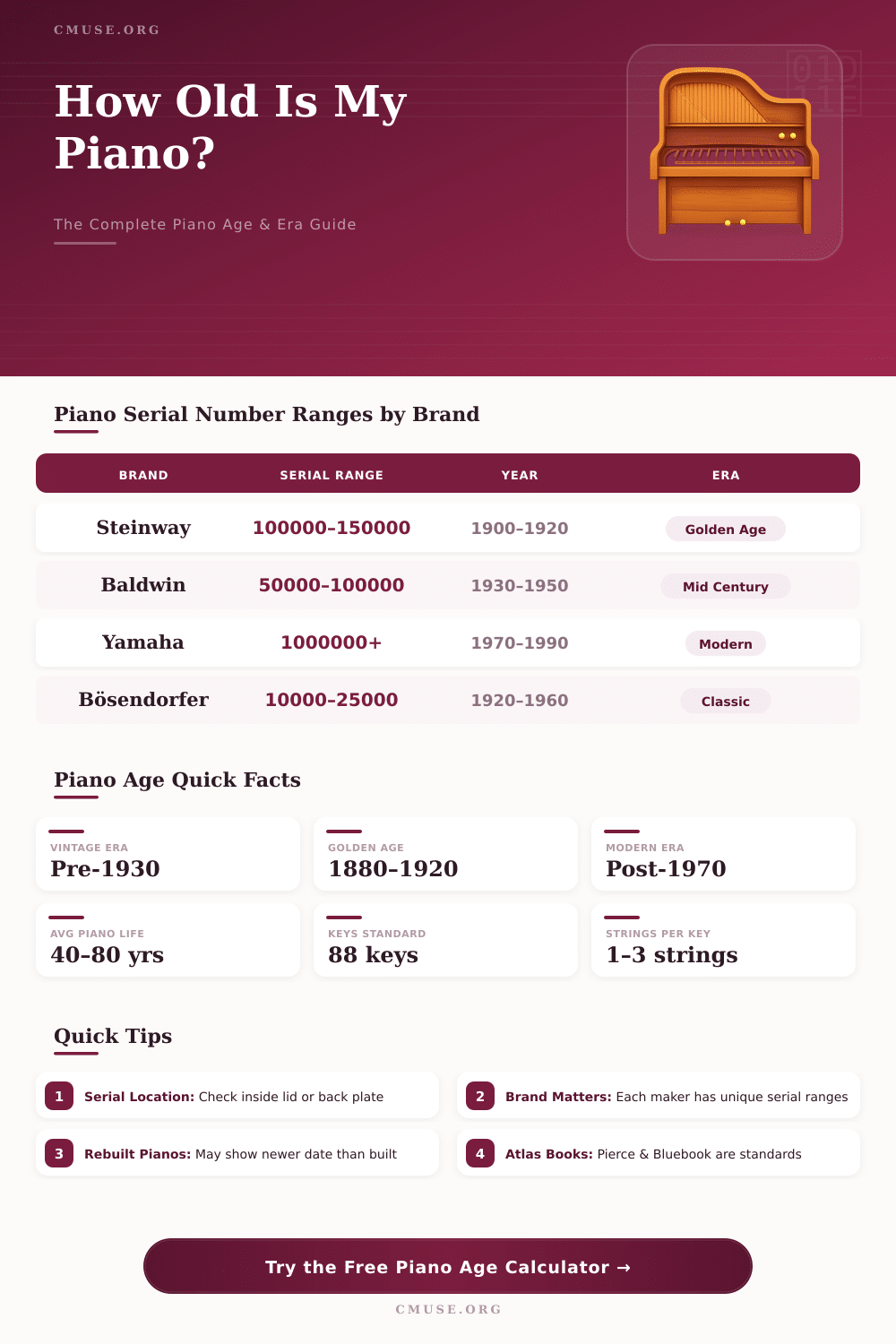
🎹 Piano Atlas Age Calculator
Find your piano's manufacturing year & era from its serial number — covers all major brands
⚡ Quick Presets
🎹 Piano Details
🎹 Your Piano Analysis Results
📊 Serial Number Reference by Brand
| Serial Number Range | Approx. Year | Era | Notes |
|---|---|---|---|
| Select a brand above and click calculate to see its full serial range table. | |||
📖 Piano Era Reference Guide
📋 Piano Lifespan & Service Reference
| Age Range | Typical Condition | Strings Status | Recommendation |
|---|---|---|---|
| 0–10 years | New / Like New | Stable, still settling | Regular tuning 2x/year |
| 10–25 years | Excellent to Good | Full tension, stable | Tuning + regulation check |
| 25–50 years | Good to Fair | May need voicing | Full service + voicing |
| 50–70 years | Fair — variable | Often needs restringing | Evaluate for restoration |
| 70–100 years | Variable | Likely needs replacement | Full restoration candidate |
| 100+ years | Antique / Historic | Replacement needed | Specialist restoration |
🎙 Piano Type Specifications
| Piano Type | Length / Height | Keys | Typical Use |
|---|---|---|---|
| Concert Grand | 274–305 cm (9–10 ft) | 88 | Concert halls, recordings |
| Semi-Concert Grand | 213–274 cm (7–9 ft) | 88 | Performance, teaching |
| Baby Grand | 147–183 cm (4.8–6 ft) | 88 | Home, small venues |
| Upright / Vertical | 110–135 cm tall | 88 | Home, schools |
| Console | 100–110 cm tall | 88 | Home use |
| Spinet | 91–100 cm tall | 88 | Space-saving home use |
📅 Major Brand Serial Number Timeline
| Brand | Founded | Serial at 1900 | Serial at 1950 |
|---|---|---|---|
| Steinway & Sons | 1853 | ~97,000 | ~314,000 |
| Yamaha | 1887 | ~1,000 | ~450,000 |
| Baldwin | 1891 | ~25,000 | ~120,000 |
| Kawai | 1927 | N/A | ~80,000 |
| Bösendorfer | 1828 | ~8,000 | ~20,000 |
| C. Bechstein | 1853 | ~40,000 | ~120,000 |
| Blüthner | 1853 | ~50,000 | ~145,000 |
| Chickering | 1823 | ~115,000 | ~160,000 |
Count the Piano Atlas Age of piano do not need to be hard, indeed there are simple ways to do that, if one knows where to search. The serial number is one of the most faithful tools here. It commonly appears as a stamp or print on the inside or the plate and it usually is made up of seven to nine figures, that stores all needed info about the production.
Online calculators for the Piano Atlas Age of pianos simplify this task to an impossible grade. One chooses the brand, enters the serial number and ready, one receives the year of making. Nice about those programs are, that they find misteaks, that happens sometimes in less fresh printed books.
How to Find a Piano’s Age and What It Tells You
For instance, if the part of the piano could not be made after the piano itself, the calculator automatically marks and fixes that logical crash.
Big pianos of Yamaha have different origin places according to the models, that one considers. The models GA1E, DGA1E, GB1, DGB1, GB1K and DGB1K all came from Jakarta in Indonesia. Each other big Yamaha?
That one finds in Hamamatsu, Japan.
Even so here is something, what truly matters. Only the Piano Atlas Age does not determine or strengthen or weaken the value of piano. Those instruments are built from tough materials.
We talk about silver wire, spruce, iron, that lasts on a long-term basis. In addition, one designs them like this, that workers can fix, swap or alter the worn parts when needed. That shows, that well taken care piano can have several lifetimes.
With good care piano of any age sounds almost perfectly. One finds pianos, that pass 100 years and yet sound surprisingly well.
There is that belief, that newer piano is automatically better. Workers of piano? Most say to you the opposite.
If old piano stayed in good shape, it can sound more rich then fresh from the factory. Good guitars prove that, guitars Martin before the war cost tenfold more than new. Even violin players commonly agree, that age can be advantage, although the opinions a bit differ.
So, when one should start to learn piano? Most children start between seven and nine years, when they already have good control of hands and their brains grew quite a lot. Eight years mark the sweet spot for many reasons: the hands grew, the link between eyes and hands works more well and they are ready to learn basic notions of math.
Methods work also with four year olds, but not always that is the best. If a child truly wants and is ready, earlier start helps. Also the size of hands plays a role.
Start more late? Fully possible. Folks start at 18, 20, 25, even older.
The main difference depends on regular practice. Thirty minutes each day beat one long heavy session. Early finding a good teacher helps toescape bad habits, that stay for always.