🎹 Piano Scale Calculator
Find notes, intervals, modes & diatonic chords for any scale on piano
| Semitones | Interval Name | Short | Example (C) |
|---|---|---|---|
| 0 | Perfect Unison | P1 | C |
| 1 | Minor Second | m2 | C♯ |
| 2 | Major Second | M2 | D |
| 3 | Minor Third | m3 | E♭ |
| 4 | Major Third | M3 | E |
| 5 | Perfect Fourth | P4 | F |
| 6 | Tritone / Aug 4th | TT | F♯ |
| 7 | Perfect Fifth | P5 | G |
| 8 | Minor Sixth | m6 | A♭ |
| 9 | Major Sixth | M6 | A |
| 10 | Minor Seventh | m7 | B♭ |
| 11 | Major Seventh | M7 | B |
| 12 | Perfect Octave | P8 | C (up) |
| Scale Degree | Major Key | Natural Minor | Chord Quality |
|---|---|---|---|
| I (1st) | Major | Minor | Root chord |
| II (2nd) | Minor | Diminished | Supertonic |
| III (3rd) | Minor | Major | Mediant |
| IV (4th) | Major | Minor | Subdominant |
| V (5th) | Major | Minor | Dominant |
| VI (6th) | Minor | Major | Submediant |
| VII (7th) | Diminished | Major | Leading tone |
| Note | Octave 3 | Octave 4 (Middle) | Octave 5 |
|---|---|---|---|
| C | 130.81 Hz | 261.63 Hz | 523.25 Hz |
| D | 146.83 Hz | 293.66 Hz | 587.33 Hz |
| E | 164.81 Hz | 329.63 Hz | 659.25 Hz |
| F | 174.61 Hz | 349.23 Hz | 698.46 Hz |
| G | 196.00 Hz | 392.00 Hz | 783.99 Hz |
| A | 220.00 Hz | 440.00 Hz | 880.00 Hz |
| B | 246.94 Hz | 493.88 Hz | 987.77 Hz |
Every major scale has a relative natural minor built on its 6th degree. C major's relative minor is A minor — they share the exact same notes, just starting from a different point.
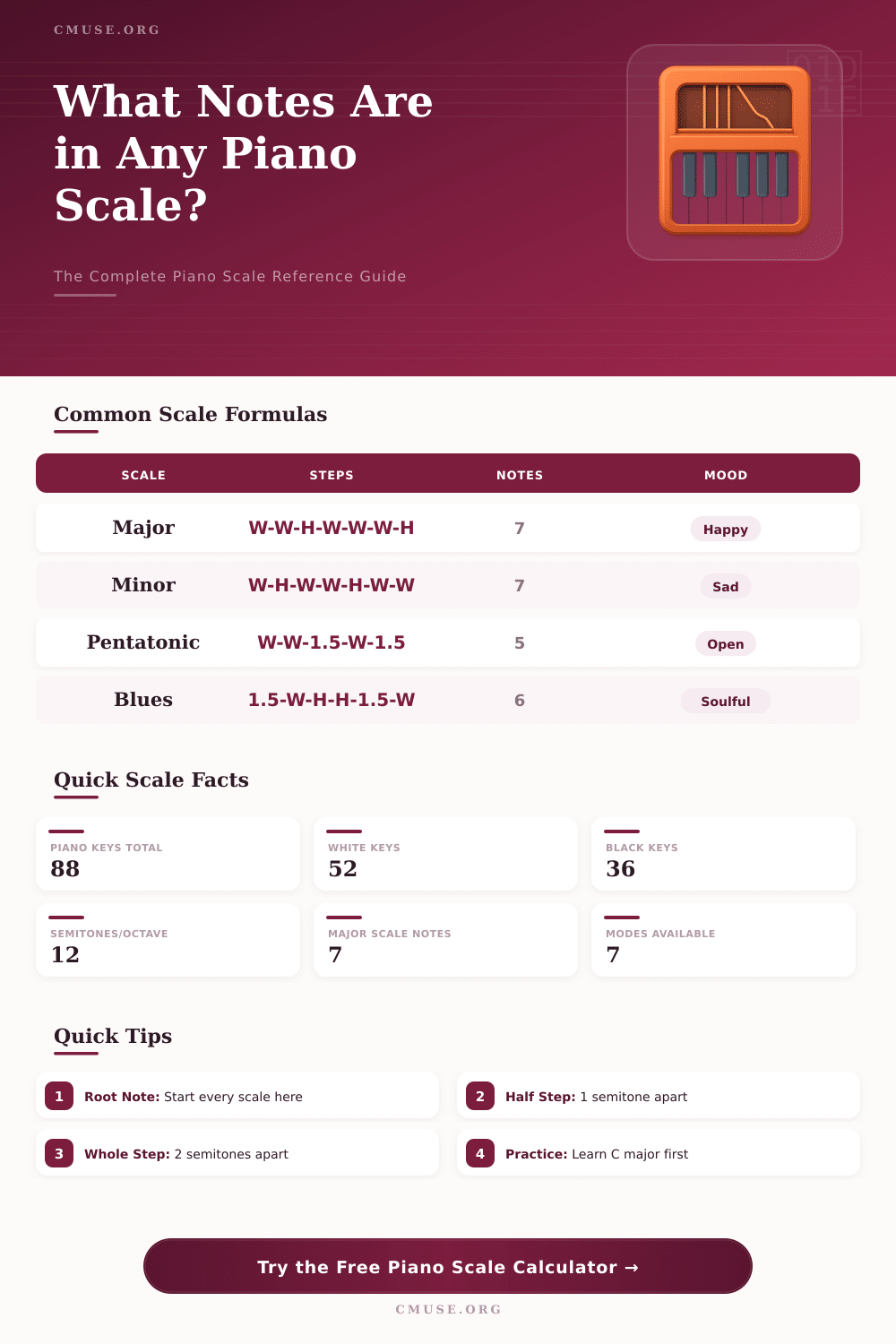
W = Whole step (2 semitones), H = Half step (1 semitone). The major scale formula is always W–W–H–W–W–W–H. Apply this to any root note to build a major scale instantly.
Learn piano scale maybe seem like boring work at first, even so they form one of the main building blocks that we must learn as newcomers. Each of them follows its own pattern of intervals spread through the whole keyboard. Major and minor scales are those that you will meet most commonly, and each of them adds something unique to the sound.
Between them the major scales usually are the most commonly used and the first in that most folks start first.
Why Learn Piano Scales and How to Practice
Major scales really matter when you try to grasp the structure of musical pieces. They appear everywhere and help you understand what musicians mean when they talk about keys. If some mention sonata of Franz Schubert in major tone…
That means that the whole turns around that piano scale and the particular mood that it creates. Picture the key as the color palette of painter, where each note role works like a different shade that blends with the others to form the every feeling.
The C-major scale works perfectly as a starting spot for newcomers. It carries the notes C, D, E, F, G, A, B and later back to C. Here the bright part: on the piano, you simply touch only the white keys. That clearness and ease make it much more simple to explore.
The E natural minor scale, on the other hand, includes E, F, G, A, B, C and D. You will meet it commonly in both classical and popular muisc.
Is something surprising in that, how Chopin handled this. He considered the C-scale the most difficult from technical view, believe that or no. Instead of start with something what seemed logical, he advised to start with B-major for the right hand and D-flat major for the left hand instead. His argument was clever, that setup forces you to practice thumb crossing in a way that feels more natural, focusing on the moves instead of getting lost in theory.
When you sit to practise, split your hands first. Walk through the fingering slowly and carefully. The metronome becomes your most faithful friend here, helping you build steady timing.
Try to stress every first note in four-note group, it gives you clear sense about the shape. After that, try to learn all twelve major and minor scales with both hands, until they become second nature, that is a good goal.
The half step is the most small gap that you find in European music. On your keyboard, it is simply the space between two neighboring keys. Scales always cover an octave and they follow very precise patterns of those gaps.
Oddly enough, some piano scale fingerings skip the pinky entirely. C-major, D-major, F-major, G-major and A-major all do that. The secret lies in making sequences 123 and 1234 in the fingering and using the same pattern for every octave, except at the start and finish.
That method makes sure that your thumbs stay on white keys when possible, witch keeps everything comfortable.
Muscle memory works when you repeat scales quite often. When those same patterns appear in real pieces that you learn, everything goes more quickly and easily. Knowing that notes belong to a key also helps you notice when the piece shifts to a new key.
Beyond simply classical stuff, jazz players look at scales differently, the minor pentatonic, Mixolydian and blues scales are great for playing freely. In short, learning scales is like learning the alphabet beforediving into real reading.