🎹 Piano Age Calculator
Estimate your piano's age using its serial number, brand, and type
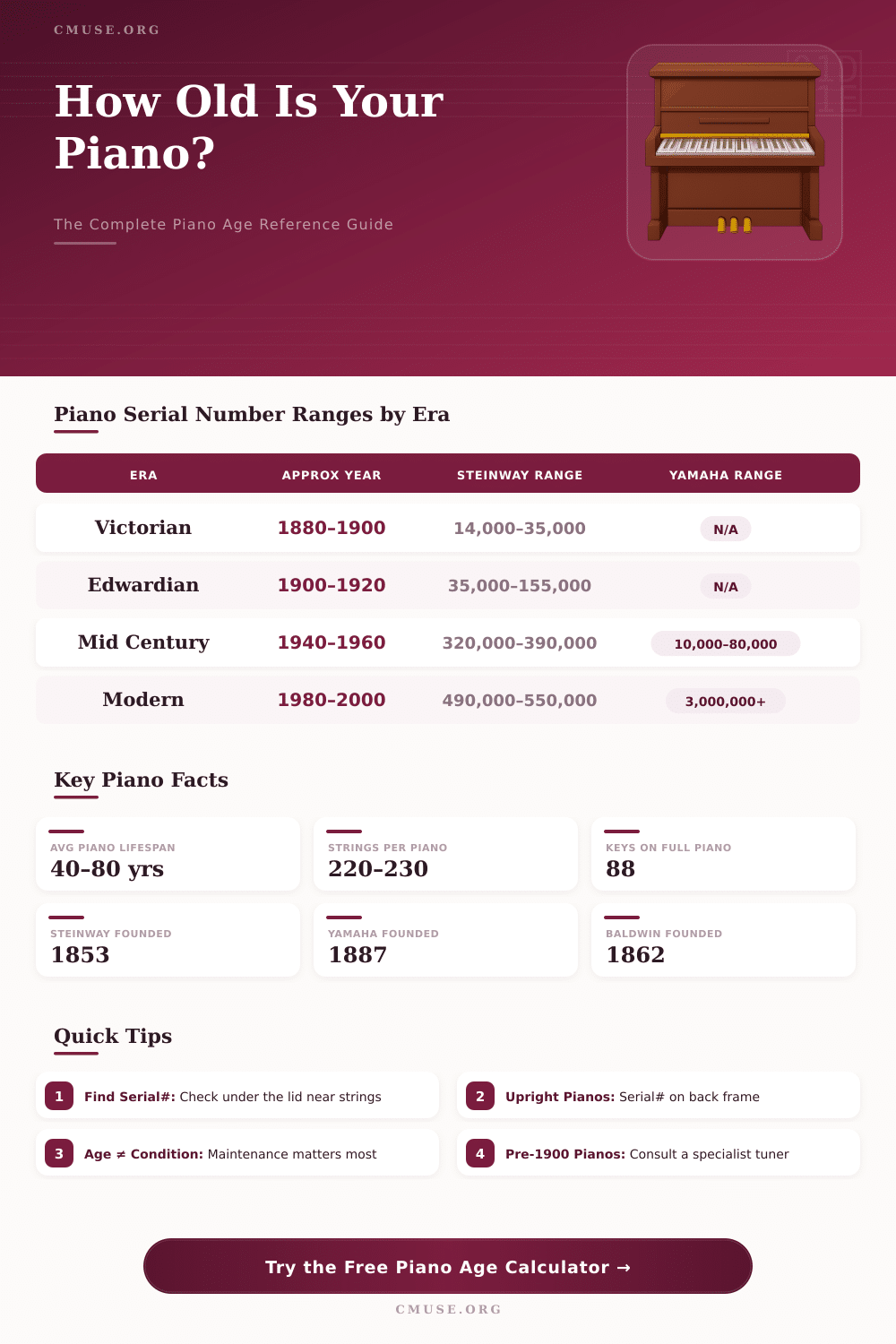
| Serial Number Range | Approximate Year | Era | Notes |
|---|---|---|---|
| 1 – 1,000 | 1853 – 1860 | Early Steinway | Extremely rare, collector items |
| 1,000 – 14,000 | 1860 – 1880 | Victorian | Square grands common |
| 14,000 – 55,000 | 1880 – 1900 | Late Victorian | Duplex scaling introduced |
| 55,000 – 155,000 | 1900 – 1915 | Edwardian | Model D concert grand era |
| 155,000 – 230,000 | 1915 – 1925 | Post-WWI | Accelerated production |
| 230,000 – 300,000 | 1925 – 1935 | Jazz Age | Duplex stringing refined |
| 300,000 – 365,000 | 1935 – 1950 | Depression/WWII | Slower production |
| 365,000 – 435,000 | 1950 – 1965 | Post-War | Renewed demand, quality high |
| 435,000 – 490,000 | 1965 – 1980 | Modern Classic | CBS ownership period |
| 490,000 – 560,000 | 1980 – 2000 | Contemporary | Post-CBS, quality improved |
| 560,000+ | 2000 – Present | 21st Century | CNC precision manufacturing |
| Serial Number Range | Approximate Year | Era | Notes |
|---|---|---|---|
| 1 – 10,000 | 1900 – 1920 | Early Yamaha | Original Nippon Gakki era |
| 10,000 – 80,000 | 1920 – 1950 | Pre-War/War | Domestic Japan market focus |
| 80,000 – 600,000 | 1950 – 1965 | Post-War Rebuild | Export expansion begins |
| 600,000 – 2,000,000 | 1965 – 1975 | Growth Era | U3 model popularized |
| 2,000,000 – 4,000,000 | 1975 – 1985 | Mass Production | Global market dominance |
| 4,000,000 – 5,500,000 | 1985 – 1995 | Modern | CX Series introduced |
| 5,500,000 – 6,500,000 | 1995 – 2005 | Digital Integration | Silent piano technology added |
| 6,500,000+ | 2005 – Present | Contemporary | TransAcoustic and CFX flagship |
| Piano Type | Avg. Lifespan | Rebuild Threshold | Key Indicators of Age |
|---|---|---|---|
| Steinway Grand | 60 – 100+ years | 50 – 80 years | Ivory keys, serial number, hammers |
| Yamaha Upright (U3) | 40 – 60 years | 40 – 50 years | Plastic keys, serial, damper felt |
| Baldwin Grand | 50 – 80 years | 40 – 60 years | Acrylic keys (post-1970), frame color |
| Baby Grand (Any Brand) | 40 – 70 years | 35 – 50 years | Pin block condition, soundboard |
| Console / Upright | 30 – 50 years | 25 – 40 years | Key covering material, action wear |
| Spinet Piano | 25 – 40 years | 20 – 30 years | Drop action, bass register tone |
| Victorian Square Grand | 100+ years | Usually beyond rebuild | Frame style, string layout, case wood |
| Brand | Serial Range | Year Estimate | Country of Origin |
|---|---|---|---|
| C. Bechstein | 1 – 10,000 | 1853 – 1880 | Germany |
| C. Bechstein | 10,000 – 55,000 | 1880 – 1920 | Germany |
| C. Bechstein | 55,000 – 100,000 | 1920 – 1960 | Germany |
| Baldwin | 1 – 50,000 | 1890 – 1920 | USA |
| Baldwin | 50,000 – 200,000 | 1920 – 1960 | USA |
| Baldwin | 200,000 – 600,000 | 1960 – 1990 | USA |
| Bosendorfer | 1 – 20,000 | 1828 – 1930 | Austria |
| Bosendorfer | 20,000 – 40,000 | 1930 – 1980 | Austria |
| Kawai | 1 – 500,000 | 1927 – 1970 | Japan |
| Kawai | 500,000 – 2,000,000 | 1970 – 1995 | Japan |
| Chickering | 1 – 100,000 | 1823 – 1890 | USA |
| Knabe | 1 – 80,000 | 1839 – 1920 | USA |
For finding the piano age everything depends on one main thing: the serial number. One usually finds it stamped or marked directly on the frame or the plate of the instrument. It is made up of five to nine figures, that the maker assigned.
If you choose the brand and enter the serial number, you can find in that year one made the piano. Online exist calculators for the piano age, that eases this process.
How to Find a Piano’s Age and Care for It
A bit of info about dates can be different sometimes. It is based on programming help to correct and update such mistakes. For instance, the action of piano can not be installed later than the piano itself, so when apperas such mismatch, one must fix it.
Big pianos of Yamaha have separate places of production according to the model. If the big piano is model GA1E, DGA1E, GB1, DGB1, GB1K or DGB1K, one made it in Jakarta, Indonesia. All other models of Yamaha big pianos come from Hamamatsu, Japan.
When folks buy pianos, they commonly think that newer are always better, but technicians believe that less new can be even more precious. Only the piano age does not decide the price of piano. Pianos well built last against the time, similarly too good house or even human body.
One uses strong materials like spruce, pine and iron for the building. The makers do them so that one can take care of them, so technicians restore, change or swap bits according to need. Like this good piano can have several lifetimes.
Even piano after 100 years still can sound well if one takes care of it regularly.
Whether piano truly becomes better because of age, that is good question. Guitars of good quality do improve. Martin-guitars before the war value even tenfold more than new.
About violins the opinions range, but many violin players would say yes. Whether that counts for pianos in good state, that is less clear.
About the start of learning of piano, the most many children start between the 7th and 9th year, when they already have good hand coordination and enough brains. The 8th year sometimes seems ideal because of the hand size and brain growth that processes for eye-hand teamwork and basic math ideas. Since 4 years it is possible with certain methods, but not always worth the work.
Child of 6 years is usually ready. For more little children the hand size matters.
Are never too late for start. Folks start to learn in various ages and still find joy and success. If one starts more late, big achievements maybe will come only in the twentieth or at the start of the thirtieth years.
Regular practice, even only 15 to 30 minutes daily, give better results than one long session. Early finding good teacher help toescape wrong habits.