🔊 Double Bass Reflex Calculator
Calculate port length, box volume, and tuning frequency for ported speaker enclosures
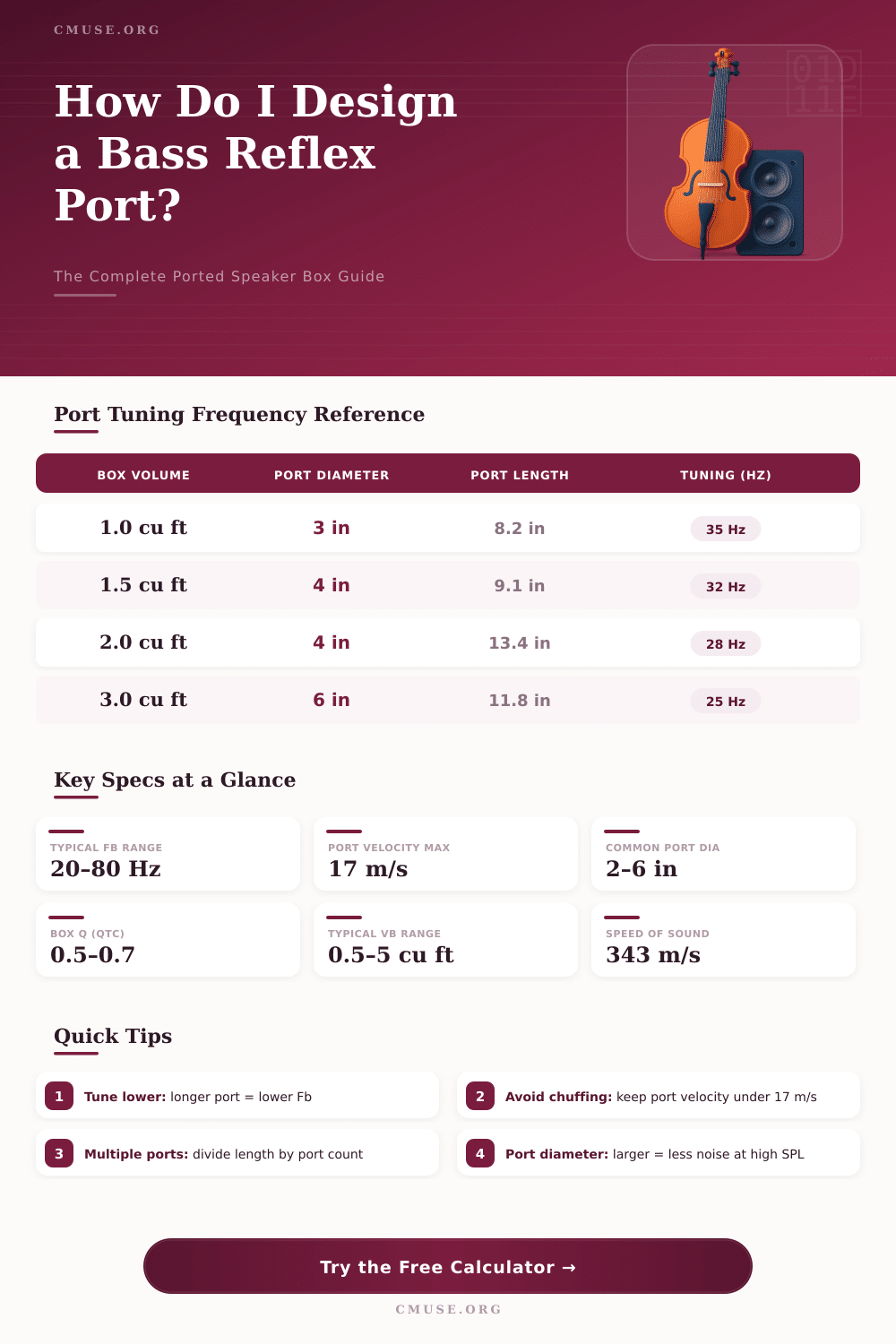
| Box Volume | Volume (Liters) | Port Length (in) | Port Length (cm) |
|---|---|---|---|
| 0.5 cu ft | 14.2 L | 3.1 in | 7.9 cm |
| 0.75 cu ft | 21.2 L | 5.8 in | 14.7 cm |
| 1.0 cu ft | 28.3 L | 8.6 in | 21.8 cm |
| 1.5 cu ft | 42.5 L | 14.0 in | 35.6 cm |
| 2.0 cu ft | 56.6 L | 19.4 in | 49.3 cm |
| 2.5 cu ft | 70.8 L | 24.8 in | 63.0 cm |
| 3.0 cu ft | 84.9 L | 30.2 in | 76.7 cm |
| Driver Size | Sealed Box | Ported Box | Typical Fb |
|---|---|---|---|
| 6.5" Woofer | 0.2–0.4 cu ft | 0.3–0.6 cu ft | 50–70 Hz |
| 8" Woofer | 0.3–0.6 cu ft | 0.5–1.0 cu ft | 45–65 Hz |
| 10" Subwoofer | 0.5–0.9 cu ft | 0.75–1.5 cu ft | 35–50 Hz |
| 12" Subwoofer | 0.8–1.5 cu ft | 1.2–2.5 cu ft | 28–45 Hz |
| 15" Subwoofer | 1.5–3.0 cu ft | 2.5–5.0 cu ft | 25–40 Hz |
| 18" Subwoofer | 3.0–5.0 cu ft | 4.0–8.0 cu ft | 20–35 Hz |
| 21" Subwoofer | 5.0–8.0 cu ft | 7.0–12.0 cu ft | 18–30 Hz |
| Driver Size | Cone Area (Sd) | Min Port Area | Recommended Port |
|---|---|---|---|
| 8" Woofer | ~33 sq in | ~8 sq in | 2"–3" dia |
| 10" Subwoofer | ~55 sq in | ~14 sq in | 3"–4" dia |
| 12" Subwoofer | ~80 sq in | ~20 sq in | 3"–4" dia |
| 15" Subwoofer | ~127 sq in | ~32 sq in | 4"–6" dia |
| 18" Subwoofer | ~184 sq in | ~46 sq in | 6"–8" dia |
Double bass reflex speaker systems form a variation of the usual bass reflex box. It aims to extend the answer for deep tones even more than a typical bass reflex box. Extra deep sound happens because of the addition of a second space in the reflex system.
Like this instead of one space with one port, we have two spaces, that work to push the bottom frequencies yet more down.
How Double Bass Reflex Speakers Work
Double bass reflex builds use a little room for the driver, that opens to a bigger space. The big space then connects to the outside world. That two stage setup creates a secondary resonance, that helps to fill the mid-bass range.
In a single chamber bass reflex, low tuning of the port can weaken the mid-bass area. If one sets the port height, it commonly causes a big dip in the frequency curev, which makes the sound too thin. Two chamber builds fix that by means of two separate tuning points.
If we observe the impedance answer of a two chamber reflex system, we find three peaks instead of the normal too in simple bass reflex. Two tuning frequencies become clear. The most bottom one appears where the bass speaker knows both spaces as one vast area, as if no wall separates them.
The upper tuning frequency sits a bit under one octave above the bottom.
Both spaces in the box tune to different frequencies. The goal is to disconnect the driver over a much more broad range, than simply let it vibrate freely in low tones. To build such, one splits the whole box volume in three parts.
The bass speaker enters the section, that holds two thirds of the whole, with a full wall separating it from the remaining third space.
Such boxes can become quite large. Programs like WinISD 0.7 help simulate double bass reflex builds with speakers and tuned ports. Getting the lengths of the ports right is key, because two spaces and several ports make the whole thing very sensitive to exact tuning.
The actual building will be only that much good, as far as exact was the used model to design it.
Two chamber reflex boxes are commonly seen as more efficient than average bass reflex boxes. Some of the best speakers use ported forms, and nothing in a ported setup stops it from being very precise. In a big box volume the double bass reflex method becomes especially attractive.
Bass reflex builds widely use the sound of the back side of the speaker cone to strengthen the whole output. The doubletype simply advances that idea by means of an extra space and tuning point.