🎤 Tube Bass Trap Calculator
Calculate resonant frequency, tube dimensions & how many traps your room needs
lb/cu yd
lb/cu yd
lb/cu yd
lb/cu yd
lb/cu yd
lb/cu yd
lb/cu yd
lb/cu yd
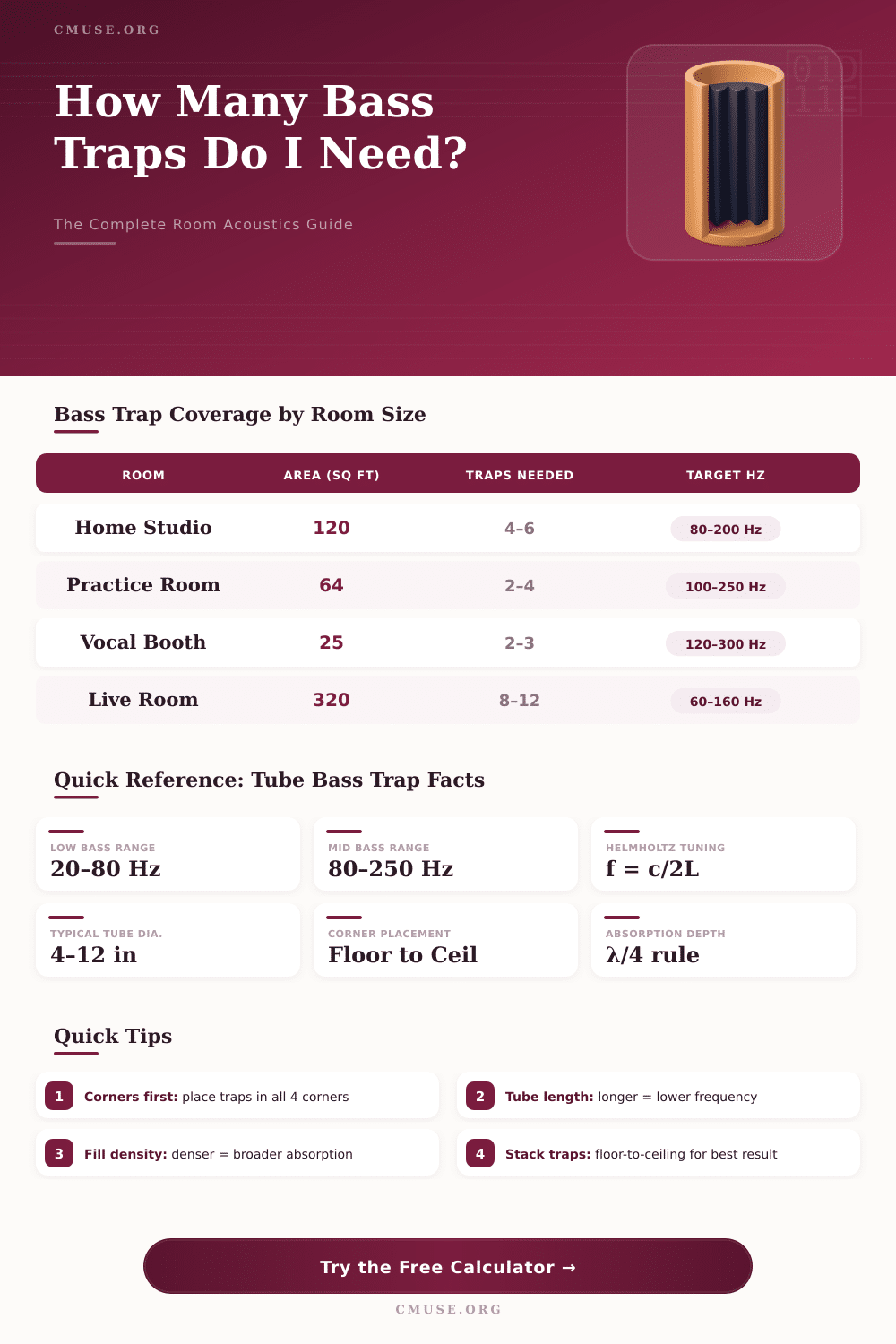
Formula: f = c / (2 × L) where c = speed of sound (1125 ft/s or 343 m/s) and L = tube length. Tube acts as a half-wave resonator.
| Tube Length (in) | Tube Length (cm) | Resonant Freq (Hz) | Target Bass Problem |
|---|---|---|---|
| 12 in | 30 cm | 563 Hz | Upper-mid resonances |
| 18 in | 46 cm | 375 Hz | Mid-frequency buildup |
| 24 in | 61 cm | 281 Hz | Upper bass (general use) |
| 36 in | 91 cm | 188 Hz | Low-mid bass buildup |
| 48 in | 122 cm | 141 Hz | Low bass frequencies |
| 60 in | 152 cm | 113 Hz | Deep bass trap |
| 72 in | 183 cm | 94 Hz | Sub-bass problems |
| 84 in | 213 cm | 80 Hz | Deep sub (room modes) |
| 96 in | 244 cm | 70 Hz | Severe room modes |
| Room Size | Corners Only | Corners + Junctions | Full Perimeter |
|---|---|---|---|
| Small (up to 100 sq ft) | 4 traps | 6–8 traps | 10–14 traps |
| Medium (100–200 sq ft) | 4 traps | 8–10 traps | 14–20 traps |
| Large (200–350 sq ft) | 4 traps | 10–14 traps | 20–28 traps |
| Studio (350+ sq ft) | 4–8 traps | 14–20 traps | 28–40 traps |
| Tube Dia. (in) | Cross Section (sq in) | Vol per Foot (cu in) | Fill per 48-in Tube (cu ft) |
|---|---|---|---|
| 4 in | 12.6 sq in | 12.6 cu in | 0.29 cu ft |
| 6 in | 28.3 sq in | 28.3 cu in | 0.65 cu ft |
| 8 in | 50.3 sq in | 50.3 cu in | 1.16 cu ft |
| 10 in | 78.5 sq in | 78.5 cu in | 1.81 cu ft |
| 12 in | 113.1 sq in | 113.1 cu in | 2.61 cu ft |
| 16 in | 201.1 sq in | 201.1 cu in | 4.63 cu ft |
| Project | Room Size | Traps (Corners) | Traps (Full) |
|---|---|---|---|
| Home Studio Small | 10 × 12 ft (120 sq ft) | 4 | 12–16 |
| Practice Room | 8 × 8 ft (64 sq ft) | 4 | 8–12 |
| Vocal Booth | 5 × 5 ft (25 sq ft) | 4 | 6–8 |
| Control Room | 12 × 14 ft (168 sq ft) | 4 | 14–18 |
| DJ Booth | 6 × 6 ft (36 sq ft) | 4 | 6–8 |
| Live Room | 20 × 20 ft (400 sq ft) | 8 | 28–36 |
| Podcast Studio | 8 × 10 ft (80 sq ft) | 4 | 8–10 |
| Rehearsal Space | 16 × 18 ft (288 sq ft) | 4–8 | 22–30 |
Bass traps have a main task to control bottom sounds in any space. For home cinema, recording room or listening room, one always needs a good plan of bass traps to reach equal bass response. Only big speakers alone do not work for that.
When bottom sounds bounce through the room, this causes standing waves. Such waves are pressure knots that exist when reflected sound waves from a wall crash with the direct sound from the speaker. At some frequencies, those effects strengthen the original sound, pushing it stronger here.
How Bass Traps Work
At others, they remove the direct sound, lowering the strength or even erasing it entirely. The bass traps weaken those effects. They also increase the sounds at spots where removal happens.
Because of that, adding such traps commonly creates an impression of richer bass, not less of it.
Sound energy turns into physical shaking, that later becomes small amounts of heat. That energy loss causes a drop in sound force. Decrease of amplitude lowers peaks and raises valleys, causing flatter bass response evreywhere.
Small spaces commonly have the most severe problems with bass. If bass is not pure from the start, it muddies upper details and makes everything confused. First one should lay bass traps in corners.
The best places are corners between walls, then those between wall and ceiling, and finally flat on walls. Laying traps only in wall-wall corners can give only around 0.5 to 1 dB drop at specific spots however.
The idea does not really deal about covering surfaces. More it concerns adding the right absorbing amount to manage bottom frequency drop. A waterfall chart before and after treatment usually shows shorter decay tails, fewer ringing peaks and clearer separation between tones.
Bass then becomes more dynamic and moor uniform through the whole space.
“Small” does not match well with “bass traps”. Panels of six inches can help in middle and upper ranges, but they do not solve low problems. Fixing bass problems requires very thick porous absorbers, tuned bass traps as panels or Helmholtz units or active bass traps.
A tube bass trap ranks between the most useful types, and following the math usually requires 20 to 24 inches deep trap to reach down to 40 Hz below. Rockwool one should lay at least 15 to 20 cm away from the wall, because absorbing happens here, where sound wave movements are highest and those movements stop at the wall face.
The main challenge for bass traps in an untreated room will always be their size. Filling large areas with rockwool can still absorb bass well and control unwanted higher frequencies too. Bass traps do not even need to be triangular.
A table pushed to the wall, with high density fiberglass stuffed below and covered with fabric materials, worksas a bass trap.