🎸 Bass String Gauge Calculator
Find ideal string gauges, tension values, and recommendations for your bass guitar scale length and tuning
| String | Note | Freq (Hz) | 30" Tension | 32" Tension | 34" Tension | 35" Tension |
|---|---|---|---|---|---|---|
| G (.045) | G2 | 98.0 Hz | 28.4 lbs | 32.3 lbs | 36.5 lbs | 38.7 lbs |
| D (.065) | D2 | 73.4 Hz | 31.2 lbs | 35.4 lbs | 40.1 lbs | 42.5 lbs |
| A (.080) | A1 | 55.0 Hz | 33.1 lbs | 37.6 lbs | 42.6 lbs | 45.2 lbs |
| E (.100) | E1 | 41.2 Hz | 34.5 lbs | 39.2 lbs | 44.4 lbs | 47.0 lbs |
| Tuning | String 1 (Low) | String 2 | String 3 | String 4 (High) | Rec. Gauge |
|---|---|---|---|---|---|
| E Standard | E1 (41.2 Hz) | A1 (55.0 Hz) | D2 (73.4 Hz) | G2 (98.0 Hz) | .045–.100 |
| Drop D | D1 (36.7 Hz) | A1 (55.0 Hz) | D2 (73.4 Hz) | G2 (98.0 Hz) | .050–.105 |
| E♭ Standard | Eb1 (38.9 Hz) | Ab1 (51.9 Hz) | Db2 (69.3 Hz) | Gb2 (92.5 Hz) | .045–.105 |
| D Standard | D1 (36.7 Hz) | G1 (49.0 Hz) | C2 (65.4 Hz) | F2 (87.3 Hz) | .050–.110 |
| Drop C | C1 (32.7 Hz) | G1 (49.0 Hz) | C2 (65.4 Hz) | F2 (87.3 Hz) | .055–.115 |
| B Standard (5-str) | B0 (30.9 Hz) | E1 (41.2 Hz) | A1 (55.0 Hz) | D2 (73.4 Hz) | .125 + .045–.100 |
| Material | Tone Character | Feel | Tension Factor | Lifespan |
|---|---|---|---|---|
| Roundwound Nickel | Bright, balanced | Medium roughness | 1.00x (baseline) | 2–4 months |
| Roundwound S/S | Very bright, aggressive | Rougher feel | 1.02x | 2–4 months |
| Flatwound | Warm, mellow, vintage | Very smooth | 1.08x higher | 1–5 years |
| Half-Wound / Ground | Semi-bright, balanced | Smooth | 1.04x | 6–12 months |
| Tapewound Nylon | Very warm, upright-like | Very smooth, soft | 0.85x lower | 1–3 years |
| Coated Polymer | Slightly warmer | Slippery smooth | 1.00x | 6–12+ months |
| Setup / Style | Scale | Tuning | Gauge Set | Avg. Total Tension |
|---|---|---|---|---|
| Jazz / Funk Fingerstyle | 34" | E Standard | Light .040–.095 | ~135 lbs |
| Rock / Pop All-Around | 34" | E Standard | Medium .045–.100 | ~163 lbs |
| Metal Drop Tuning | 34" | Drop D / Drop C | Heavy .050–.110 | ~155 lbs |
| Slap & Pop | 34" | E Standard | Light .040–.095 | ~135 lbs |
| 5-String Modern | 34"–35" | B-E-A-D-G | .045–.130 | ~185 lbs |
| Vintage / Motown | 30"–32" | E Standard | Flatwound .045–.100 | ~175 lbs |
| Beginner Setup | 34" | E Standard | Light .040–.095 | ~135 lbs |
The Bass String Gauge relate chiefly to the thickness of each string. The number of the Bass String Gauge point to the diameter of the string measured in inches. For instance, a string marked with 45 has a true thickness of 0.045 inches, while one with 65 is 0.065 inches wide.
Even though those values can seem small, they still cause big impact on the feeling and sound of the bass.
How Bass String Gauge Changes Sound and Tension
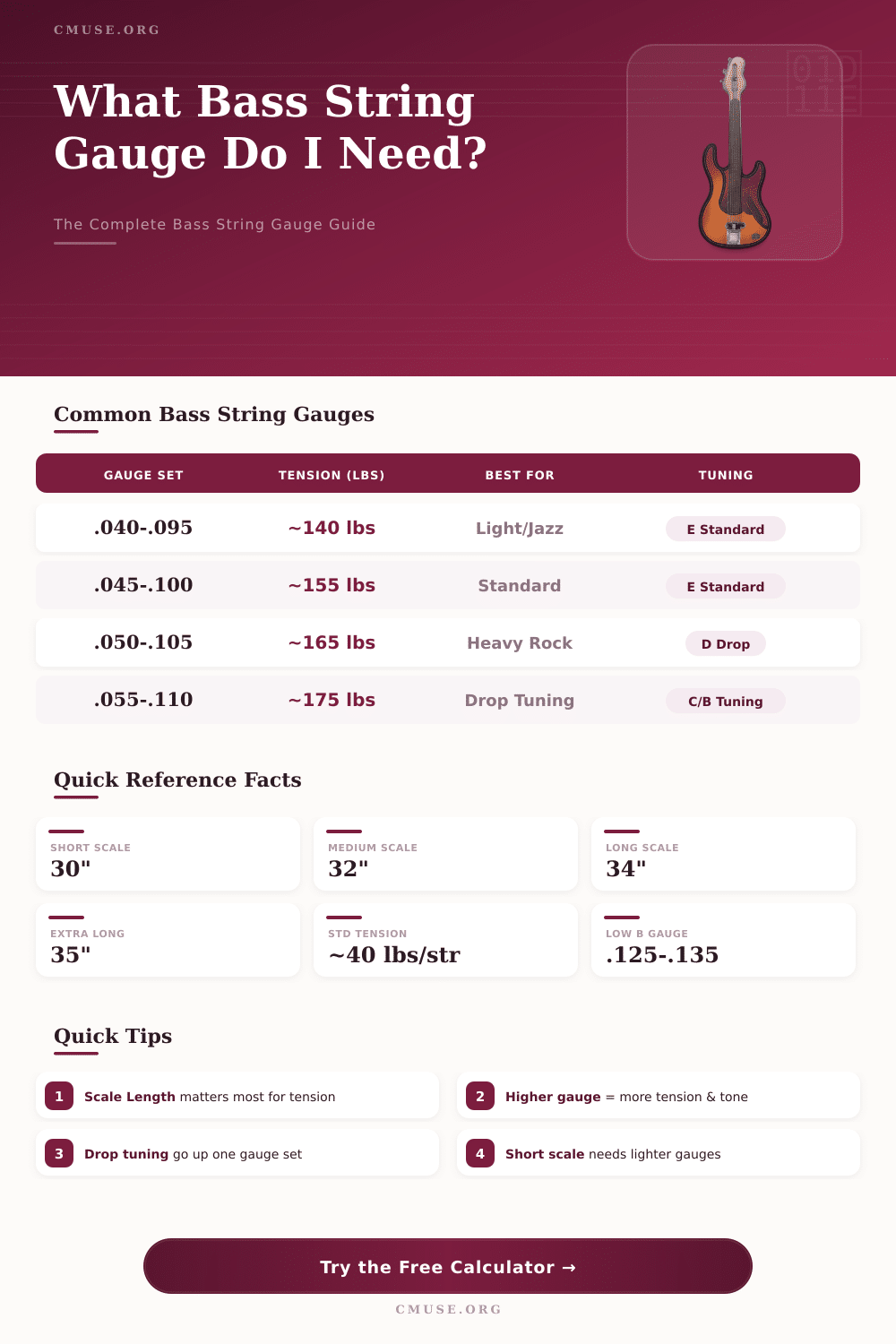
Standard set of Bass String Gauge for a typical 34-inch scale bass is made up of 45, 65, 85 and 105. It is the most used setup for four-string bass. In five-string bass, the usual sets range from 0.045 to 0.130.
Many basses arrive from the factory with 45-100 strings instead. Some modles of Fender have 45-110 and tapered E-string.
Thick strings usually give stronger and dark tone. The higher the Bass String Gauge, the warmer the sound tends to become. That results in more midtones and bass, that projects, with fewer high frequencies.
Middle Bass String Gauge strings offer a mix of warm low tones and clear high. They have bright and clear sound, with longer duration than lightweight Bass String Gauge. Players of rock, blues and country music commonly choose middle Bass String Gauge strings.
Bass String Gauge also affect the tension of the strings. The Bass String Gauge controls how strained the strings feel and how much tension they put on the neck. Bigger Bass String Gauge work more well four low setups, because they keep more tension.
For standard E-tuning, 45-105 form a reliable option. In drop C-tuning, stuff like 50-120 work well. Extra tension of strings helps better stability of the tuning.
Heavy Bass String Gauge even can allow low action, if the instrument is correctly set.
Lightweight strings need less tension for standard tuning. They are thinner and flexible, so they sit more well on the fretboard. Also they ring more long when you pluck them.
No rule says that short-scale bass must use heavy Bass String Gauge. If lightweight sets work, no need to change them.
Switching between Bass String Gauge is not always easy. Change of Bass String Gauge affects the tension, which can need fixes at the bridge, tuners and nut. For very low tunings like drop B, big Bass String Gauge even can force you to redo the nuts to fit the thick strings.
Most strings are machine-wound, while more expensive ones can be hand-wound. Some sets use other mixes like 50-70-85-105 or 45-65-80-100, and that happens for good reason. The usual low B-string sits between 0.125 and 0.135 Bass String Gauge.
Using 0.130 for the low B, you keep thetension felt right.
Try out different Bass String Gauge as part of the search for the right feeling, but always be ready to set the tuning after that.