🔊 Bass Box Calculator
Design sealed, ported, or bandpass subwoofer enclosures with accurate volume, port length & tuning frequency
⚡ Quick Presets
📏 Enclosure Settings
📡 Port / Vent Settings
🎵 Bandpass Settings
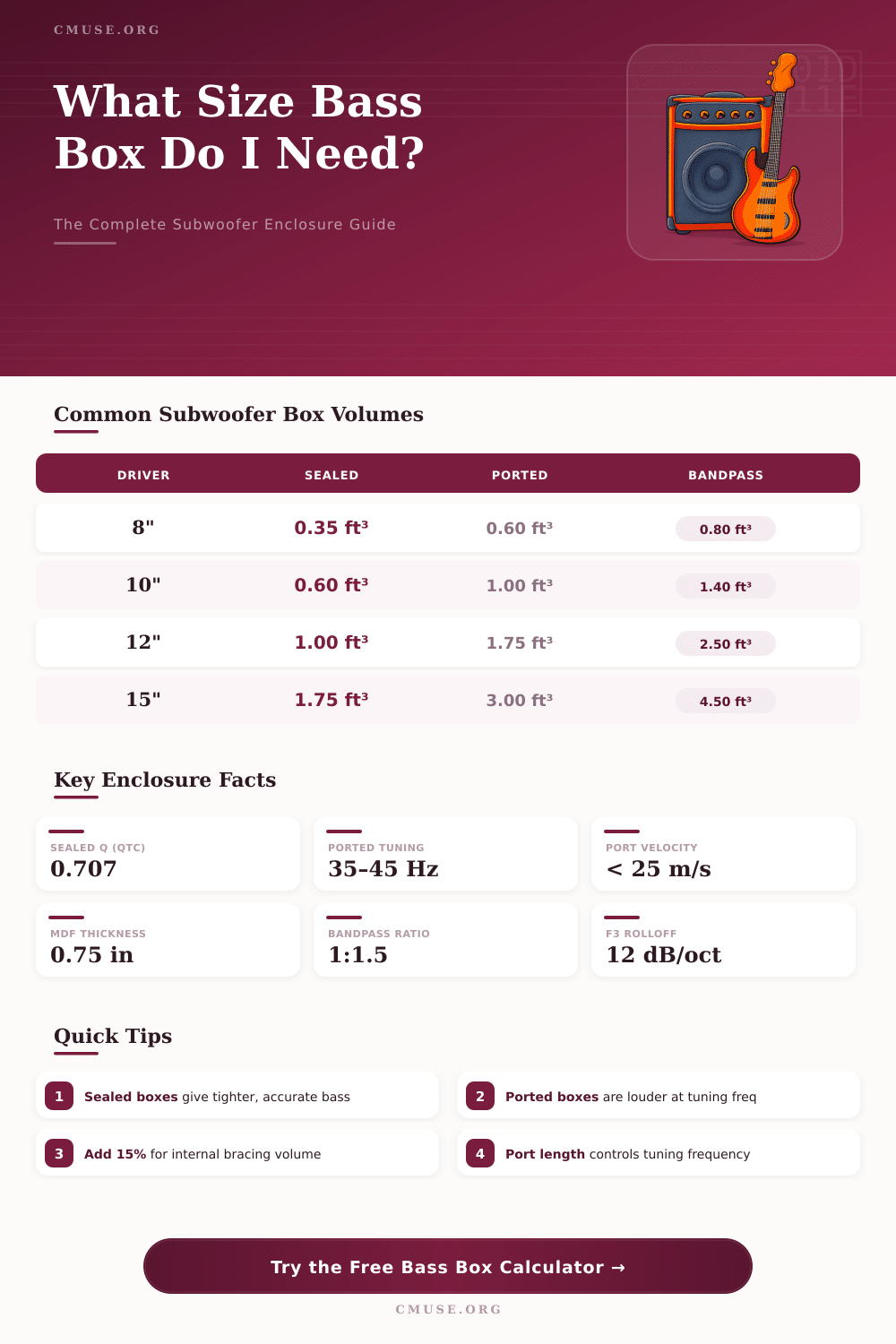
📦 Recommended Volumes by Driver Size
📋 Tuning Frequency vs Box Volume (Ported)
| Driver Size | Box Volume (ft³) | Box Volume (L) | Tuning Freq (Hz) | F3 –3dB (Hz) |
|---|---|---|---|---|
| 8 inch | 0.60–0.80 | 17–23 L | 35–40 Hz | 40–45 Hz |
| 10 inch | 1.00–1.25 | 28–35 L | 32–38 Hz | 36–42 Hz |
| 12 inch | 1.50–2.50 | 42–71 L | 28–35 Hz | 32–38 Hz |
| 15 inch | 3.00–5.00 | 85–142 L | 25–32 Hz | 28–35 Hz |
| 18 inch | 5.00–8.00 | 142–227 L | 20–28 Hz | 24–32 Hz |
🔧 Port Length Reference Table (Round Port)
| Port Dia (in) | Box Vol (ft³) | Tuning 30 Hz | Tuning 35 Hz | Tuning 40 Hz |
|---|---|---|---|---|
| 3 inch | 1.0 | 21.3 in | 13.8 in | 9.2 in |
| 4 inch | 1.5 | 26.1 in | 17.2 in | 11.6 in |
| 4 inch | 2.0 | 17.4 in | 11.1 in | 7.3 in |
| 6 inch | 2.5 | 34.7 in | 22.8 in | 15.4 in |
| 6 inch | 3.5 | 24.2 in | 15.7 in | 10.4 in |
📐 Common Project Box Dimensions
| Project | Ext Dims (LxWxH in) | Net Volume (ft³) | Net Volume (L) |
|---|---|---|---|
| 10" Car Sealed | 14 x 13 x 13 | 0.75 | 21.2 |
| 12" Car Ported | 24 x 15 x 15 | 1.75 | 49.6 |
| 12" Home Sealed | 18 x 16 x 16 | 1.25 | 35.4 |
| 15" Home Ported | 30 x 20 x 18 | 3.50 | 99.1 |
| 18" PA Sub | 40 x 24 x 24 | 6.00 | 169.9 |
The size of the bass box ranks between the main parts, that affects the sound of the speaker. Not only about simple tin. The box works like an acoustic net that involves the details of the driver and the room.
The internal space of the box, together with any set tubes, set the low frequency resonance of the whole system, so it rules the scope of the bass and the sharpness of the frequency curve.
How Box Size Affects Bass
There are many free tools with calculators, that help to estimate the volume of the bass box, the length of the tube and the intended frequency. These programs involve themselves with sealed and ported boxes, and they even generate a pressure chart. A program like BB6 gives three different possible ways to estimate the box volume, one for high output another for flatter HiFi curve and third for extended deep sound.
The resulting spaces can differ a lot according to the chosen type, whether sealed or with port.
A speaker with very low Q needs a small box in sealed design, while one with higher Q wants more space. The box strengthens the Qms of the speaker, and the main task is choosing spaces, that gives the wanted curve. Sealed boxes enjoy popularity because of their precise sound and good motion of the cone.
Commonly small sealed boxes work well for regular rock, punk or fast metal music, because those styles have many hits of drums, but little truly deep content.
Making the bass box bigger lowers the internal air cushion, so one receives more bass with less energy. Even so there are limits. Many speaker drivers require, that the air pressure of the box reach the wanted flexibility.
When the box grows, the resonance frequency sinks, but the bass above it can actually shrink. One should set the box size too reach the intended Q.
Too little volume of the box raises the resonance of the cone, what limits the useful bass. If one halves the advised spaces, the output of the speaker slides upward. The bass sounds then more crisp, but less deep, with decrease of impact and increase of distortion.
For better bass in a sealed box, it is better to aim for the maximum volume for the speaker and go a bit bigger than the minimal.
Figuring out everything costs a lot of time. First one counts the tube length according to its cross-section and the final space, later adds the volume taken by the tube, then finds the box sizes while one considers the thickness of the material; everything adds up quickly. Even the chosen materials matter.
A box done from three-quarter inch of MDF has other internal space than the same outer form from half-inch MDF.
Vb means the final volume of the box, so the internal usable space after removing the place taken by the speaker and other bits. A ported 56-liter box set to 35 Hz can work well for some drivers, while a sealed version in almost half of that size also works. The original specs of the woofer and the box depend on the Thiele/Small parameters, Fs, Vas andQts.