🎸 Guitar String Length Calculator
Calculate scale length, fret positions, nut-to-saddle distance & string requirements for any guitar or bass
| Fret # | Distance from Nut (in) | Distance from Nut (mm) | String Remaining (in) |
|---|---|---|---|
| 1 | 1.432 | 36.37 | 24.068 |
| 2 | 2.781 | 70.63 | 22.719 |
| 3 | 4.052 | 102.92 | 21.448 |
| 4 | 5.250 | 133.36 | 20.250 |
| 5 | 6.381 | 162.08 | 19.119 |
| 7 | 8.438 | 214.33 | 17.062 |
| 9 | 10.241 | 260.11 | 15.259 |
| 12 | 12.750 | 323.85 | 12.750 |
| 15 | 15.563 | 395.30 | 9.937 |
| 17 | 17.219 | 437.37 | 8.281 |
| 19 | 18.719 | 475.47 | 6.781 |
| 22 | 20.813 | 528.64 | 4.687 |
| 24 | 21.875 | 555.62 | 3.625 |
| Guitar Type | Scale Length | Nut to 12th Fret | Typical Total String |
|---|---|---|---|
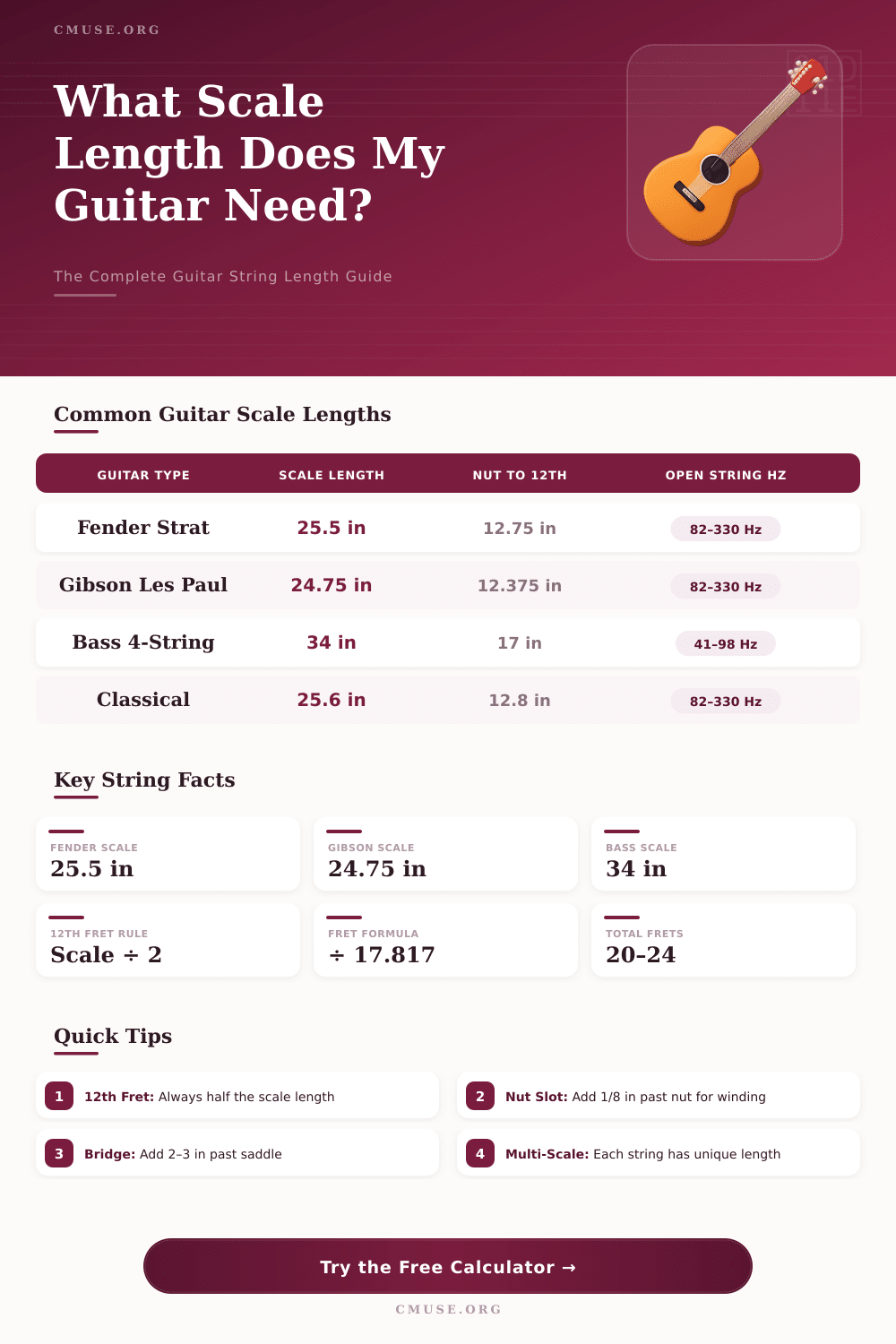
| Fender Stratocaster / Telecaster | 25.5 in (647.7 mm) | 12.75 in | ~28 in (711 mm) |
| Gibson Les Paul / SG | 24.75 in (628.6 mm) | 12.375 in | ~27.25 in (692 mm) |
| PRS Custom 24 | 25.0 in (635 mm) | 12.5 in | ~27.5 in (699 mm) |
| Classical / Nylon String | 25.6 in (650 mm) | 12.8 in | ~28.1 in (714 mm) |
| Baritone Guitar | 27.0 in (685.8 mm) | 13.5 in | ~29.5 in (749 mm) |
| Standard Bass (4-str) | 34.0 in (863.6 mm) | 17.0 in | ~38 in (965 mm) |
| Short-Scale Bass | 30.0 in (762 mm) | 15.0 in | ~34 in (864 mm) |
| 5-String Bass | 34.0 in (863.6 mm) | 17.0 in | ~38 in (965 mm) |
| Multi-Scale 7-String | 25.5–26.5 in | Varies per string | ~28–29 in |
| String | Note | Frequency (Hz) | Octave |
|---|---|---|---|
| 6th (Low E) – Guitar | E2 | 82.41 Hz | 2 |
| 5th (A) – Guitar | A2 | 110.00 Hz | 2 |
| 4th (D) – Guitar | D3 | 146.83 Hz | 3 |
| 3rd (G) – Guitar | G3 | 196.00 Hz | 3 |
| 2nd (B) – Guitar | B3 | 246.94 Hz | 3 |
| 1st (High E) – Guitar | E4 | 329.63 Hz | 4 |
| 4th (Low E) – Bass | E1 | 41.20 Hz | 1 |
| 3rd (A) – Bass | A1 | 55.00 Hz | 1 |
| 2nd (D) – Bass | D2 | 73.42 Hz | 2 |
| 1st (G) – Bass | G2 | 98.00 Hz | 2 |
| 5th (Low B) – Bass 5-str | B0 | 30.87 Hz | 0 |
| Set Name | High E | Low E | Best For |
|---|---|---|---|
| Super Light | .008" | .038" | Lead playing, bending |
| Light | .009" | .042" | Versatile, most popular |
| Regular | .010" | .046" | All-round standard |
| Medium | .011" | .049" | Rhythm, heavier tone |
| Heavy | .012" | .054" | Drop tunings, jazz |
| Bass Light | .040" | .095" | Lighter feel, short scale |
| Bass Regular | .045" | .105" | Standard bass set |
| Bass Heavy | .050" | .115" | 5-string, drop tuning |
The Guitar String Length is one of those elements that matters much more than most folks imagine. It deals with the distance from the nut to the bridge, where the strings touch both. This defines the actual vibrating part of the string that alone decided about the sound and the feel of the guitar.
Various brands of guitars apply different lengths for the scales. Usually Fender use a scale of 25.5 inches. Gibson favours 24.75 inches.
How Guitar String Length Affects Sound and Feel
Gretsch have a scale of 24.6 inches. The length adjusts according to the model of the instrument. For classical guitars the standard scale length is 650 mm, which matches around 25.6 inches and is close to that of Fender.
The Guitar String Length affects the sound strongly. It changes the spacing between the frets, the feeling of the strings under the fingers and even the general tone. Every kind of Guitar String Length gives its own sound character, independent of other elements in the sound chain like cables, pedals, amplifiers and speakers.
When the scale is short, the string tension drops and the frets stand more closely one to the other. Long scale helps for more easily reaching low tunings.
The rating of strings ties closely to the Guitar String Length. The tension of any string depends on the length of the scale, the tuning and the weight of that particular string. A set of strings rated 10-46 on Gibson Les Paul will be less strained than the same set on Fender Stratocaster, because the Strat has a longer scale.
For acoustic guitars the ratings of strings usually split into four groups: 10s for extra light, 11s for light, 12s for medium and 13s for heavy. Most acoustic guitars come with 12s strings as standard gear.
The name of strings points to the diameter of the thinnest string. A set of “12s” means that the thinnest string measures 0.012 inches. In a guitar all strings must have almost the same length.
Otherwise it simply would not bee a real guitar.
Even so some instruments find ways around that. The six-string bass of Dingwall has scales that range from 37 inches at the low B-string to 33.25 inches at the high C. The frets end up like a Chinese fan, because the bridge and the nut no longer form a parallel line.
For classical guitars a scale of 650 mm works well for most musicians. Smaller hands benefit from a bit shorter scale. If one lays a finger at the first fret on a guitar with 650 mm scale, the real length drops to around 613.5 mm.
A builder can also build a new nut with more spacing of strings for better playability. Terzo-guitars have a scale around 550 mm, and some half-size classical guitars reach even 530 to 540 mm.
The Guitar String Length should not be more than double the distance from the nut to the 12th fret. The bridge sits a bit further down to adjust for the tension of strings in use. For a standard scale of 650 mm one needs at least 1.5 mm for thecompensation and 0.5 mm for the roll of the bridge.