🎸 Guitar Cabinet Size Calculator
Calculate internal volume, baffle area, port dimensions & speaker clearance for your guitar cab build or upgrade
Min Cab Depth: 8 in
Min Cab Depth: 10 in
Min Cab Depth: 11 in
Min Cab Depth: 13 in
~1.5–2.0 cu ft
~3.0–3.8 cu ft
~6.0–7.2 cu ft
~3.0–3.5 cu ft
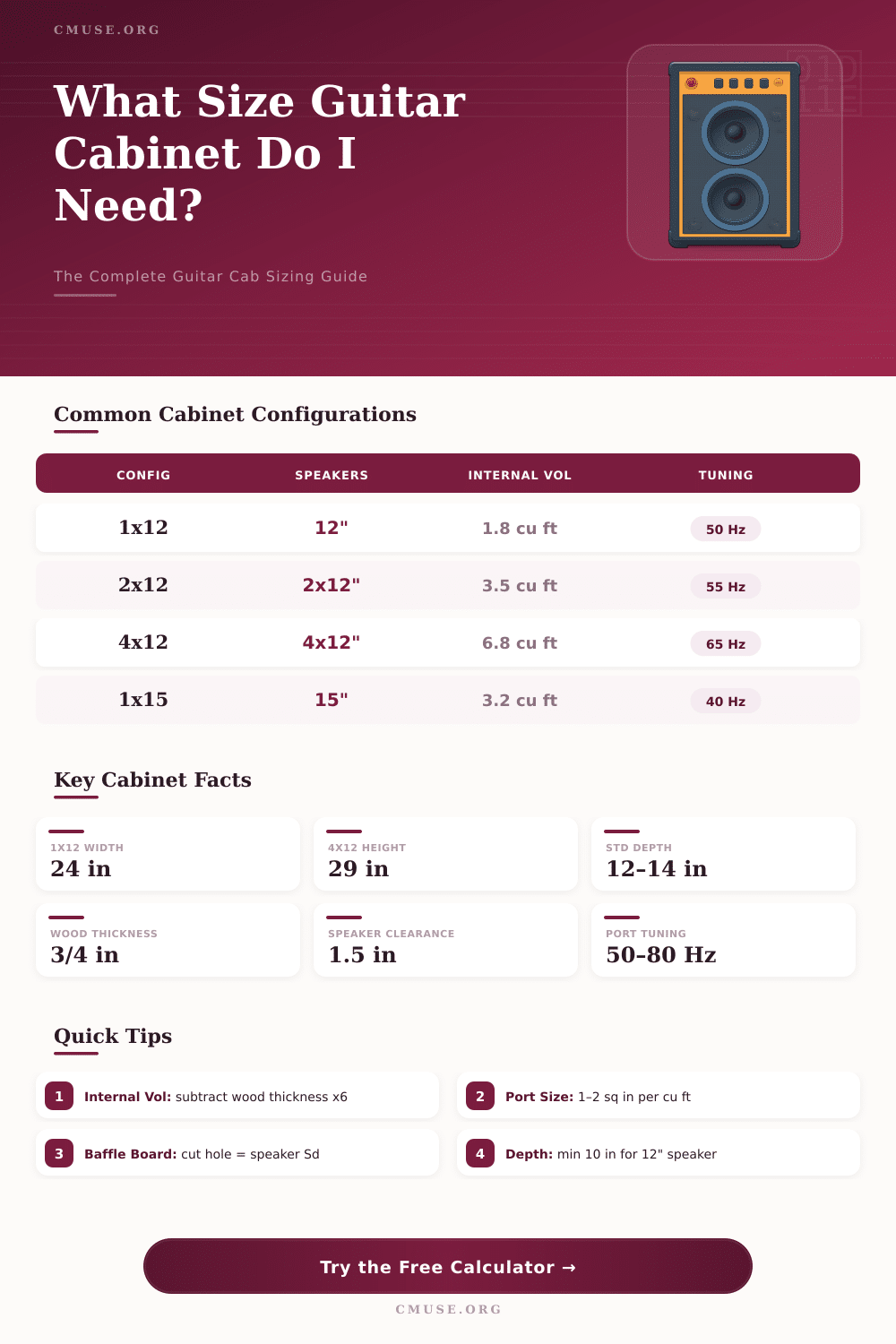
| Config | Ext W x H x D (in) | Internal Vol (cu ft) | Internal Vol (L) | Cab Type | Typical Use |
|---|---|---|---|---|---|
| 1x8 | 14 x 12 x 9 | ~0.55 | ~15.6 | Closed | Practice, bedroom |
| 1x10 | 18 x 16 x 10 | ~0.95 | ~26.9 | Open/Closed | Blues, country |
| 1x12 Open | 24 x 20 x 12 | ~1.65 | ~46.7 | Open Back | Vintage, jazz, rock |
| 1x12 Closed | 26 x 22 x 14 | ~2.1 | ~59.5 | Closed Back | High gain, metal |
| 2x12 | 28 x 20 x 12 | ~3.4 | ~96.3 | Open/Closed | Combo, gigging |
| 4x12 | 30 x 29 x 14 | ~6.6 | ~186.9 | Closed | Stage, high gain |
| 1x15 | 22 x 24 x 14 | ~3.1 | ~87.8 | Ported | Bass, country |
| 4x10 Bass | 24 x 24 x 16 | ~5.0 | ~141.6 | Ported | Bass guitar |
| 3x12 | 30 x 22 x 14 | ~5.0 | ~141.6 | Closed | Custom, boutique |
| Wood Thickness | Total Deduction (per dim) | Volume Loss on 1x12 (%) | Typical Application | Weight (lb / sq ft) |
|---|---|---|---|---|
| 1/2 in (13mm) | 1.0 in per side | ~8% | Lightweight, practice | 1.6 |
| 5/8 in (16mm) | 1.25 in per side | ~11% | Mid-weight builds | 2.0 |
| 3/4 in (19mm) | 1.5 in per side | ~13% | Standard guitar cabs | 2.4 |
| 1 in (25mm) | 2.0 in per side | ~17% | Heavy duty stage cabs | 3.2 |
| Port Dia (in) | Port Length (in) | Cab Volume (cu ft) | Tuning Freq (Hz) | Suitable For |
|---|---|---|---|---|
| 2.0 | 4.0 | 1.0 | ~75 | 1x10 guitar |
| 2.5 | 5.0 | 1.5 | ~65 | 1x12 guitar |
| 3.0 | 6.0 | 2.0 | ~58 | 1x12 ported |
| 3.0 | 8.0 | 3.0 | ~48 | 1x15 bass |
| 4.0 | 7.0 | 4.0 | ~52 | 2x12 bass |
| 4.0 | 10.0 | 5.0 | ~43 | 4x10 bass |
| Material | Density (lb/cu ft) | Resonance | Workability | Best For |
|---|---|---|---|---|
| Baltic Birch Ply | 34–38 | Tight, punchy | Excellent | Boutique, studio cabs |
| Pine Plywood | 28–32 | Warm, airy | Good | Vintage-style cabs |
| MDF | 44–50 | Neutral, dead | Good (heavy) | Recording, flat response |
| Void-Free Birch | 35–40 | Clear, articulate | Excellent | High-end custom builds |
| Poplar Plywood | 28–33 | Bright, light | Good | General purpose |
| Solid Pine | 26–31 | Warm, resonant | Fair | Vintage open back |
| Solid Oak | 42–48 | Dense, tight | Difficult | Heavy stage cabs |
| Particleboard | 40–45 | Dull, absorptive | Poor | Budget builds only |
How many thought you genuinely give to your guitar cabinet size? Many musicians do not know how loudly it can affect your sound… It is just as important as the speakers installed in it.
The size and build style matters more than many believe because changing one format to another can entirely alter what comes from the final part.
How Guitar Cabinet Size Changes Your Sound
The most small guitar cabinet sizes are filled with one single 6.5-inch or 8-inch speaker, and those designs work well for home practice in the bedroom. A bit bigger, and you see two-speaker models, maybe a pair of 10-inch or 12-inch… That work well for rehearsal rooms and small venues.
The 4×12 stands at the peak of the chain. It is the biggest and most powerful option, and a funny historic detail: Jim Marshall, the folk behind that famous design, chose those sizes because it is the smallest space that comfortably bears four 12-inch speakers without looking silly. Weight and volume also play a role, which affects shipping transfer and whether you genuinely can carry the stuff yourself.
Open-back guitar cabinet sizes follow other rules. They work best between 9 and 11 inches of depth, and honestly, because of their open back, the exact sizes do not matter almost as much. You can use something compact as 1×10 with only 14x14x7 inches and still get good results.
The portability becomes much more simple with that type of space use.
There is a clear heard difference between sizes of speakers. 10-inch speakers usually cut the mid tones while they give more bass and highs. 12-inch, on the other hand, provide much more of cleanness during play; that is the ideal.
15-inch speakers happen too, but they are rarely used for guitars and genuinely, they more work for basses. Because guitar does not require those really low tones, the 12-inch became the standard size that best works.
Here is wear the physics gets tricky: guitar cabinet size has a basic trade-off. You can reach two of those three things, size, impact and response to low frequencies, but not all three together. Want it strong and loud?
It does not stay small. Most guitar cabinet sizes on sale try to sound great and stay quite compact, which means that they lost a bit of bass response.
Guitar speakers act differently at low volumes than other kinds of speakers, and that changes everything. The Thiele-Small parameters apply much less in practice than in books. Double or halve the guitar cabinet size and it barely affects how a guitar speaker reacts.
If the speaker does not push low tones past its natural vibration, the exact size is not that important. Simply choose something that works for your speakers and feels right.
2×12 is enough for most gigs without going to stadium sizes. For club shows, 4×12 spreads the sound more evenly through the space. Sometimes bigger 2×12 sound too thin in the mids, so a smaller version can help strengthen that.
Test some different guitarcabinet sizes within your budget, the build, sizes and speakers change everything.