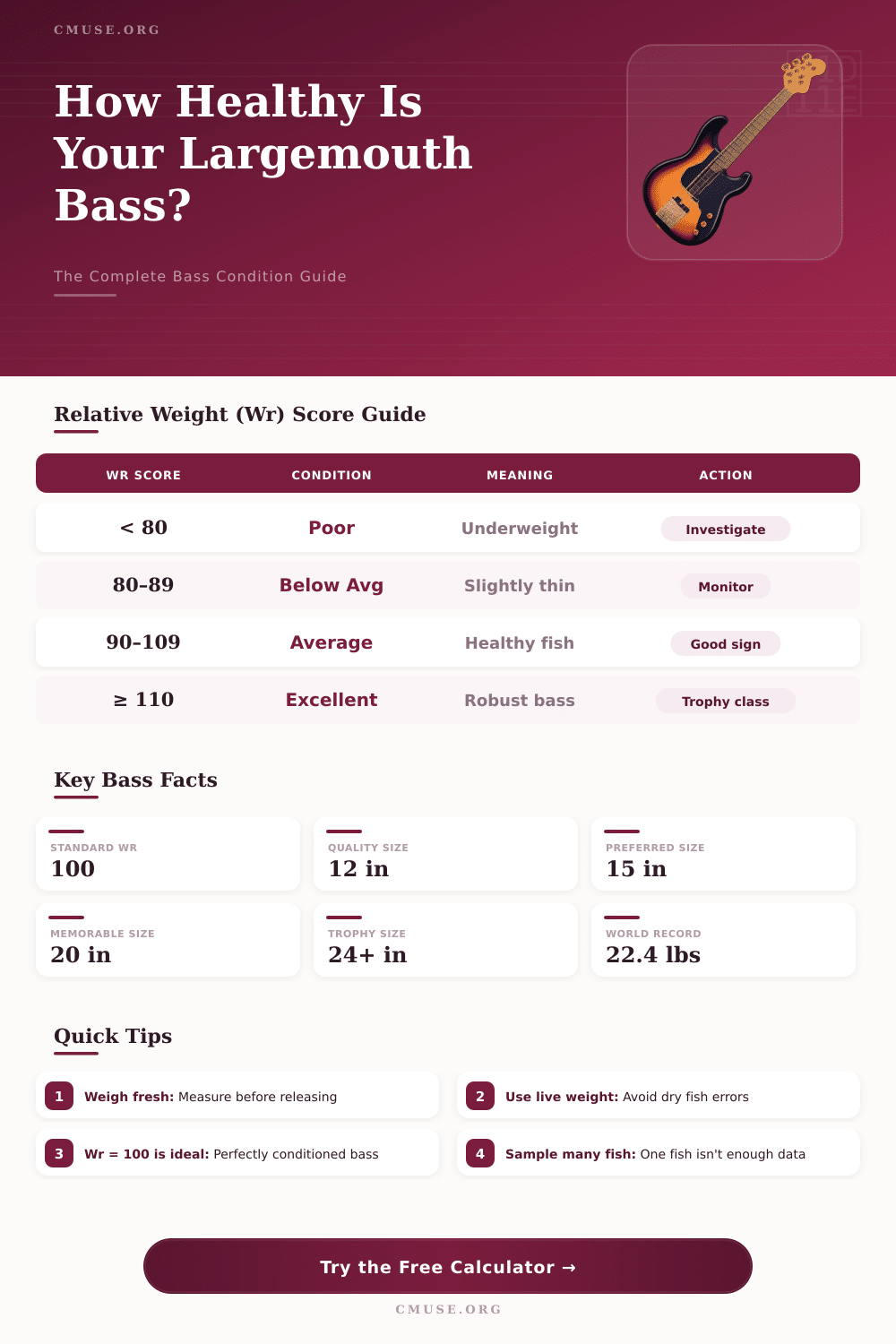
🐟 Largemouth Bass Relative Weight Calculator
Enter length & weight to calculate Wr score and fish condition rating
| Length (in) | Length (cm) | Standard Ws (lbs) | Standard Ws (kg) | Quality Category |
|---|---|---|---|---|
| 8 | 20.3 | 0.27 | 0.12 | Substock |
| 10 | 25.4 | 0.52 | 0.24 | Substock |
| 11 | 27.9 | 0.69 | 0.31 | Stock |
| 12 | 30.5 | 0.90 | 0.41 | Stock |
| 13 | 33.0 | 1.16 | 0.53 | Stock |
| 14 | 35.6 | 1.47 | 0.67 | Quality |
| 15 | 38.1 | 1.83 | 0.83 | Quality |
| 16 | 40.6 | 2.26 | 1.03 | Quality |
| 17 | 43.2 | 2.75 | 1.25 | Preferred |
| 18 | 45.7 | 3.31 | 1.50 | Preferred |
| 19 | 48.3 | 3.95 | 1.79 | Preferred |
| 20 | 50.8 | 4.67 | 2.12 | Memorable |
| 21 | 53.3 | 5.47 | 2.48 | Memorable |
| 22 | 55.9 | 6.36 | 2.89 | Memorable |
| 23 | 58.4 | 7.34 | 3.33 | Trophy |
| 24 | 61.0 | 8.43 | 3.82 | Trophy |
| 25 | 63.5 | 9.63 | 4.37 | Trophy |
| 26 | 66.0 | 10.93 | 4.96 | Trophy |
| Category | Min Length (in) | Min Length (cm) | Description |
|---|---|---|---|
| Substock (SS) | < 8 | < 20.3 | Too small to assess condition |
| Stock (S) | 8 | 20.3 | Minimum harvestable size range |
| Quality (Q) | 12 | 30.5 | Desirable angling size |
| Preferred (P) | 15 | 38.1 | Sought-after sport fish size |
| Memorable (M) | 20 | 50.8 | Exceptional catch, above average |
| Trophy (T) | 24 | 61.0 | Elite trophy bass |
| Length Range (in) | Avg Healthy Wr | Good Wr Range | Notes |
|---|---|---|---|
| 8–11 | 95 | 85–110 | Young-of-year; highly variable |
| 12–14 | 98 | 88–112 | Stock-quality transition class |
| 15–17 | 100 | 90–115 | Core quality class; benchmark |
| 18–20 | 100 | 90–115 | Preferred-memorable class |
| 21–23 | 98 | 88–112 | Larger fish; slight natural drop |
| 24+ | 95 | 85–108 | Trophy class; energy maintenance |
Guessing the weight of deep fish without use of a scale is a hard task. A simple way helps: one measures the length of the fish and checks a typical table about length and weight. Like this one gets a rough number that depends only on the length.
When the fish is fat or female almost ready to spawn, one can add some pounds to that rating for a better idea.
How to Estimate Bass Weight
A more exact method combines length with belly size. The core of the method is: weight matches length squared times belly size, later divided by 1 200. Length and belly size one takes in inches, and the result comes in pounds.
Belly size shows the distance around the body at the thickest place. Also websites offer calculators, where one enters length and belly size to get an immediate result. They give only general ratings for typical basses, naturally.
Largemouth Bass Relative Weight is another idea. To find it, one divides the real weight of the fish by the standard weight for that length, later multiplied by 100. For instance, a 20.5-inch bass weighing 4.2 pounds can be compared to the average with that method.
A healhty 22-inch copy weighs around 6.21 pounds. Season seriously affects the weight, because basses change mass through the year, a bit heavier or lighter.
What causes one bass to weigh more than another of the same length? Food and physical form both matter. An 18-inch fish sometimes reaches weight close too longer fish, if it is especially thick.
A fat 20-inch largemouth maybe weighs around 7 pounds, although that stays only a guess.
Various resources help to estimate weight in different ways. Some give formulas online. Others use online tools for counting.
Some simply list weights by length in a table. Length one usually takes as total length, from the tip of the mouth to the tail end. At least one source favors fork length for basses, which changes the result compared to total length.
The world record for confirmed largemouth bass is 22.25 pounds. George Perry caught it in Montgomery Lake near Valdosta, Georgia, in 1932. For most fishermen, a good bass is something around 5 to 6 pounds in northern areas.
The line for big catches starts at 3 pounds, because here the body truly starts to feel the difference during the fight. Something under that weight can still give a good fight, butmore body mass simply changes the feeling.