🔊 Bass Horn Calculator
Design horn loaded subwoofers — calculate mouth area, throat size, flare rate & path length
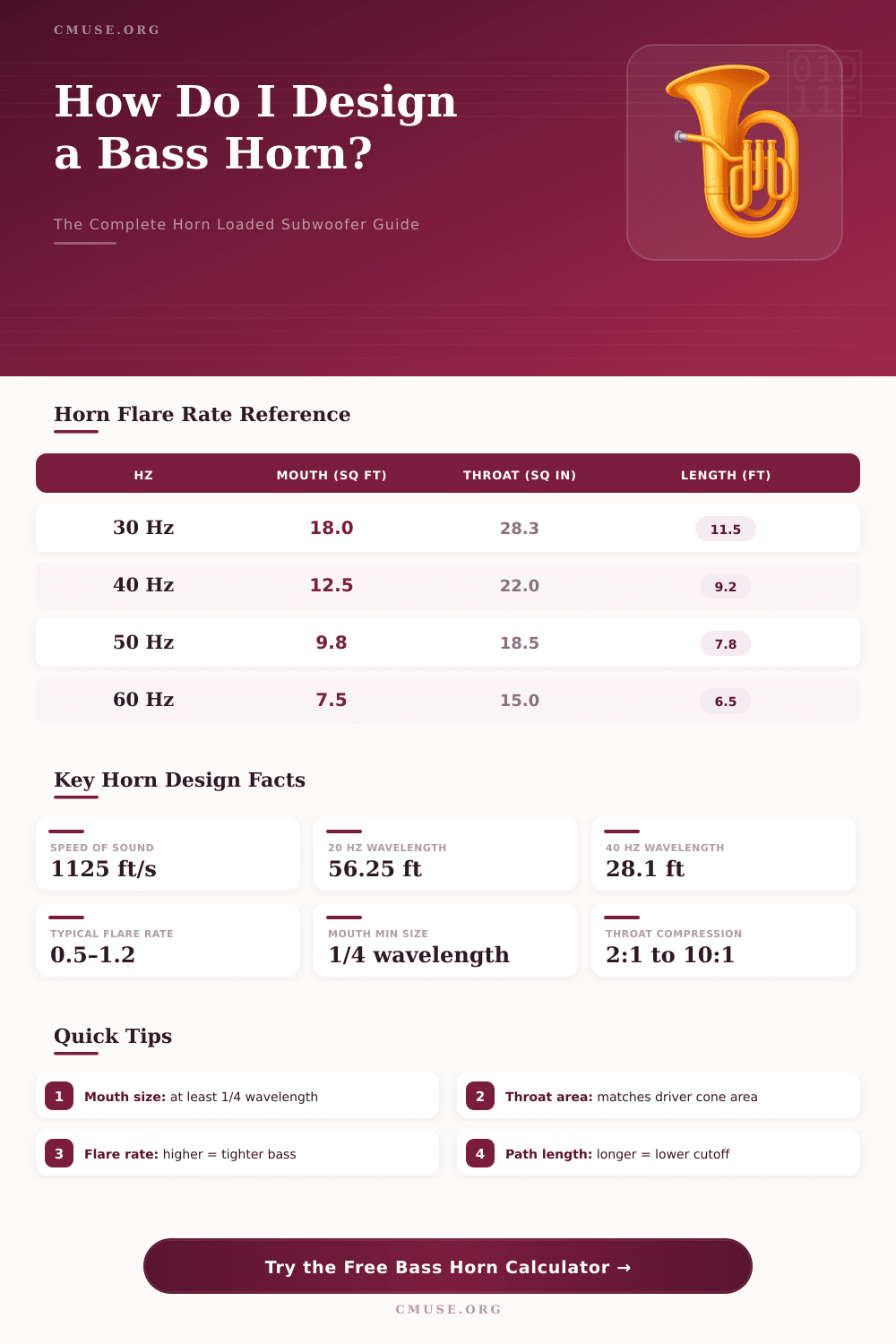
| Cutoff Freq (Hz) | Min Mouth Area (sq ft) | Min Mouth Area (m²) | Wavelength (ft) | Recommended Path (ft) |
|---|---|---|---|---|
| 20 Hz | 39.5 | 3.67 | 56.3 | 19.0 |
| 25 Hz | 25.3 | 2.35 | 45.0 | 15.2 |
| 30 Hz | 17.5 | 1.63 | 37.5 | 12.7 |
| 35 Hz | 12.9 | 1.20 | 32.1 | 10.9 |
| 40 Hz | 9.88 | 0.918 | 28.1 | 9.5 |
| 50 Hz | 6.33 | 0.588 | 22.5 | 7.6 |
| 60 Hz | 4.39 | 0.408 | 18.8 | 6.3 |
| 80 Hz | 2.47 | 0.229 | 14.1 | 4.7 |
| 100 Hz | 1.58 | 0.147 | 11.3 | 3.8 |
| Flare Type | Rolloff Character | Bandwidth | Low-End Extension | Typical Use |
|---|---|---|---|---|
| Exponential | Sharp below Fc | Wide | Good | PA Subs, W-bins |
| Tractrix | Smooth, gradual | Very Wide | Excellent | Hi-Fi, Studio |
| Hyperbolic (Bessel) | Gentle below Fc | Wide | Very Good | Stadium, Concert |
| Conical | Very gradual | Narrow | Fair | Mid-bass, Monitors |
| Design | Driver Size | Mouth Area (sq ft) | Path Length (ft) | Sensitivity Gain |
|---|---|---|---|---|
| Straight Horn | 18" | 9.9 | 9.5 | +6 dB |
| Folded Horn | 18" | 9.9 | 9.5 | +6 dB |
| W-Bin (Double Fold) | 2x 15" | 18.0 | 10.2 | +9 dB |
| Scoop / Bin | 15" | 7.5 | 7.8 | +4 dB |
| Tapped Horn | 18" | 5.0 | 6.2 | +3 dB |
| Rear-Loaded | 12" | 4.5 | 5.5 | +3 dB |
The name “bass horn” for the basic instrument is practical, but a bit unclear. It reminds of vertical snakes, that is mouth-driven instruments from wood and metal. Such snakes mainly were used in European armed groups and chamber music groups around the end of the 18th century and at the start of the 19th.
There are versions done in Germany and in England of the English bass horn. One sometimes describes it as an old wind instrument that looks like a bassoon, but with a mouthpiece in the form of a cup. Simply said it is the deep brass wind instrument.
Bass Horns: Musical Instruments and Speakers
The word “bass horn” is used also sometimes for a simple point tube.
An interesting detail is that the instrument called bass horn seems to be an F-tube, that developed in the shape of French horn. Cymbals and counter-bass trombones look like cylinder-shaped deep instruments. Even so, although some producers continuously make them, their usage stays very limitde.
The counter-bass horn, that is very rare, works best by means of orchestral euphonium or high or tenor trombone, for a richer sound.
Away from the range of brass instruments, the expression “bass horn” matters a lot in the field of speakers and sound builds. Bass horns naturally are huge. Because of that size, many horn speakers include active subwoofers in there structure.
To reach real horn load in deep sounds, you need a lot of space. For instance, the company Klipsch advise to lay their speakers in the corners of the room, to create deep bass. The Klipschorn indeed is the biggest produced model of speaker in history.
It applies folded horn designs for the depth and delivers truly rich, pure sound.
Horn enclosures are the most efficient kinds for speakers. They truly strengthen the skill of the driver to handle power, because more energy turns into sound than into heat. Also they keep more stable direction for low frequencies compared to average designs.
That helps to reduce problems caused by room excitement and offer more precise sound for livingarrangements.
New design of bass horn uses spiral horn channel, to reproduce deep frequencies of 30 Hz until 100 Hz, with rated sensitivity of 105 dB in one watt in one metre. Folded horns became popular for depth, because the fold makes a longer path, what gives the base more space to grow. Some low notes truly require several feet, so that the real wave forms.
For instance, low B can force around 18 feet.
In the world of deep guitar, horn high speakers in enclosures restore the high frequencies, that the low speaker can not reach. Most deep enclosures apply only 50 or 100 watt high speakers with a filter for high sounds. Some musicians like to turn the horn, especially during close miking, because it adds too much noise.
Even so players of five-string or six-string bass commonly favour horn high speakers because of the extra gloss.