🎶 Bass Trap Calculator
Calculate how much acoustic treatment material you need for your room or studio
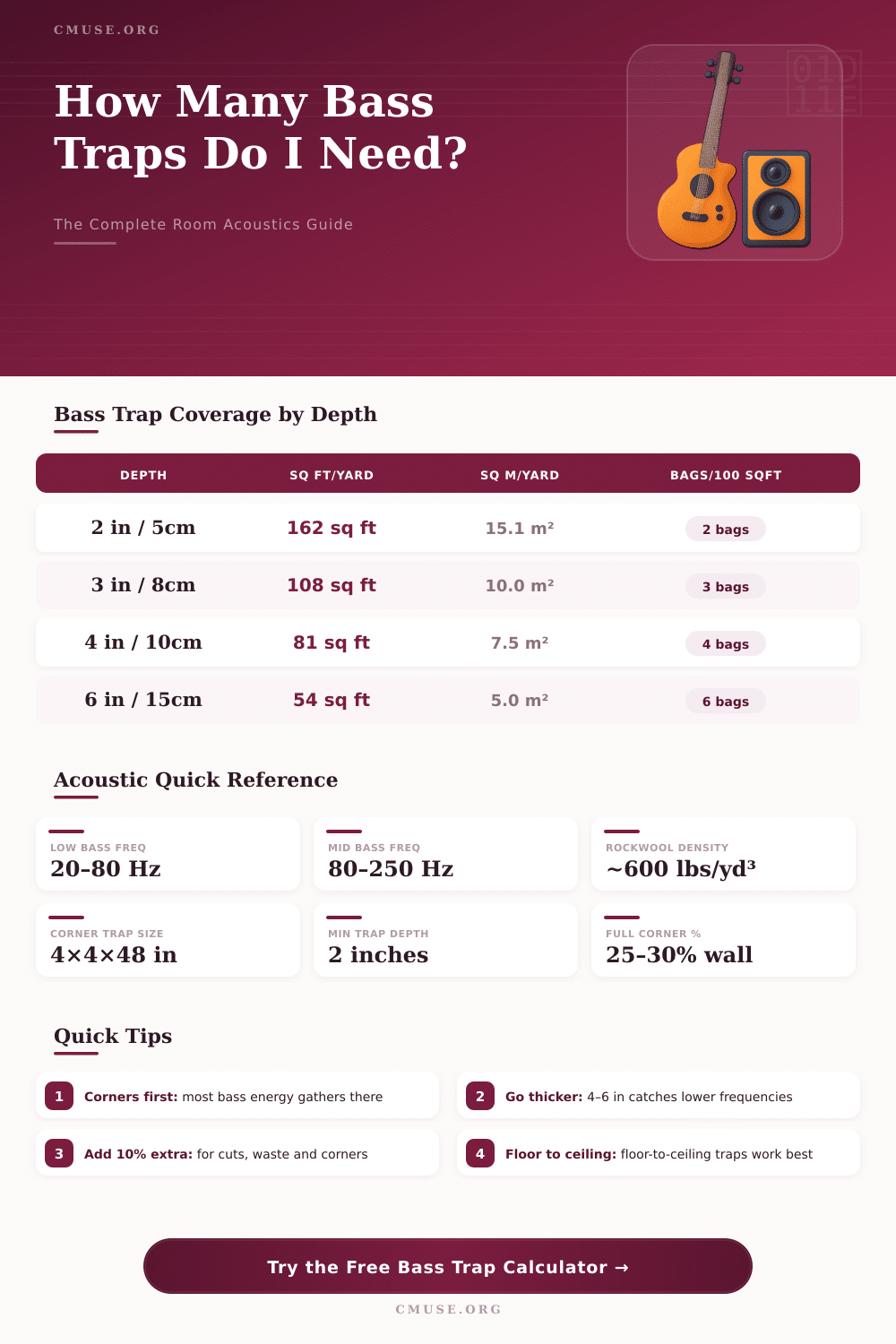
| Depth (in) | Depth (cm) | Sq Ft per Cu Yd | Sq M per Cu Yd | Cu Yd per 100 Sq Ft |
|---|---|---|---|---|
| 1 in | 2.5 cm | 324 sq ft | 30.1 m² | 0.31 yd³ |
| 2 in | 5.1 cm | 162 sq ft | 15.1 m² | 0.62 yd³ |
| 3 in | 7.6 cm | 108 sq ft | 10.0 m² | 0.93 yd³ |
| 4 in | 10.2 cm | 81 sq ft | 7.5 m² | 1.23 yd³ |
| 6 in | 15.2 cm | 54 sq ft | 5.0 m² | 1.85 yd³ |
| Bag Size | Volume per Bag | Bags per Cu Yd | Coverage at 3 in | Coverage at 4 in |
|---|---|---|---|---|
| 2 cu ft bag | 0.074 yd³ | 13.5 bags | 8 sq ft | 6 sq ft |
| 3 cu ft bag | 0.111 yd³ | 9 bags | 12 sq ft | 9 sq ft |
| 4 cu ft bag | 0.148 yd³ | 6.75 bags | 16 sq ft | 12 sq ft |
| Bulk (1 yd³) | 27 cu ft | 1 unit | 108 sq ft | 81 sq ft |
| Project | Area (sq ft) | Cu Yd at 3 in | Bags (2 cu ft) at 3 in | Cu Yd at 6 in |
|---|---|---|---|---|
| Vocal Booth 5x5 | 25 sq ft | 0.23 yd³ | 3 bags | 0.46 yd³ |
| Recording Booth 8x6 | 48 sq ft | 0.44 yd³ | 6 bags | 0.89 yd³ |
| Home Studio 10x12 | 120 sq ft | 1.11 yd³ | 15 bags | 2.22 yd³ |
| Practice Room 12x12 | 144 sq ft | 1.33 yd³ | 18 bags | 2.67 yd³ |
| Mix Room 14x10 | 140 sq ft | 1.30 yd³ | 18 bags | 2.59 yd³ |
| Live Room 18x14 | 252 sq ft | 2.33 yd³ | 32 bags | 4.67 yd³ |
| Large Studio 24x20 | 480 sq ft | 4.44 yd³ | 60 bags | 8.89 yd³ |
The size of a bass trap has big impact when dealing with the acoustics of the room. Usually one says that bigger traps work more well. In typical studios, four bass traps of six feet of height and one foot of depth with enough spacing can work well for the sound.
Try to use the maximum treatment, that the space allows even so keeping the room usable.
How Big and Deep Should Bass Traps Be
One small bass trap does not work for good impact. The wavelength of the intended frequencies must be considered. The bigger the trap regarding the wave, the more it works well.
Depth and placement both matter for settling basic problems.
There is good method for guessing the depth. Search the frequency, that you want to address, calculate its wavelength and aim for one-quarter of it. For instance, 250 hertz has a wavelength of around five feet.
One quarter of that is 16 inches, so the trap should have 16 inches of thickness for well controlling 250 hertz. For reaching down to 40 hertz, typical membrane bass trap requires 20 to 24 inches of depth.
For porous absorbers one advises minimum of 15 to 20 centimetres of thickness to catch basses. If you lay the trap 15 to 20 centimetres in front of the wall, that also helps, because sound absorbs hear, where the wave moves, while at the wall surface the movement is zero. Four-inch thick panels can serve as bass traps, if one installs them diagonally in corner.
Six inches of thickness work even more well. Above six inches, on the other hand, the gains slowly disappear. In most rooms for bass capture there really does not exist something too thick, so one should go to the maximum thickness inside the available space without care.
One commonly uses 24 inches of width for homemade bass traps. That comes partly from that, that rigid fiberglass panels are sold in two feet of width, what makes it easy to cut them in triangles for corner setting. Many DIY videos show 24-inch square traps because of same reason.
But four 24-inch traps in the corners can take almost 40 percent of the wall space. 34-inch pieces work well, if the room allows. For filled corner bass trap 60 centimetres or 32 inches of width are good, because it avoids waste of insulation during cutting.
The thickness depends on the available space, the place of the trap, the type of music, that one plays, and the intended results along with the size of the room. 200 mm thick traps instead of 100 mm give better output, but they take more place. Soffit-traps should sit flat in the corner for the best results.
Twenty-inch square traps work more well than 17-inchor simple four-inch panels.