🎸 Guitar Setup Calculator
Calculate ideal action height, neck relief, saddle compensation & intonation for any guitar
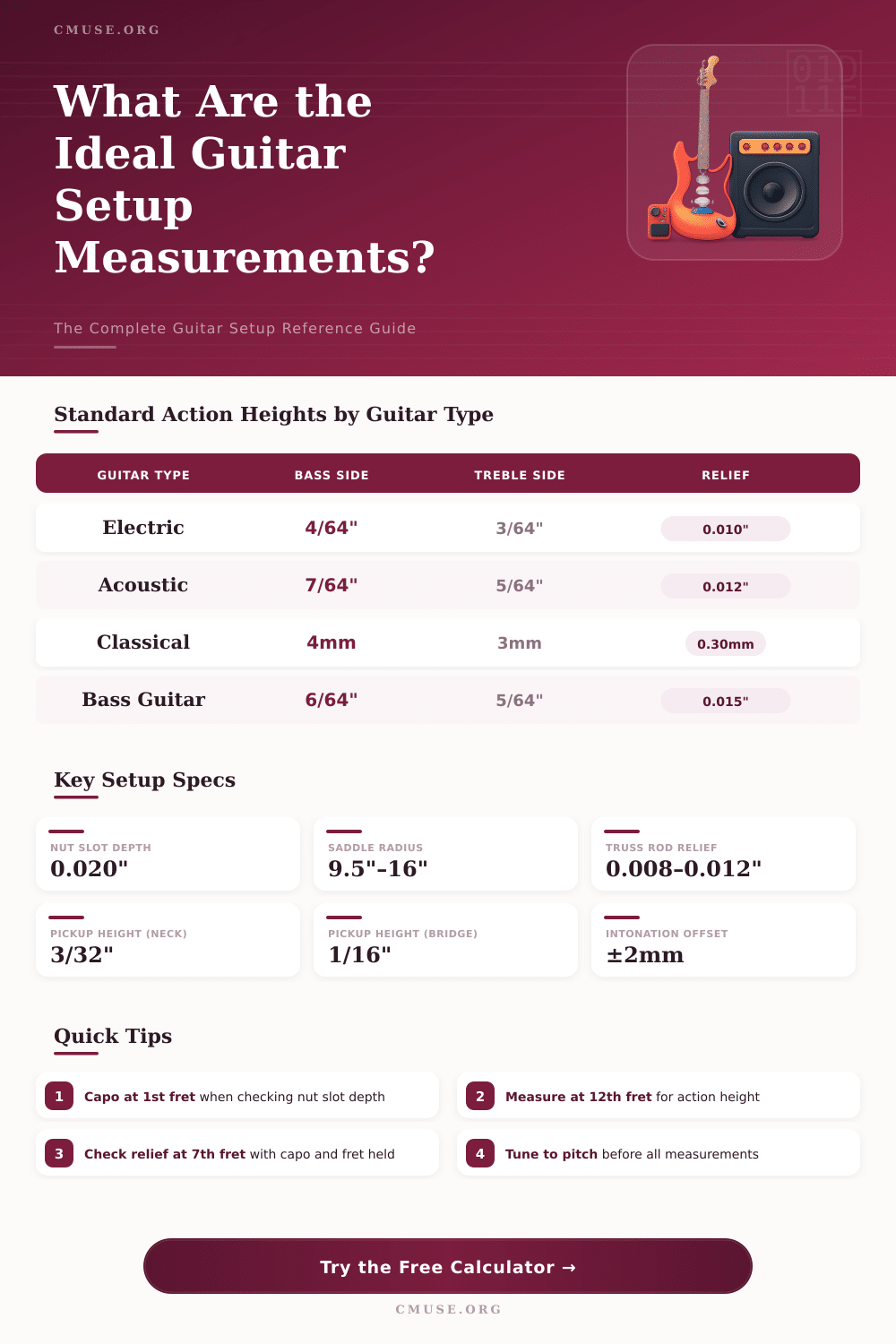
| Guitar Type | Bass Side (12th) | Treble Side (12th) | Relief (7th) | Nut – Bass |
|---|---|---|---|---|
| Electric – Standard | 4/64" (1.59mm) | 3/64" (1.19mm) | 0.010" (0.25mm) | 0.023" (0.58mm) |
| Electric – Low Action | 3/64" (1.19mm) | 2/64" (0.79mm) | 0.007" (0.18mm) | 0.018" (0.46mm) |
| Electric – Jazz | 5/64" (1.98mm) | 4/64" (1.59mm) | 0.012" (0.30mm) | 0.025" (0.64mm) |
| Electric – Shred | 3/64" (1.19mm) | 2/64" (0.79mm) | 0.006" (0.15mm) | 0.016" (0.41mm) |
| Acoustic – Standard | 7/64" (2.78mm) | 5/64" (1.98mm) | 0.012" (0.30mm) | 0.025" (0.64mm) |
| Acoustic – Bluegrass | 9/64" (3.57mm) | 7/64" (2.78mm) | 0.015" (0.38mm) | 0.028" (0.71mm) |
| Acoustic – Fingerpicking | 6/64" (2.38mm) | 4/64" (1.59mm) | 0.010" (0.25mm) | 0.022" (0.56mm) |
| Classical (nylon) | 4.0mm (5/32") | 3.0mm (7/64") | 0.30mm (0.012") | 0.020" (0.51mm) |
| Bass – Standard | 6/64" (2.38mm) | 5/64" (1.98mm) | 0.015" (0.38mm) | 0.030" (0.76mm) |
| Slide Guitar | 10/64" (3.97mm) | 8/64" (3.18mm) | 0.015" (0.38mm) | 0.032" (0.81mm) |
| Guitar Type | Minimum Relief | Recommended | Maximum Relief | Effect of Too Much |
|---|---|---|---|---|
| Electric (light strings) | 0.005" (0.13mm) | 0.008" (0.20mm) | 0.012" (0.30mm) | High action mid-neck |
| Electric (medium strings) | 0.007" (0.18mm) | 0.010" (0.25mm) | 0.015" (0.38mm) | High action mid-neck |
| Acoustic | 0.008" (0.20mm) | 0.012" (0.30mm) | 0.020" (0.51mm) | Buzzing / intonation issues |
| Classical | 0.008" (0.20mm) | 0.012" (0.30mm) | 0.018" (0.46mm) | Sharp intonation |
| Bass Guitar | 0.010" (0.25mm) | 0.015" (0.38mm) | 0.025" (0.64mm) | Uneven feel |
| Scale Length | Saddle Offset B-string | Saddle Offset G-string | Check Note | Tolerance |
|---|---|---|---|---|
| 24.75" (Gibson) | +2.0mm back | +1.5mm back | 12th fret harmonic vs fretted | ±2 cents |
| 25.5" (Fender) | +2.5mm back | +1.8mm back | 12th fret harmonic vs fretted | ±2 cents |
| 25.0" (PRS) | +2.2mm back | +1.6mm back | 12th fret harmonic vs fretted | ±2 cents |
| 26.5" (Baritone) | +3.0mm back | +2.0mm back | 12th fret harmonic vs fretted | ±2 cents |
| 34.0" Bass | +3.5mm back | +2.5mm back | 12th fret harmonic vs fretted | ±3 cents |
| Gauge Set | High E Tension | Low E Tension | Total Tension | Action Adjust |
|---|---|---|---|---|
| .008–.038 Extra Light | ~11.5 lbs | ~13.1 lbs | ~68 lbs | –1/64" lower |
| .009–.042 Light | ~14.4 lbs | ~16.0 lbs | ~84 lbs | Standard –0.5/64" |
| .010–.046 Med-Light | ~17.5 lbs | ~18.4 lbs | ~99 lbs | Standard reference |
| .011–.052 Medium | ~20.8 lbs | ~21.5 lbs | ~117 lbs | +0.5/64" higher |
| .012–.056 Heavy | ~24.0 lbs | ~24.3 lbs | ~134 lbs | +1/64" higher |
| .045–.105 Bass Med | ~45 lbs | ~38 lbs | ~165 lbs | Bass reference |
Guitar Setup is made up of a set of changes that involves ways to improve the feel and the sound of the instrument. Like a car that requires tuning to reach the right tone in the season, the Guitar Setup must match the changes that the guitar goes through over time. To set up a guitar, one commonly changes the height of the strings at the nut and the bridge, makes sure that nut slots match the strings levels the frets, rounds their edges and does other work.
Three main parts ensure proper Guitar Setup. They are the plane of the shelf of frets, the height of the strings at the bridge regarding that shelf and the fit of the nut for the used strings. The truss rod, the high bridge, the angle of the neck, the high nut, the high saddle, the spacing of strings and the dressing of frets all relate.
How to Set Up a Guitar
Changing one of them can afefct the others.
The usual process starts by placing fresh strings and tuning to the wanted pitch. Later, one sets the relief of the neck first by means of the truss rod. Then one changes the height of the saddle, later that of the nut.
Truss rods are only massive steel, and because of unknown where hardly expect how they will react to changes. Letting the neck rest after adjustment is a reliable method.
Many cheaper guitars, even some costly models, come with nut slots that are way too high. That causes big distance between the string and the first few frets. Such distances can create sharp tone, when one presses on frets one until five, although the intonation works well at the sixteenth fret.
The depth of nut slots truly matters and one should address it between the relief of the neck and the steps of intonation.
The length of the string also affects the reaching of octaves in the melody. At the sixteenth fret, where the string halves, the note should be a perfect octave above the open string. Even so, a bit of pressing down can strain the string, which can mess up the intonation in higher zones.
If the note up the neck sounds sharp, one moves the saddle more toward the bridge. If low, one moves it more toward the saddles. A precise tuner is useful here, a phone app does not suffice.
Even budget instruments can improve with good Guitar Setup. Standard Guitar Setup implies correction to factory specs for that guitar model, including relief, action, spacing of strings and saddle height. But factory specs are only a starting point for personal finishing.
Preferences about action really vary. Some players want strings as low as possible, without buzz.
Guitar Setup is an everyday task. Tools like gauges, feelers, rockers for pressure, straight edges, needle files and materials to polish frets all help for efficient work. A mat for work above the workspace protects the instrument, and keeping tools aside stops casual drops of something on the guitar.
Thebase is to reach good sound and good feel for the way that the player actually plays.