🎸 Guitar Action Calculator
Calculate ideal string height, relief, and action specs for any guitar type
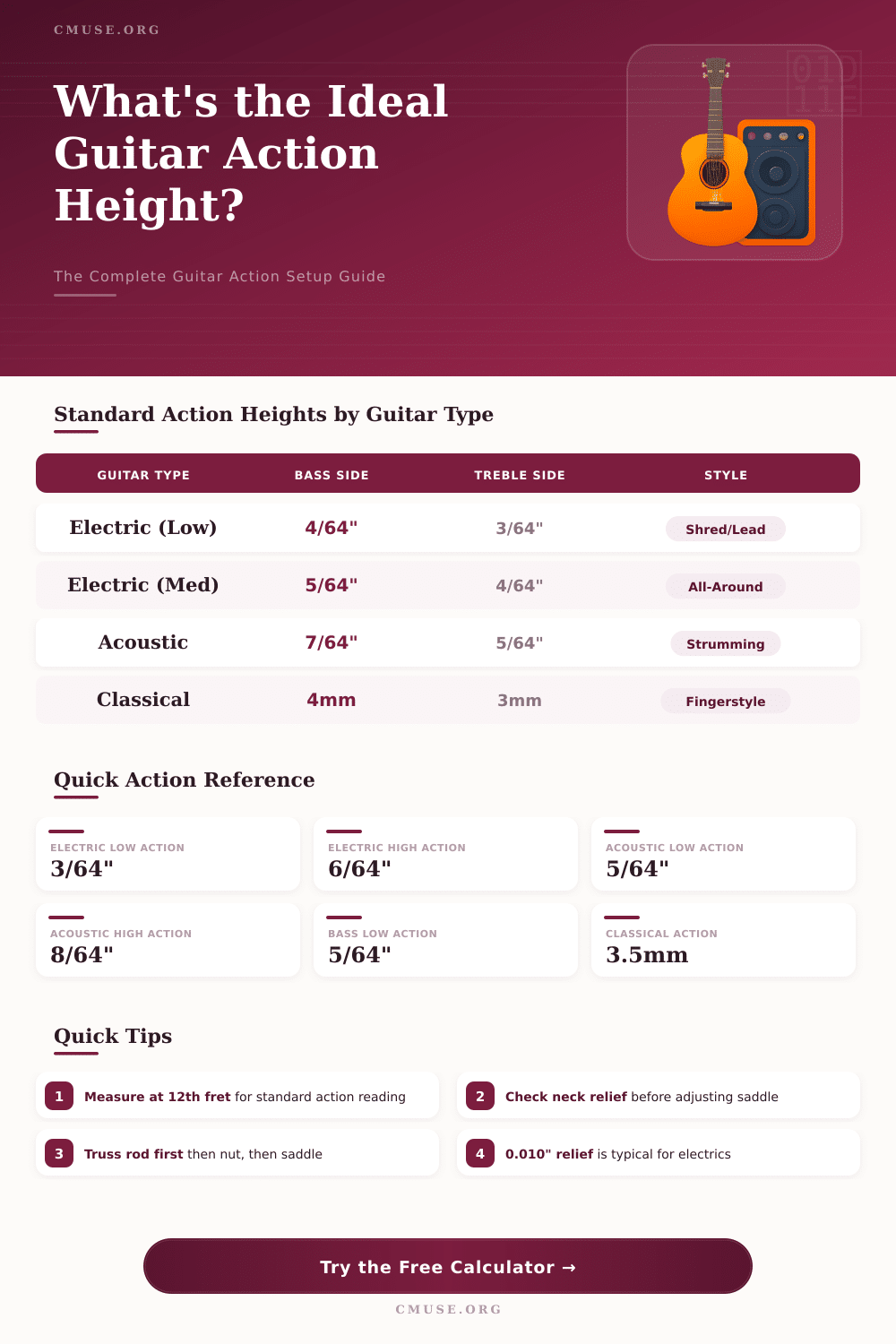
| Guitar Type | Low (Bass / Treble) | Medium (Bass / Treble) | High (Bass / Treble) | Metric Equiv. (Med) |
|---|---|---|---|---|
| Electric (6-string) | 4/64" / 3/64" | 5/64" / 4/64" | 6/64" / 5/64" | 2.0mm / 1.6mm |
| Electric (7-string) | 4/64" / 3/64" | 5/64" / 4/64" | 7/64" / 5/64" | 2.0mm / 1.6mm |
| Acoustic (Steel) | 5/64" / 4/64" | 7/64" / 5/64" | 9/64" / 7/64" | 2.8mm / 2.0mm |
| Classical (Nylon) | 3mm / 2.5mm | 4mm / 3mm | 5mm / 3.5mm | 4.0mm / 3.0mm |
| Bass Guitar (4-str) | 5/64" / 4/64" | 6/64" / 5/64" | 7/64" / 6/64" | 2.4mm / 2.0mm |
| Baritone Guitar | 5/64" / 4/64" | 6/64" / 5/64" | 8/64" / 6/64" | 2.4mm / 1.6mm |
| Guitar Type | Relief (inches) | Relief (mm) | Gauge Influence |
|---|---|---|---|
| Electric (Light Strings) | 0.008" – 0.010" | 0.20 – 0.25mm | 009–010 sets |
| Electric (Medium Strings) | 0.010" – 0.012" | 0.25 – 0.30mm | 011–013 sets |
| Acoustic (Light) | 0.010" – 0.014" | 0.25 – 0.36mm | 012–013 sets |
| Acoustic (Medium) | 0.012" – 0.016" | 0.30 – 0.41mm | 013–014 sets |
| Classical | 0.010" – 0.014" | 0.25 – 0.36mm | Nylon tension |
| Bass Guitar | 0.014" – 0.020" | 0.36 – 0.51mm | 045–105 sets |
| String Position | Electric (inches) | Acoustic (inches) | Bass (inches) |
|---|---|---|---|
| 1st String (Treble) | 0.018" – 0.022" | 0.020" – 0.025" | 0.025" – 0.030" |
| 2nd String | 0.020" – 0.024" | 0.022" – 0.028" | 0.027" – 0.033" |
| 3rd String | 0.023" – 0.027" | 0.025" – 0.030" | 0.030" – 0.036" |
| 6th String (Bass) | 0.026" – 0.030" | 0.030" – 0.038" | 0.040" – 0.050" |
| Scale Length | Guitar Model Example | Tension Feel | Action Tendency |
|---|---|---|---|
| 24.75" (628mm) | Gibson Les Paul | Softer / Lower | Easier low action |
| 25.4" (645mm) | Martin D-28 | Medium | Standard acoustic |
| 25.5" (648mm) | Fender Strat/Tele | Higher tension | Slightly higher |
| 26.5" (673mm) | Baritone Electric | High tension | Higher action typical |
| 30" (762mm) | Short Scale Bass | Lower bass tension | Low action easy |
| 34" (864mm) | Fender P-Bass | Standard bass | Standard bass action |
The Guitar Action of strings relates to their height above the frets. It points to the space between the upper part of the fret and the bottom part of the string. Above the bridge the strings rest in two places normally the nut and the saddle, and that height here decides the Guitar Action.
One usually measures it at the 12th fret, because the distance grows the more away one goes from the nut.
How String Height Affects Guitar Playing
The Guitar Action probably most strongly works on the playability and the sound quality. That makes it a key part for beginners as well as for professionals. The Guitar Action is separate from other parts of guitar setup.
When strings rest close to the frets, the instrument has low Guitar Action. If they stand more distant, it has high Guitar Action. That gap decides how much pressure the string needs to push down for sounding, which alters the feleing during play of the instrument.
High Guitar Action provides more sustain, but plays harder. It means strong attacks in the play without ruining of the tone. Even so playing with lightweight style with high Guitar Action can lack force.
Low Guitar Action protects the fingers and works well for fast runs and solo parts. Heavy playing with low Guitar Action commonly sounds bad. With comfortably soft pressure and louder sound low Guitar Action tends too create nice sustain and long duration.
The Guitar Action deals with personal choice. There is not one alone right or wrong setting. Some players like high Guitar Action with thick strings because of the good tone.
Others want it as low as it is possible. The goal with low Guitar Action is that the strings stay only just high enough to escape buzz. Too low height causes problems with fret buzz.
A metal string vibrates hundreds of times a second with little space above metal frets, which can produce noise, but if the buzz does not sound during playing, it is fine.
Before changing the string height, the neck should be straight or with a bit of curve. The truss rod affects the straightness of the neck. Flat wound strings have more tension than round wound.
Big tension causes stronger forward bending of the neck, if not balanced by the truss rod. It also reduces the motion of strings, so the Guitar Action one can set a bit more low without buzz. After Guitar Action change the pickup usually needsadjusting.
At electric guitars, around 2 mm on the low side and 1.5 mm on the high side at the 12th fret forms a commonly used standard. Standard Guitar Action on classical guitar reaches about 3 mm at the high E and 4 mm at the low E. Up to around 5 mm stays playable on classical, but more than that becomes too much. High Guitar Action caused that many players stopped, thinking the guitar too tiring.
Professional setup at a guitar shop is worth the money well.