🎸 Guitar Chord Calculator
Find notes, intervals, and voicings for any chord in any key instantly
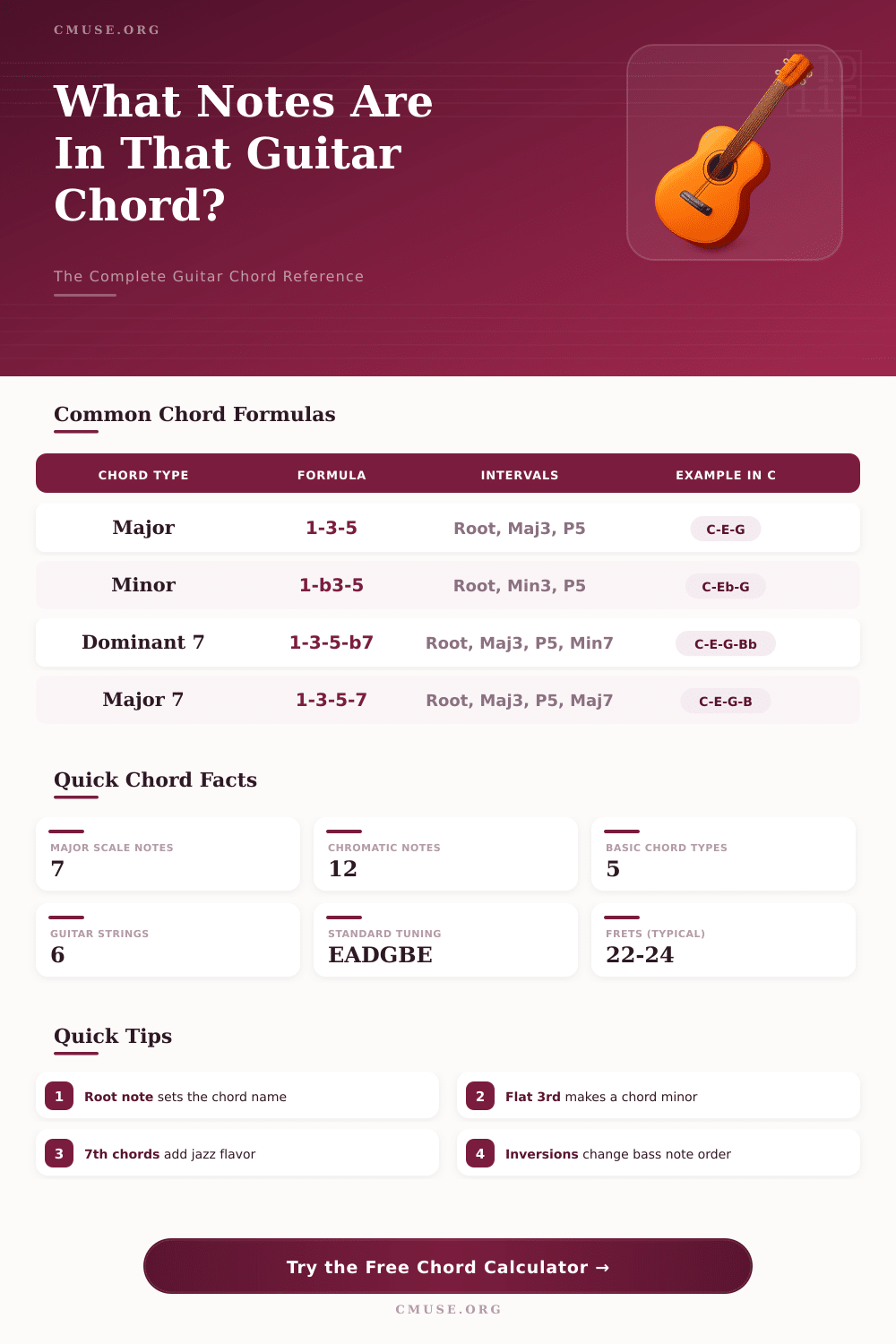
| Chord Type | Symbol | Semitone Intervals | Notes (in C) | Sound Character |
|---|---|---|---|---|
| Major | C | 0, 4, 7 | C – E – G | Bright, happy |
| Minor | Cm | 0, 3, 7 | C – Eb – G | Dark, sad |
| Dominant 7 | C7 | 0, 4, 7, 10 | C – E – G – Bb | Bluesy, tense |
| Major 7 | Cmaj7 | 0, 4, 7, 11 | C – E – G – B | Dreamy, jazzy |
| Minor 7 | Cm7 | 0, 3, 7, 10 | C – Eb – G – Bb | Smooth, mellow |
| Sus2 | Csus2 | 0, 2, 7 | C – D – G | Open, floating |
| Sus4 | Csus4 | 0, 5, 7 | C – F – G | Tense, anticipating |
| Diminished | Cdim | 0, 3, 6 | C – Eb – Gb | Dissonant, eerie |
| Augmented | Caug | 0, 4, 8 | C – E – G# | Tense, mysterious |
| Dim 7 | Cdim7 | 0, 3, 6, 9 | C – Eb – Gb – A | Very tense |
| Half Dim (m7b5) | Cm7b5 | 0, 3, 6, 10 | C – Eb – Gb – Bb | Dark jazz |
| Add 9 | Cadd9 | 0, 4, 7, 14 | C – E – G – D | Full, lush |
| Power Chord | C5 | 0, 7 | C – G | Raw, powerful |
| Key | Sharps/Flats | Notes Added | Relative Minor |
|---|---|---|---|
| C Major | 0 sharps | — | A Minor |
| G Major | 1 sharp | F# | E Minor |
| D Major | 2 sharps | F#, C# | B Minor |
| A Major | 3 sharps | F#, C#, G# | F# Minor |
| E Major | 4 sharps | F#, C#, G#, D# | C# Minor |
| F Major | 1 flat | Bb | D Minor |
| Bb Major | 2 flats | Bb, Eb | G Minor |
| Eb Major | 3 flats | Bb, Eb, Ab | C Minor |
| Ab Major | 4 flats | Bb, Eb, Ab, Db | F Minor |
| Degree | Roman | Chord Type | In C Major | In G Major | In D Major |
|---|---|---|---|---|---|
| 1st | I | Major | C | G | D |
| 2nd | ii | Minor | Dm | Am | Em |
| 3rd | iii | Minor | Em | Bm | F#m |
| 4th | IV | Major | F | C | G |
| 5th | V | Major | G | D | A |
| 6th | vi | Minor | Am | Em | Bm |
| 7th | vii° | Diminished | Bdim | F#dim | C#dim |
A guitar chord is made up of three or more notes that sound together at the same time. From that basic idea comes everything that follows. In most guitar chord charts, the fingers of the left hand get numbers, and the bottom strings show as the thickest with the lowest pitch while the upper are the thinnest with the highest pitch.
The eight main guitar chord types that appear in almost every place, are C major, A major, G major, E major, D major, A minor, E minor and D minor. They form the ideal starting group for anyone that picked up guitar first. Practice first with simple ones like C, D and G is a good start.
Easy Guitar Chords and How to Play Them
With only those three one can play many songs. Later adding A and E feels logical, because they have almost the same shape, only moved one spot up along the strings.
The name “open guitar chord types” comes from the fact that they include at least one string without pressure of a finger, so played freely. E guitar chord, A guitar chord, C guitar chord and G guitar chord all belong to that type. Em is among the eaisest, because it needs only two fingers.
G guitar chord with the odd pressure on the B-string is another usual one, often noted as 320033.
C major is made up of the root C, the third E and the fifth G, what gives the tones C, E, G. Its open spot on the guitar is x32010. For the minor version one uses the root, the minor third and the fifth, so C and E flat. The open form then is x02210. A minor guitar chord is like the major one, but one note moves down by one fret. Two notes sounding together are called an interval, not a guitar chord.
Learning guitar chord shapes like G, A, Bm, C, D, Em, F, A, B, Dm, E and F#m, together with basics, lets you play almost everything in pop or folk song books. Knowing the theory of guitar chord building in different keys really helps. Such ideas are useful, when one gets a guitar in another tuning or must adapt a song quickly.
A guitar chord progression can get its name using Roman numbers. For instance, F# major, B major, C# major become I, IV, V in the key of F# major. One can switch that sequence too G major as G, C, D. Guitar chord types with a slash, like G/E, put the bass note E under the G guitar chord instead of the usual root, which adds color.
Online there are programs, where one enters finger placement and it says the name of the guitar chord. Reverse search for guitar chord types and school finders also areuseful when finding new sounds. Picking up guitar first is a joyful experience, and guitar chord shapes open the door to real musical creation.