🎙 Membrane Bass Trap Calculator
Calculate resonant frequency, panel mass, air gap & dimensions for your low-frequency absorber
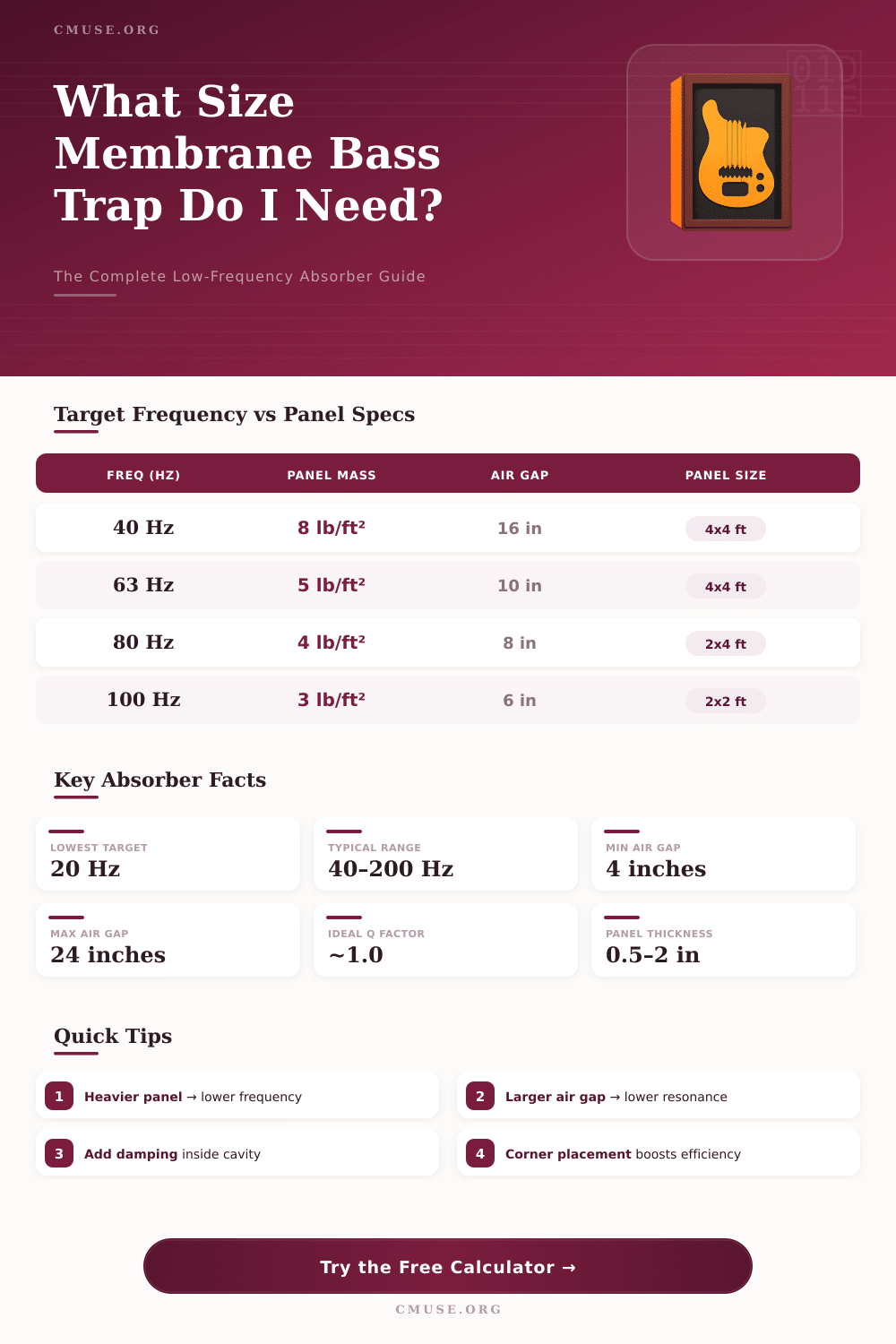
| Target Freq (Hz) | Panel Mass (lb/ft²) | Panel Mass (kg/m²) | Air Gap (in) | Air Gap (cm) |
|---|---|---|---|---|
| 30 Hz | 8.0 | 39.1 | 16 | 40.6 |
| 40 Hz | 6.0 | 29.3 | 12 | 30.5 |
| 50 Hz | 4.5 | 22.0 | 10 | 25.4 |
| 63 Hz | 3.0 | 14.6 | 8 | 20.3 |
| 80 Hz | 2.0 | 9.8 | 6 | 15.2 |
| 100 Hz | 1.5 | 7.3 | 5 | 12.7 |
| 125 Hz | 1.0 | 4.9 | 4 | 10.2 |
| 160 Hz | 0.7 | 3.4 | 3 | 7.6 |
| 200 Hz | 0.5 | 2.4 | 2 | 5.1 |
| Damping Level | Fill Material | Bandwidth (octaves) | Peak Absorption | Notes |
|---|---|---|---|---|
| None (Air) | Empty cavity | Narrow (<0.5 oct) | Very high at Fo | Sharp resonance, fragile |
| Light | 1 in rockwool | ~1 octave | High | Best balance |
| Medium | 2 in rockwool | ~1.5 octaves | Moderate-High | Broader coverage |
| Heavy (Full) | Full cavity | ~2 octaves | Moderate | Widest, lowest peak |
| Panel Size (imperial) | Panel Size (metric) | Area (sq ft) | Area (m²) | Panels for 10% Coverage |
|---|---|---|---|---|
| 2 x 2 ft | 61 x 61 cm | 4.0 | 0.37 | ~6 panels |
| 2 x 4 ft | 61 x 122 cm | 8.0 | 0.74 | ~3 panels |
| 4 x 4 ft | 122 x 122 cm | 16.0 | 1.49 | ~2 panels |
| 4 x 8 ft | 122 x 244 cm | 32.0 | 2.97 | ~1 panel |
| Custom | Variable | — | — | Use calculator |
When one talks about room sound, the size of bass trap really matters, as well sound spreads. Here the simple fact: bigger usually is better. If you have space for that, without pushing the room smaller that is the best solution.
There is an easy way to count how deep it really needs. Start by finding the frequency that causes problems, count its wavelength, later aim for around one-quarter of that length. For 250 Hz, the wavelength is around 5 feet, so a bass trap for that frequency works well at a thickness of 16 inches.
How Big Should Bass Traps Be
If you want to go lower and address 40 Hz by means of a Membrane Bass Trap, you need around 20 to 24 inches of depth.
Most builders choose 24-inch beams, and there is a practical reason for that. Rigid fiberglass panels come in 2-foot beams, which makes them easy to cut into triangles, that fit perfectly for corners. One usually sees 24-by-24-inch bits in DIY guides because of that alone reasoning.
Even so, filling every corner with 24-inch traps can take almost 40 percent of the usable wall space (think about that before). If your room alolws, using 34-inch bits gives good results. From my experience, around 32 inches (or 60 centimetres) are ideal for filled corner traps, without too much waste of space.
The depth has big importance hear. The smallest depth for setups is between 15 and 20 centimetres, and placing the trap 15 to 20 centimetres in front of the wall makes a clear difference. Because rock wool absorbs sound based on wave movement, and those moves cancel at the wall surface, one must leave space for better results.
Really, in most rooms there is no such thing as too thick a bass trap. Six inches give good results. Four-inch panels also work, if one mounts them across a corner.
If your material is only 2 inches thick, doubling it to at least 4 inches helps. But past 6 inches? Here you start to waste material.
Commercial corner traps usually have sizes like 24 by 48 by 13 inches, weighing around 40 pounds each. They are made from materials like Roxul Rockboard 60 and Roxul AFB, with internal wooden frame for structural strength. For bedroom or big studio setups, a good plan is to place four bass traps, tall 6 feet and deep 1 foot, with small space behind them.
What really matters is how big the trap is compared to the wave itself, the bigger the ratio, the more efficient the absorption. Depth and covering area should be your main goals for bass treatment. Soffit traps work best, if one fills them fully in the corner.
In the end, successful basstrapping depends on a mix of surface coverage and good thickness.