🔊 Helmholtz Resonator Bass Trap Calculator
Design precision bass traps by calculating resonant frequency, cavity volume, and neck dimensions for any target frequency
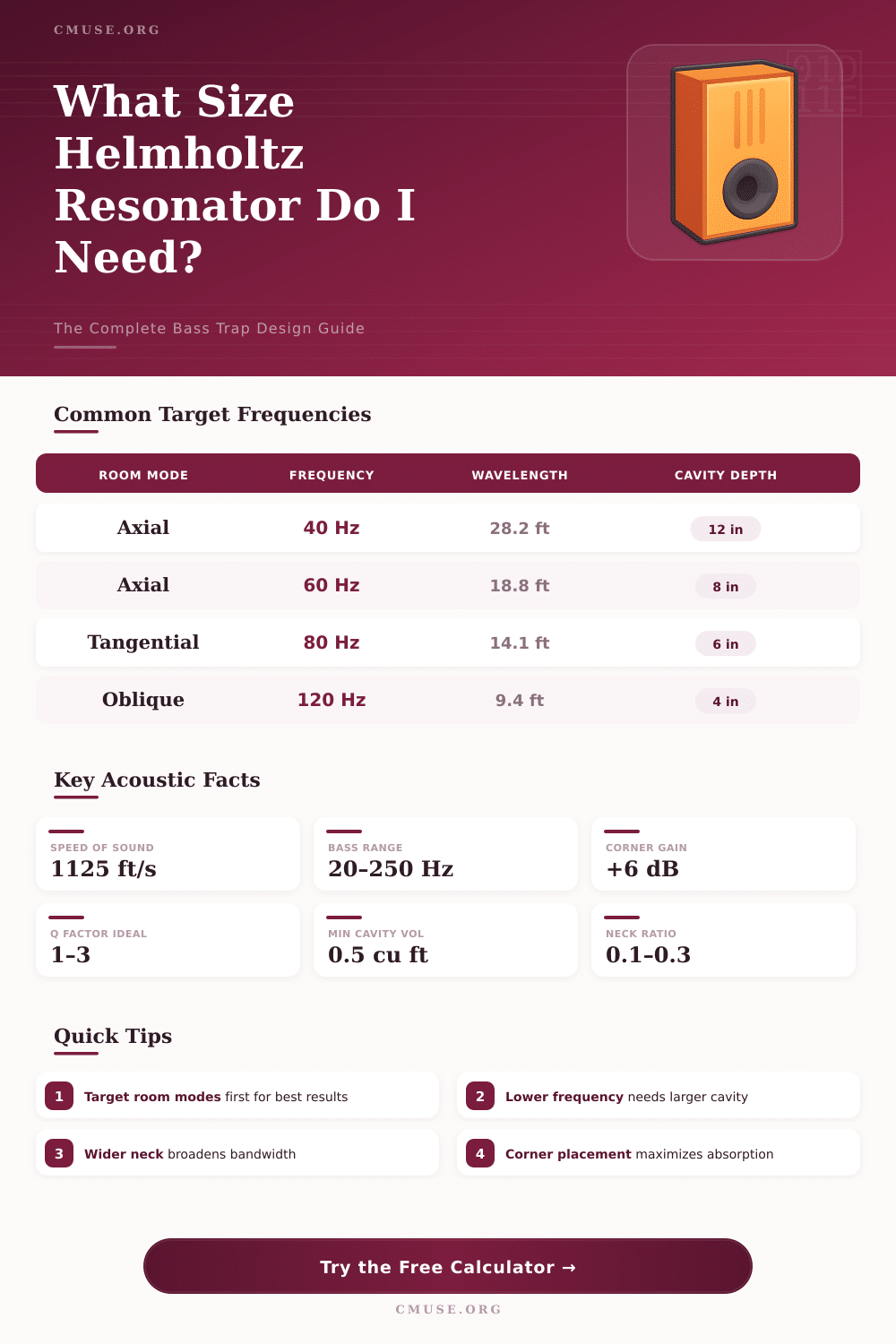
| Cavity Vol (cu in) | Neck Dia (in) | Neck Len (in) | Resonant Freq | Wavelength (ft) |
|---|---|---|---|---|
| 1,728 | 2.0 | 2.0 | ~40 Hz | 28.2 |
| 2,304 | 2.5 | 2.0 | ~50 Hz | 22.5 |
| 3,072 | 3.0 | 2.0 | ~60 Hz | 18.8 |
| 4,096 | 3.5 | 2.0 | ~70 Hz | 16.1 |
| 2,048 | 3.0 | 1.5 | ~80 Hz | 14.1 |
| 1,536 | 3.0 | 1.5 | ~100 Hz | 11.3 |
| 1,024 | 2.5 | 1.0 | ~120 Hz | 9.4 |
| 768 | 2.0 | 1.0 | ~150 Hz | 7.5 |
| Room Dimension | Mode Type | Frequency (Hz) | Cavity Depth Needed | Priority |
|---|---|---|---|---|
| 8 ft (2.44 m) | Axial | 70 Hz | 8–10 in | High |
| 10 ft (3.05 m) | Axial | 56 Hz | 10–12 in | High |
| 12 ft (3.66 m) | Axial | 47 Hz | 12–14 in | High |
| 14 ft (4.27 m) | Axial | 40 Hz | 14–16 in | High |
| 16 ft (4.88 m) | Axial | 35 Hz | 16–18 in | Medium |
| 20 ft (6.10 m) | Axial | 28 Hz | 18–24 in | Medium |
| Various | Tangential | 50–100 Hz | 8–12 in | Medium |
| Various | Oblique | 80–200 Hz | 4–8 in | Lower |
| Q Factor | Bandwidth at 60 Hz | Bandwidth at 80 Hz | Bandwidth at 100 Hz | Damping Level |
|---|---|---|---|---|
| 5.0 | 12 Hz | 16 Hz | 20 Hz | Very light (empty cavity) |
| 3.0 | 20 Hz | 27 Hz | 33 Hz | Light (foam) |
| 2.0 | 30 Hz | 40 Hz | 50 Hz | Moderate (fiberglass) |
| 1.5 | 40 Hz | 53 Hz | 67 Hz | Medium-heavy |
| 1.0 | 60 Hz | 80 Hz | 100 Hz | Heavy (rockwool full) |
Deep traps are made up of special acoustic absorbers that one lays in rooms to reduce peaks, nulls and resonance in frequencies under around 300 Hz. They catch sound, when one sets them on walls or ceilings, instead of allowing it to bounce back in the space. For music the main deep frequency range goes from around 60 to 300 Hz, because here lies the area where basses must do their task.
Waves of low frequencies have very big length. For instance, a sound wave at 30 Hz reaches 11 metres, so it can easily go across walls. Real bass traps work already from around 50 Hz.
What Bass Traps Are and How to Use Them
Compared to higher tones, that one absorbs fairly simply by means of usual acoustic panels the low frequencies carry much more energy and their wavelengths are much bigger. Because of that they are much harder to fix.
When sound waves reach a bass trap, the internal material turns the sound energy into heat by means of friction and air flow. Like this the sound drops. Bass traps form more thick and dense versions of average acoustic panels, designed to absorb deep frequencies down to 40 Hz below.
Usual panels mainly care about high and middle tones, like voices or drums.
Two main kinds of bass traps exist: those based on speed and those based on pressure. Set traps, resonators, panel absorbers and porous absorbers all belong to one of those two classes. Porous absorbers commonly bear board or paper in front, to reflect frequencies over 500 Hz.
That front surface also helps to absorb deep bass, because it turns the air movement at the outside into fiber compression inwardly.
Very thick corner bass traps manage to give absorption down to around 60 Hz, or maybe a bit more below. Even so no bass trap works well with extremely low tones. Getting full absorption down too around 250 Hz happens fairly simply, but the task gets much harder, when the frequencies sink.
If one uses 4 inches of mineral wool and creates a corner, one reaches down under 200 Hz. For foam at least 4 inches of mineral wool insulation is needed, that only reaches the upper bass around 120 Hz. For deeper tones one needs thicker traps with more insulation.
The deepest frequencies gather in the room corners. Setting bass traps here, where basses build up, stops waves bouncing away and creating problems elsewhere. Corner placing also changes the listening spot.
Half-round diffuser shapes spread sound for middle to upper frequencies, while it works as a bass trap under 500 Hz. Flexible panel absorbers and Helmholtz Resonator Bass Trap units help well against specific troubles, but they are harder to build andrequire more knowledge for proper placing.