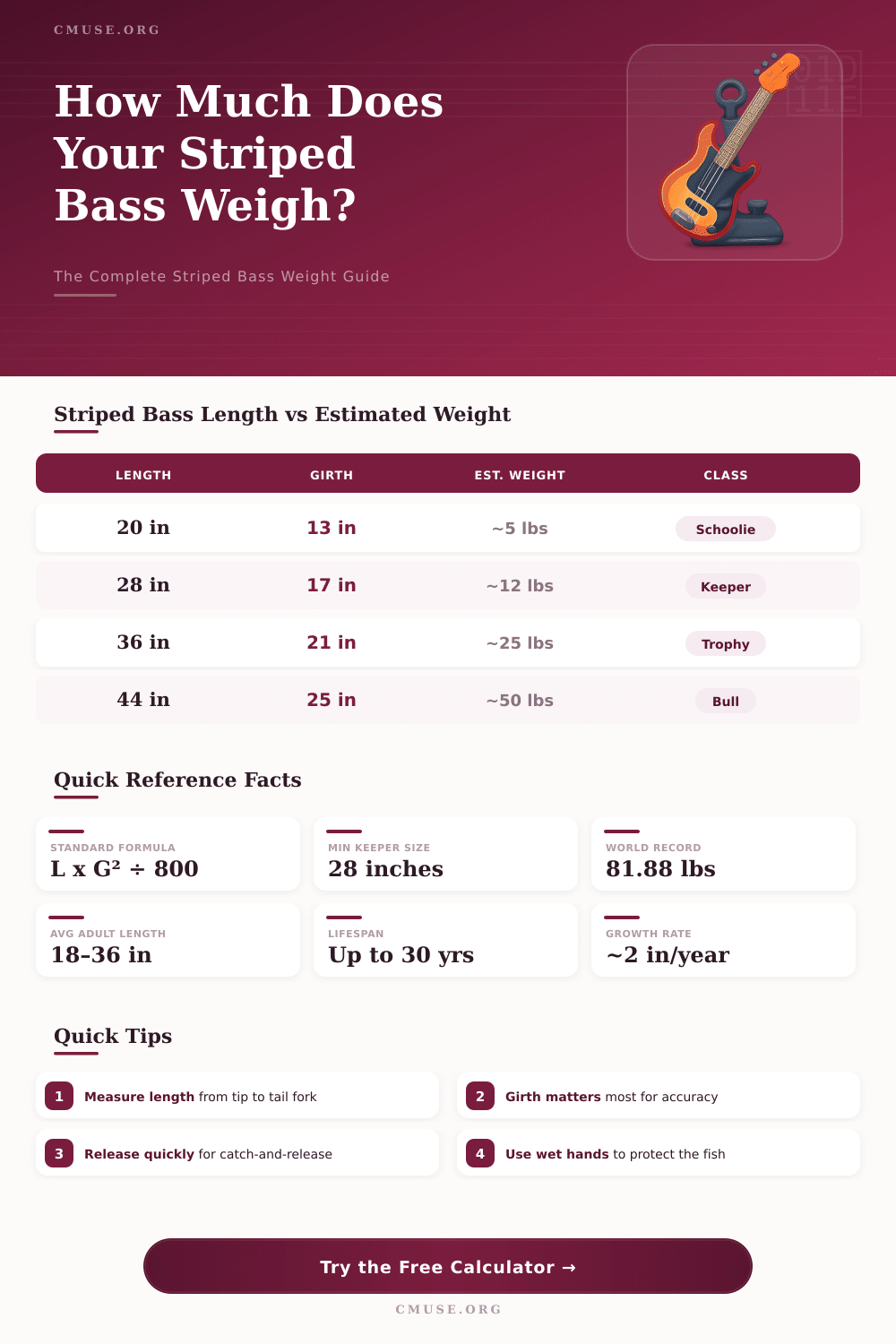
🐟 Striped Bass Weight Calculator
Estimate striped bass weight from length & girth measurements using the standard angler formula
| Length (in) | Typical Girth (in) | Est. Weight (lbs) | Classification |
|---|---|---|---|
| 16 | 11 | ~2.4 | Juvenile |
| 18 | 12 | ~3.2 | Juvenile |
| 20 | 13 | ~4.2 | Schoolie |
| 22 | 14 | ~5.4 | Schoolie |
| 24 | 15 | ~6.8 | Sub-keeper |
| 26 | 16 | ~8.3 | Near Keeper |
| 28 | 17 | ~10.1 | Legal Keeper |
| 30 | 18 | ~12.2 | Keeper |
| 32 | 19 | ~14.5 | Nice Fish |
| 34 | 20 | ~17.0 | Nice Fish |
| 36 | 21 | ~19.8 | Trophy Class |
| 38 | 22 | ~22.9 | Trophy Class |
| 40 | 23 | ~26.5 | Trophy Bull |
| 42 | 24 | ~30.2 | Trophy Bull |
| 44 | 25 | ~34.4 | Bull Bass |
| 46 | 26 | ~38.8 | Bull Bass |
| 48 | 27 | ~43.7 | Monster |
| 50 | 28 | ~49.0 | World Class |
| Total Length | Typical Girth | Girth Ratio | Weight Range (lbs) |
|---|---|---|---|
| 20 in (51 cm) | 13 in (33 cm) | 0.65 | 3.8 – 4.6 |
| 24 in (61 cm) | 15 in (38 cm) | 0.63 | 6.1 – 7.5 |
| 28 in (71 cm) | 17 in (43 cm) | 0.61 | 9.3 – 11.2 |
| 32 in (81 cm) | 19 in (48 cm) | 0.59 | 13.1 – 15.8 |
| 36 in (91 cm) | 21 in (53 cm) | 0.58 | 18.2 – 21.4 |
| 40 in (102 cm) | 23 in (58 cm) | 0.58 | 24.9 – 28.1 |
| 44 in (112 cm) | 25 in (64 cm) | 0.57 | 31.9 – 36.9 |
| 48 in (122 cm) | 27 in (69 cm) | 0.56 | 40.5 – 47.0 |
| Age (years) | Avg Length | Avg Weight | Notes |
|---|---|---|---|
| 1 | 6–8 in | 0.1–0.3 lbs | Fingerling stage |
| 2 | 10–14 in | 0.5–1 lbs | Juvenile |
| 3 | 14–18 in | 1.5–2.5 lbs | Schoolie |
| 4 | 18–22 in | 2.5–4 lbs | Schoolie |
| 5 | 22–26 in | 4–7 lbs | Sub-adult |
| 7 | 26–30 in | 7–12 lbs | Adult |
| 10 | 32–36 in | 14–22 lbs | Adult |
| 15+ | 38–44 in | 25–50 lbs | Trophy / Bull |
Figuring out the striped bass weight can be hard, although there are some handy ways to get a good guess. One way is to estimate the length and the girth of the fish in inches. Girth means the distance around the body at the thickest place.
For bass one often uses this rule: square the length, then multiply it by the girth and divide the result by 1 200. This way you get the weight in pounds. These are only guesses that count for average fish, of course.
How to Estimate Bass Weight
Another way is to use easy charts to convert length to weight. Such charts show typical masses just based on the length of the fish. Usually one measures the total length, from the tip of the mouth to the end of the tail.
Some charts use the fork length, which will change the calculation. Also online you find tools, where you enter the length and girth and the weight gets figured out on its own.
You can also figure out the relative weight. For that, you divide the real mass of the bass by the standard mass and multiply the result by 100. For instance, a 20.5-inch bass that weighed 4.2 pounds after capture can be compared with the standard mass for that size.
A typical healthy 22-inch bass has weight around 6.21 pounds. The season matters for the mass. Fat female bass before spawning weigh more then usually, so to the rating you can add a bit of extra pounds.
What makes one bass more heavy than another at the same length? Food and the body shape of the fish both affect that. An 18-inch bass sometimes almost matches up to many bigger-looking fish, which often confuses people.
For instance, a fat 20-inch bass maybe reaches around 7 pounds, if that is not a bit too hopeful a guess.
The world record for the biggest certified largemouth bass weighs 22.25 pounds. George Perry caught it in Montgomery Lake near Valdosta, Georgia, in 1932. In the early 1800s people mentioned bass heavier than that record, including one that supposedly ended at 28 pounds.
For most anglers, a lunker is every largemouth that hits 5 or 6 pounds innorth regions.
Guessing weight from a photo never turns out truly exact. The fish seems to grow with every story. Best is to bring a scale, although many experts among anglers rarely care about that.
When a scale is missing, a formula or chart stays the best option.