🔊 Bass Cabinet Calculator
Calculate enclosure volume, port dimensions & tuning frequency for your bass speaker cabinet
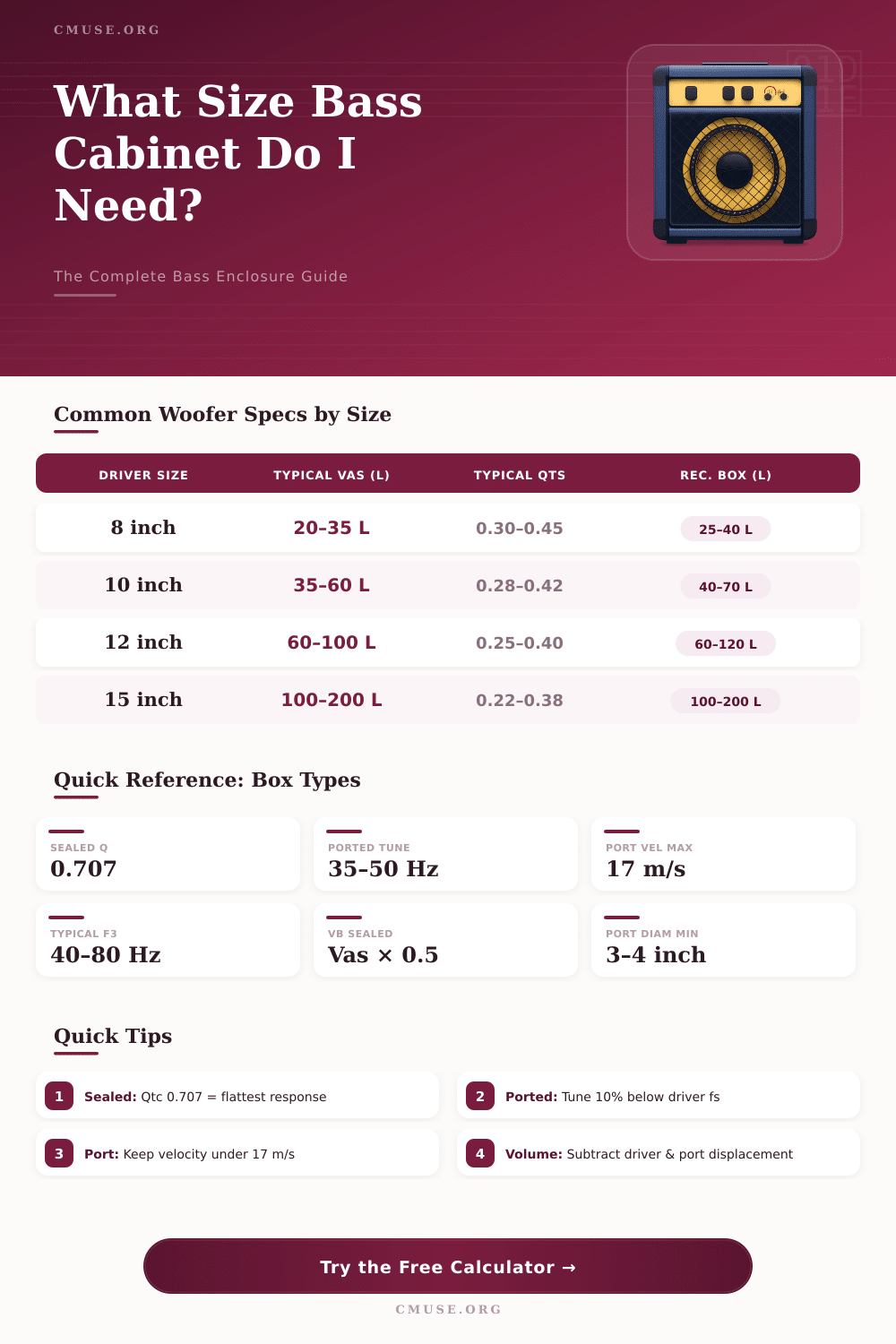
| Driver Size | Typical Vas (L) | Typical fs (Hz) | Rec. Sealed Vb (L) | Rec. Ported Vb (L) | Sd (cm²) |
|---|---|---|---|---|---|
| 6 inch (15 cm) | 10–20 | 55–90 | 8–14 | 12–20 | 125 |
| 8 inch (20 cm) | 20–40 | 40–70 | 15–25 | 25–45 | 214 |
| 10 inch (25 cm) | 35–65 | 30–55 | 25–45 | 40–80 | 346 |
| 12 inch (30 cm) | 60–110 | 25–45 | 40–80 | 60–130 | 507 |
| 15 inch (38 cm) | 100–200 | 20–40 | 70–140 | 100–200 | 855 |
| 18 inch (46 cm) | 180–350 | 18–35 | 130–250 | 180–350 | 1104 |
| Box Volume | Tuning 25 Hz | Tuning 30 Hz | Tuning 35 Hz | Tuning 40 Hz | Tuning 50 Hz |
|---|---|---|---|---|---|
| 20 L (0.71 cu ft) | — | — | 26.2 cm | 14.5 cm | 5.8 cm |
| 40 L (1.41 cu ft) | — | 32.0 cm | 17.4 cm | 8.0 cm | 1.8 cm |
| 60 L (2.12 cu ft) | — | 19.0 cm | 11.2 cm | 4.6 cm | — |
| 80 L (2.83 cu ft) | 30.5 cm | 13.8 cm | 6.8 cm | 2.0 cm | — |
| 120 L (4.24 cu ft) | 17.2 cm | 6.2 cm | 2.0 cm | — | — |
| 200 L (7.06 cu ft) | 5.0 cm | — | — | — | — |
| Qts Range | Best Alignment | Vb Multiplier (× Vas) | Expected Qtc / fb | Typical F3 Offset |
|---|---|---|---|---|
| 0.15–0.25 | Large ported | 0.5–1.0× | fb ≈ 0.8×fs | +5 to +10 Hz below fs |
| 0.25–0.35 | Ported (SBB4) | 0.4–0.6× | fb ≈ 0.9×fs | Near driver fs |
| 0.35–0.40 | Ported (QB3) | 0.3–0.5× | fb ≈ fs | 1–3 Hz above fs |
| 0.40–0.50 | Sealed (Qtc 0.707) | 0.4–0.7× | Qtc = 0.707 | +3 dB bump region |
| 0.50–0.70 | Sealed / small ported | 0.3–0.5× | Qtc = 0.65–0.9 | Moderate bump |
| > 0.70 | Free air / infinite baffle | N/A | Use as-is | High Qt = peaky |
| Material | Thickness | Density (kg/m³) | Resonance | Best Use |
|---|---|---|---|---|
| MDF (Medium Density Fiberboard) | 18–25 mm | 700–800 | Very low | Studio subs, HiFi |
| Birch Plywood (Baltic) | 15–18 mm | 600–700 | Low | Live sound, guitar cabs |
| Particle Board | 18–22 mm | 600–700 | Moderate | Budget cabinets |
| Oak Plywood | 18 mm | 650–750 | Low | Audiophile builds |
| Poplar Plywood | 15–18 mm | 450–550 | Low–Moderate | Lightweight builds |
| Void-Free Hardwood Ply | 18–24 mm | 600–720 | Low | Premium bass cabs |
Your bass cabinet, it is the talking box that pushes the tone of your amplifier out in the world. The amplifier will shape what you play, naturally, but the bass cabinet truly carries the sound to your ears. Choose the right model truly changes everything.
Bass cabinets come in very different setups. One finds everything from a simple 1×12 to a huge 8×10 size. Some have horns built in, others do not.
How to Choose a Bass Cabinet
The ability to handle power varies a lot, there are bass cabinets that well pass 800 watts. Options for impedance cover the whole range: 4, 8 and 16 ohms all available. Truly, here is something for almost every bass player.
The Hartke VXa Series VX115 sits well in the category of cheaper purchases. It is made up of one 15-inch paper cone speaker, that can receive 300 watts at 8 ohms, and the price sits between 200 and 500 dollars. Go up the pirce ladder, and prices grow quickly.
The MegaBoss 410 has an official price of 1.499,99 dollars, but indeed one finds it for 999,99 dollars. About 8×10? It usually costs around 1.700 dollars.
Your budget decides what ultimately will have place in your studio or on the stage.
Solid Municipal bass cabinets use birch plywood, strong material, that lasts the stress of constant travel. They are made with aluminum frame speakers and added compression horn with switch. What is the prize?
You receive precise, clear sound with strong, punchy bottoms and clear high tones, that cut threw everything.
Quilter works differently with his modular system for speakers. These models carry dual compression driver, tough neodymium speakers and strong wooden core. What surprises is that although they weigh little, they give volume, that rivals of double weight do not reach.
Their Venture Series, the VB-112, VB-210, VB-212 and VB-410… All come equipped with neodymium bass speakers and high frequency drivers, that gives basses a lot of freedom for any occasion.
The Reeves 4×10 are assembled right here in United States. It uses sealed box design, that ensures intense and precise bass output. One note here: open bass cabinets give more volume, but the bass can become a bit loose, while closed designs lose some sound, but deliver bass that is truly strong and controlled.
To reproduce low frequencies one requires something different than bass speakers. They must move more deeply and push more air, what requires from the bass cabinet big internal space and either closed or open shape. The industry moves away from 15-inch speakers to 12-inch models currently, even though 10-inch yet shows everywhere.
Also, modern bass cabinets surprisingly are light.
Building a bass cabinet from nothing is not easy, it requires time. Brands like Barefaced, Ampeg, AudioKinesis and MAS address that seriously and reach top standards. Barefaced bass cabinets beat the Ampeg 810 by a good difference.
If you search for used gear, Ampeg and GK models appear commonly and do not cost a lot (from 99 to 200 dollars usually). One final tip: connecting a guitar cabinet to a bass amplifier is dangerous for the speakers, although passing bass sound through a guitar amplifier today will not destroy new speakers, it only warpsthe bottoms quite strongly.