🔊 Bass Blocker Capacitor Calculator
Find the exact capacitor value to protect tweeters & mid-range speakers from low-frequency damage
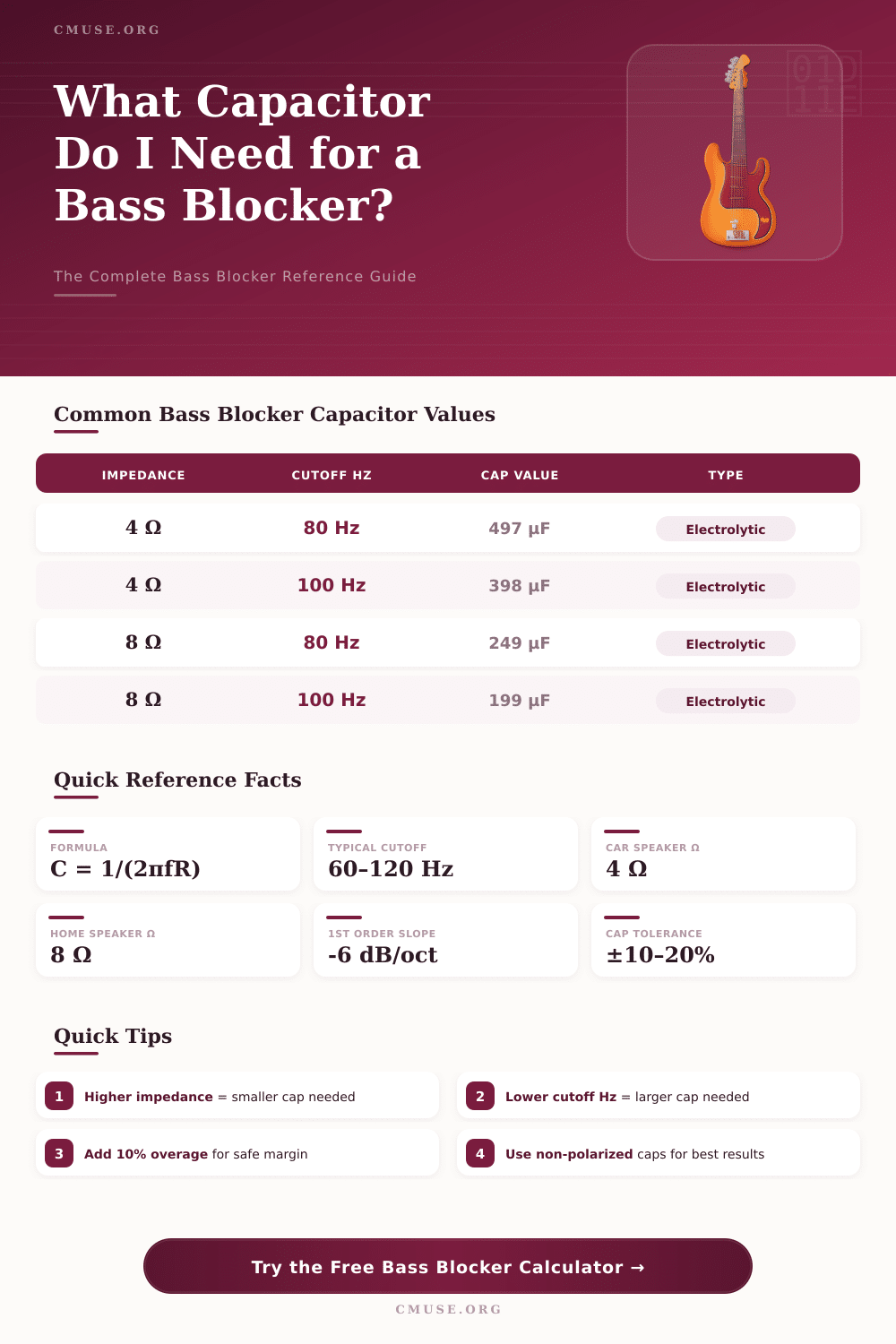
| Cutoff Freq | 2 Ω Speaker | 4 Ω Speaker | 8 Ω Speaker | 16 Ω Speaker |
|---|---|---|---|---|
| 50 Hz | 1592 µF | 796 µF | 398 µF | 199 µF |
| 60 Hz | 1326 µF | 663 µF | 332 µF | 166 µF |
| 80 Hz | 995 µF | 497 µF | 249 µF | 124 µF |
| 100 Hz | 796 µF | 398 µF | 199 µF | 100 µF |
| 120 Hz | 663 µF | 332 µF | 166 µF | 83 µF |
| 150 Hz | 530 µF | 265 µF | 133 µF | 66 µF |
| 200 Hz | 398 µF | 199 µF | 100 µF | 50 µF |
| Filter Order | Slope | Components | Attenuation at fc | Best For |
|---|---|---|---|---|
| 1st Order | -6 dB/octave | Capacitor only | -3 dB | Tweeters (gentle rolloff) |
| 2nd Order | -12 dB/octave | Cap + Inductor | -3 dB | Mid-range protection |
| 3rd Order | -18 dB/octave | Cap + L + Cap | -3 dB | Sensitive tweeters |
| 4th Order | -24 dB/octave | 2 caps + 2 inductors | -3 dB | Crossover networks |
| Speaker Type | Typical Range | Recommended Cutoff | Cap Value (4Ω) | Notes |
|---|---|---|---|---|
| Car Tweeter | 3,000–20,000 Hz | 80–100 Hz | 398–497 µF | Standard bass blocker |
| Home Tweeter | 2,000–20,000 Hz | 80–120 Hz | 332–497 µF (8Ω) | Protect silk dome |
| Mid-Range | 300–5,000 Hz | 60–80 Hz | 497–663 µF | Low-pass on woofer side |
| Full-Range | 80–20,000 Hz | 50–60 Hz | 663–796 µF | Sub-bass removal only |
| Coaxial | 60–20,000 Hz | 80–100 Hz | 398–497 µF | Most common car install |
| PA Tweeter | 1,500–20,000 Hz | 100–150 Hz | 66–100 µF (16Ω) | Larger cap = more protection |
| Capacitor Type | Typical Range | Tolerance | Polarity | Audio Quality |
|---|---|---|---|---|
| Electrolytic | 1 µF – 10,000 µF | ±20% | Polarized | Good (budget builds) |
| Bipolar Electrolytic | 1 µF – 4,700 µF | ±20% | Non-polarized | Better for audio |
| Polypropylene (PP) | 0.1 µF – 100 µF | ±5% | Non-polarized | Excellent |
| Polyester (PET) | 0.001 µF – 10 µF | ±10% | Non-polarized | Very Good |
| Ceramic | 1 pF – 100 µF | ±5–20% | Non-polarized | Not recommended |
Deep bass blocker is an electrical device that operates as a high-pass filter. It blocks low base frequency signals from flowing through it. Such bass blockers use capacitors to block or weaken low frequencies under a set limit, usually around 200 to 300 Hz.
Because of that they lead only the right mid-range and high-frequency content to smaller speakers.
How a Bass Blocker Works and Protects Speakers
One capacitor bass blocker delivers only 6 dB drop per octave. That forms quite a gentle drop, so that one hardly can say that it truly blocks exactly at one clear frequency. For instance, a capacitor of 350 μF starts blocking around 120 Hz and cuts a 60 Hz tone in almost half.
Frequencies under the limit sound quietly, but only druing low volume.
A 150 Hz frequency works as a good standard value for such bass blockers. When the amplifier or the main unit does not have built-in crossovers, a bass blocker designed for 150 Hz at 4 ohms will serve 6.5-inch speakers well. Most 6.5-inch speakers match well with a first-order bass blocker, set between 80 Hz and 120 Hz.
A great 6.5-inch device for bass probably works better around 80 to 120 Hz, while using a 300 Hz bass blocker could cause loss of many basses.
To build a bass blocker, one must find the impedance of the speaker, witch is built in. The impedance usually sits on the label below the speaker, beside the magnet, and one measures it in ohms. When one connects two capacitors in parallel, that doubles the capacity, which then cuts the crossover frequency by half at a given impedance.
Bass blockers with a 150 Hz limit do not work to protect treble speakers safely. Everything above 150 Hz passes freely through them, and such frequencies can damage most treble speakers. Many of them need blocking at 3000 to 4000 Hz with a drop of 12 dB or more each octave.
Too low a crossover frequency, like 2800 Hz with only 6 dB drop, causes the tweeter to suffer from too much power.
Rather than a simple capacitor with 6 dB drop, one can choose bass blockers that reach 12 dB drop. One can choose a slightly lower frequency, so that the speakers still handle male voices well, but no deep basses. Some of them come in 80 Hz or 100 Hz.
A 300 Hz high-pass filter at 12 dB forms a cheap way to protect front anddoor speakers in a car setup. Such bass blockers have limits in use, because they are passive, yet they create a clear difference in a simple system.