🎸 Bass Fret Calculator
Calculate precise fret positions for any bass scale length — 4, 5, or 6-string builds
| Fret # | Distance from Nut | Distance from Bridge | Fret Spacing | Note (E string) |
|---|
| Bass Model / Type | Scale Length (in) | Scale Length (cm) | Typical Frets | Strings |
|---|---|---|---|---|
| Fender Precision / Jazz Bass | 34" | 86.36 cm | 20 | 4 |
| Gibson EB Series | 30.5" | 77.47 cm | 20 | 4 |
| Hofner Violin Bass | 30" | 76.20 cm | 22 | 4 |
| Music Man StingRay | 34" | 86.36 cm | 22 | 4 / 5 |
| Rickenbacker 4003 | 33.25" | 84.46 cm | 24 | 4 |
| Ibanez SR 5-String | 34" | 86.36 cm | 24 | 5 |
| Warwick Thumb 5-String | 34" | 86.36 cm | 26 | 5 |
| Dingwall Combustion | 37" – 34" | 93.98 – 86.36 | 24 | 5 |
| Piccolo Bass | 28.6" | 72.64 cm | 22 | 4 |
| Custom Extended Scale | 36" | 91.44 cm | 24 | 5 / 6 |
| Fret | E String | A String | D String | G String |
|---|---|---|---|---|
| Open | E1 | A1 | D2 | G2 |
| 1 | F1 | A♯/B♭1 | D♯/E♭2 | G♯/A♭2 |
| 2 | F♯/G♭1 | B1 | E2 | A2 |
| 3 | G1 | C2 | F2 | A♯/B♭2 |
| 4 | G♯/A♭1 | C♯/D♭2 | F♯/G♭2 | B2 |
| 5 | A1 | D2 | G2 | C3 |
| 7 | B1 | E2 | A2 | D3 |
| 9 | C♯2 | F♯2 | B2 | E3 |
| 12 | E2 | A2 | D3 | G3 |
| 17 | A2 | D3 | G3 | C4 |
| 19 | B2 | E3 | A3 | D4 |
| 24 | E3 | A3 | D4 | G4 |
| Scale Length | Fret 1 Spacing | Fret 5 Spacing | Fret 7 Spacing | Fret 12 Position |
|---|---|---|---|---|
| 30" (76.2 cm) | 1.684" | 1.264" | 1.063" | 15.000" |
| 32" (81.3 cm) | 1.796" | 1.348" | 1.134" | 16.000" |
| 34" (86.4 cm) | 1.908" | 1.432" | 1.205" | 17.000" |
| 35" (88.9 cm) | 1.964" | 1.474" | 1.240" | 17.500" |
| 36" (91.4 cm) | 2.020" | 1.517" | 1.276" | 18.000" |
The spacing of Bass Fret on bass is one of those themes that depends on physics. For any particular scale length, the distances between the Bass Fret stay always same, because physics requires equal intervals for the note height. A formula that uses the 12th root of two decides the Bass Fret arrangement and does everything possible.
When two basses own the same scale lengths, they must have identical Bass Fret spacing. If that does not happen then one of them will not sound in tune.
How Bass Fret Spacing Works
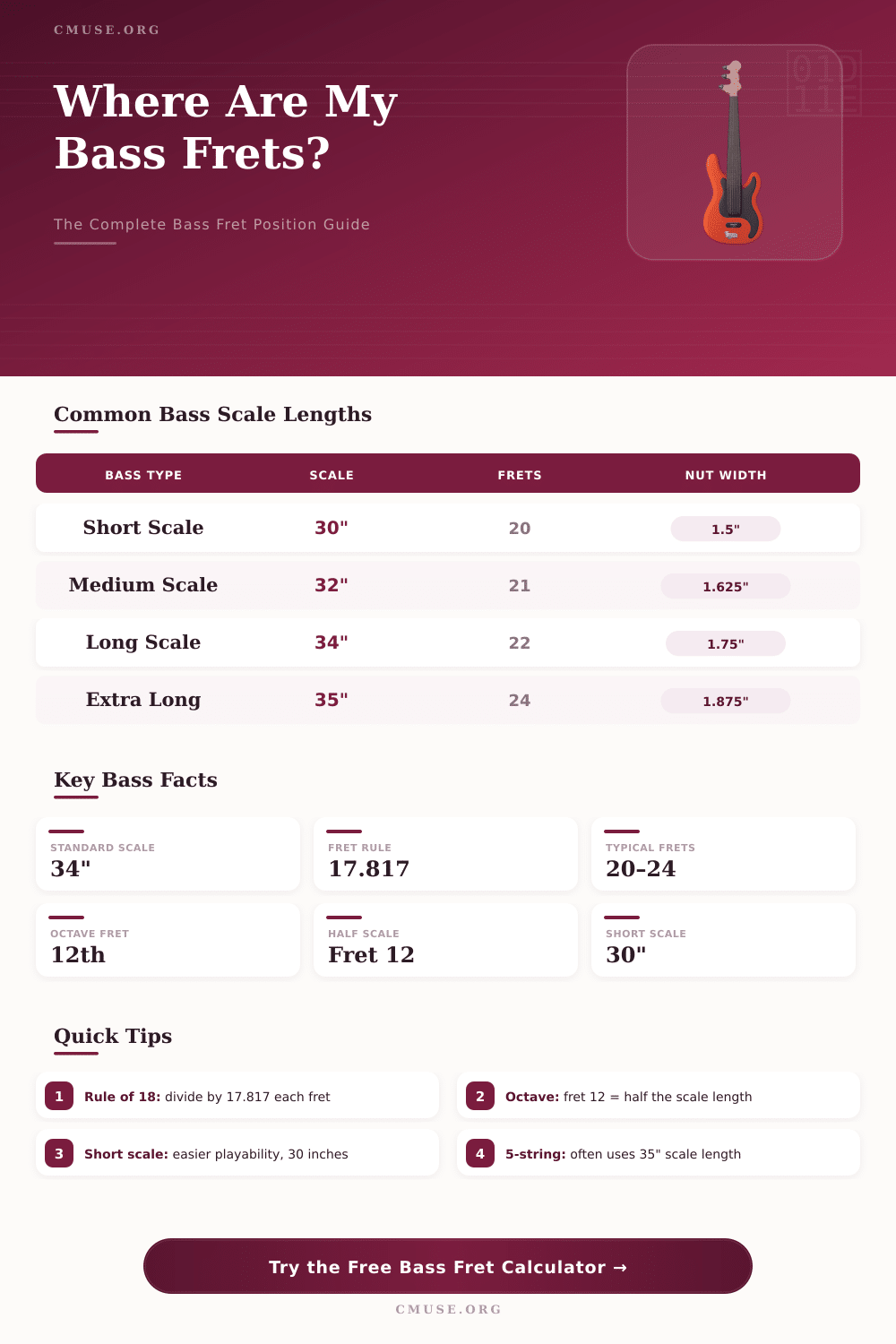
Normal scale length for bass is 34 inches. Basses with short scales start at 30 inches, and widely the lengths of scales for basses move between 30 and 36 inches. Bass with short scale will have Bass Fret that stand a bit more near.
The commonly used Fender long scale measures 86.36 cm, while the Fender short scale is 76.2 cm.
Here is something that commonly confuses people. Bass with 34-inch scale can be available with 20, 22 or 24 Bass Fret, without the real scale length changing. Extra Bass Fret simply extend upward, what extends the fretboard.
The distance between the bridge and the nut stays unchanged. The scale length does not depend on the amount of Bass Fret. Bass can happen with as few as 15 Bass Fret.
The only disadvantage of fewer Bass Fret is the absence of access too those high notes, if one requires them.
The factor for Bass Fret spacing that one uses in modern instruments is 17.817154. The Bass Fret arrange themselves in almost-logarithmic scale, what allows to play the instrument in every tone. On bass with 34-inch scale, the size of the first space between nut and first Bass Fret is 1.908 inches, while the space between the 11th and 12th Bass Fret is 1.011 inches.
For bass with 35-inch scale, those values reach 1.965 and 1.041 inches. So the extra space at the bottom is less than a tenth of an inch.
While one moves from the 12th Bass Fret to the nut, the spacing gorws about 1.06 times for every step. That shows that the distance between nut and first Bass Fret is almost half of that at the 12th Bass Fret. On 30-inch scale, the first Bass Fret sits 1.684 inches from the nut.
On 34-inch scale, that same distance rises to 1.908 inches, which is less than a quarter inch bigger. So one will find some getting-used-to troubles between the two.
Bass Fret spacing can be a challenge for musicians with little hands on full bulky bass. Having 24 Bass Fret on bass does not alter the arrangement of frets like it does on guitar, because the frets of basses sit differently. Practice really helps.
Over time, the players adjust to thefretboard by means of feeling and not even need to look at it.