🔊 Bass Reflex Port Calculator
Calculate port length, diameter & tuning frequency for your vented speaker enclosure
⚡ Quick Presets
🔧 Port Parameters
✅ Port Calculation Results
📐 Port End Correction Reference
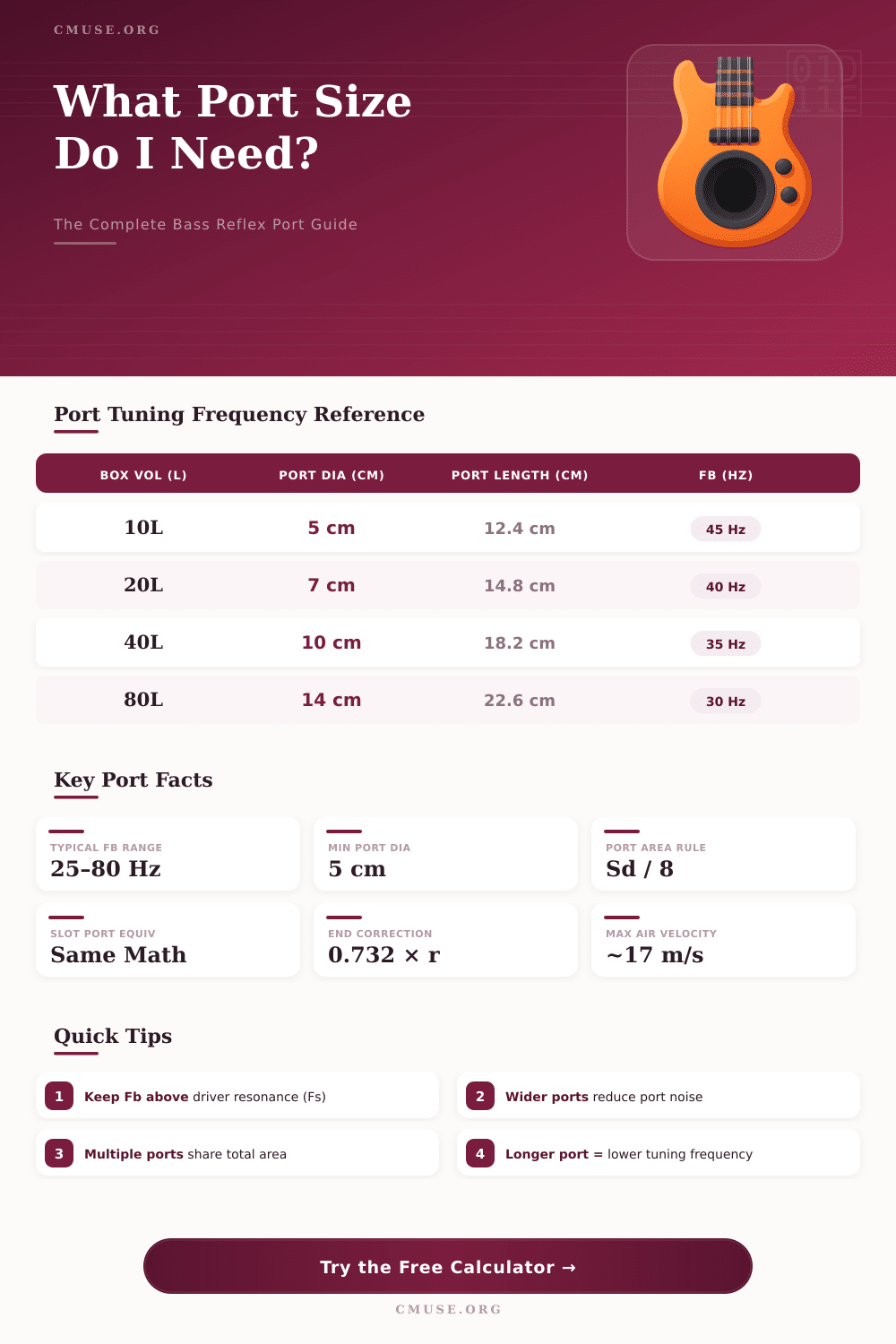
📋 Tuning Frequency vs. Box Volume Reference
| Box Volume | Liters | Suggested Fb (Hz) | Typical Application | Port Dia Recommendation |
|---|---|---|---|---|
| 0.3 ft³ | 8.5 L | 55–80 Hz | Bookshelf / PC Speaker | 1.5" – 2" (4–5 cm) |
| 0.5 ft³ | 14 L | 50–70 Hz | Compact bookshelf | 2" – 2.5" (5–6 cm) |
| 0.75 ft³ | 21 L | 45–65 Hz | Studio Monitor | 2.5" – 3" (6–7.5 cm) |
| 1.0 ft³ | 28 L | 40–55 Hz | Mid-bass / 8" driver | 3" – 3.5" (7.5–9 cm) |
| 1.5 ft³ | 42 L | 35–50 Hz | 10" Home subwoofer | 4" – 4.5" (10–11 cm) |
| 2.0 ft³ | 57 L | 30–45 Hz | 12" Home subwoofer | 4" – 5" (10–13 cm) |
| 3.0 ft³ | 85 L | 28–40 Hz | 12"–15" Car subwoofer | 5" – 6" (13–15 cm) |
| 4.0 ft³ | 113 L | 25–35 Hz | 15" PA / Home theater | 6" – 8" (15–20 cm) |
📏 Standard Round Port Sizes
| Port Dia (in) | Port Dia (cm) | Cross-section Area (in²) | Cross-section Area (cm²) | Best For Driver Size |
|---|---|---|---|---|
| 1.5" | 3.8 cm | 1.77 in² | 11.4 cm² | 3"–4" full-range |
| 2" | 5.1 cm | 3.14 in² | 20.3 cm² | 4"–5" woofer |
| 2.5" | 6.4 cm | 4.91 in² | 31.7 cm² | 5"–6" woofer |
| 3" | 7.6 cm | 7.07 in² | 45.6 cm² | 6"–8" woofer |
| 4" | 10.2 cm | 12.57 in² | 81.1 cm² | 8"–12" subwoofer |
| 5" | 12.7 cm | 19.63 in² | 126.7 cm² | 12"–15" subwoofer |
| 6" | 15.2 cm | 28.27 in² | 182.4 cm² | 15"–18" PA sub |
| 8" | 20.3 cm | 50.27 in² | 324.3 cm² | 18" high-power PA |
📊 Common Driver Specifications Reference
| Driver Size | Typical Fs (Hz) | Typical Sd (cm²) | Recommended Fb Range | Box Vol Range |
|---|---|---|---|---|
| 5" (12.7 cm) | 45–80 Hz | 80–110 cm² | 55–75 Hz | 5–12 L |
| 6.5" (16.5 cm) | 35–65 Hz | 135–165 cm² | 45–65 Hz | 10–20 L |
| 8" (20 cm) | 28–50 Hz | 210–250 cm² | 40–55 Hz | 15–35 L |
| 10" (25 cm) | 22–40 Hz | 345–400 cm² | 35–50 Hz | 25–55 L |
| 12" (30 cm) | 18–35 Hz | 490–560 cm² | 28–45 Hz | 35–100 L |
| 15" (38 cm) | 16–30 Hz | 800–900 cm² | 25–38 Hz | 60–150 L |
| 18" (46 cm) | 14–25 Hz | 1150–1300 cm² | 22–32 Hz | 100–250 L |
A Bass Reflex Port is an opening, called port or exit, cut in the box. Usually the port forms from one or several tubes, set in the front or back side of the box. Those openings commonly have circular or square cross section.
Rather than closed boxes for speakers, that almost does not allow air Bass Reflex Port setups benefit of that port for improve the output compared to similarly big sealed box.
How to Choose the Right Bass Reflex Port
Find the right size of port is really hard. The size of the port, so the area of its cross section, forms a key part, that one must set right during design of the box. When the opening too small and the box receive much power, the air, that passes through it, quickly plays.
Therefore, that can create troubles with the sound.
The diameter of the port depends mostly on the diameter of the driver and one should count it to escape noise. For any reflex build, good starting points are made up of port area equal to the useful cone area of the driver. The length of the port never pass double of its diameter.
Also matters to do everything to escape port shrinking.
In stores search the right port size can be hard. A bit of stores hardly offer tubes for ports between 7 cm and 10 cm diameter. The available options jump from 7 cm directly to 10 cm, without in-between sizes.
Big diameter requires longer port, what can cause space problems in the box. On the other hand, use 75 mm diameter instead of 80 mm do not form real trouble. It maybe already answers, because the internal diameter really matters for the speaker.
Adjustable sliding reflex ports form a handy tool. They are found in small and big stores and well help for precise setup of speaker boxes. One can adapt the bass response by means of them, and they are useful for testing during finishing of designs or changing of bass unit.
The volume of the box and the tuning frequency depends fully on the settings of the drivers. Choose those values are not this simple, as it seems, and mistakes here commonly cause lack of bass in many home-made builds. For instance, shrink the diameter of port of 3.125 inches to 3 inches, keeping the length same, move the tuning of around 34.5 Hz down to almost 33.3 Hz.
Even small changes in the size of port clearly alter the tuning.
Also one can block the port. Put a bit of light insulating material in the opening quite a lot removes the tuning of the Bass Reflex Port and the deep reach. It will not hurt the drivers or the amps.
Even so, ready-made plugs for that hardly exist, because each speaker has different shape, size and port depth, so many models wood be required.
Two-level Bass Reflex Port boxes also exist, where one port plays in other section with other tuning. The port of the driver box operate as driver for the second space. Some builds even bind very long tubes to thespeakers, what basically creates huge Bass Reflex Port impact.