🎸 Guitar Neck Shim Calculator
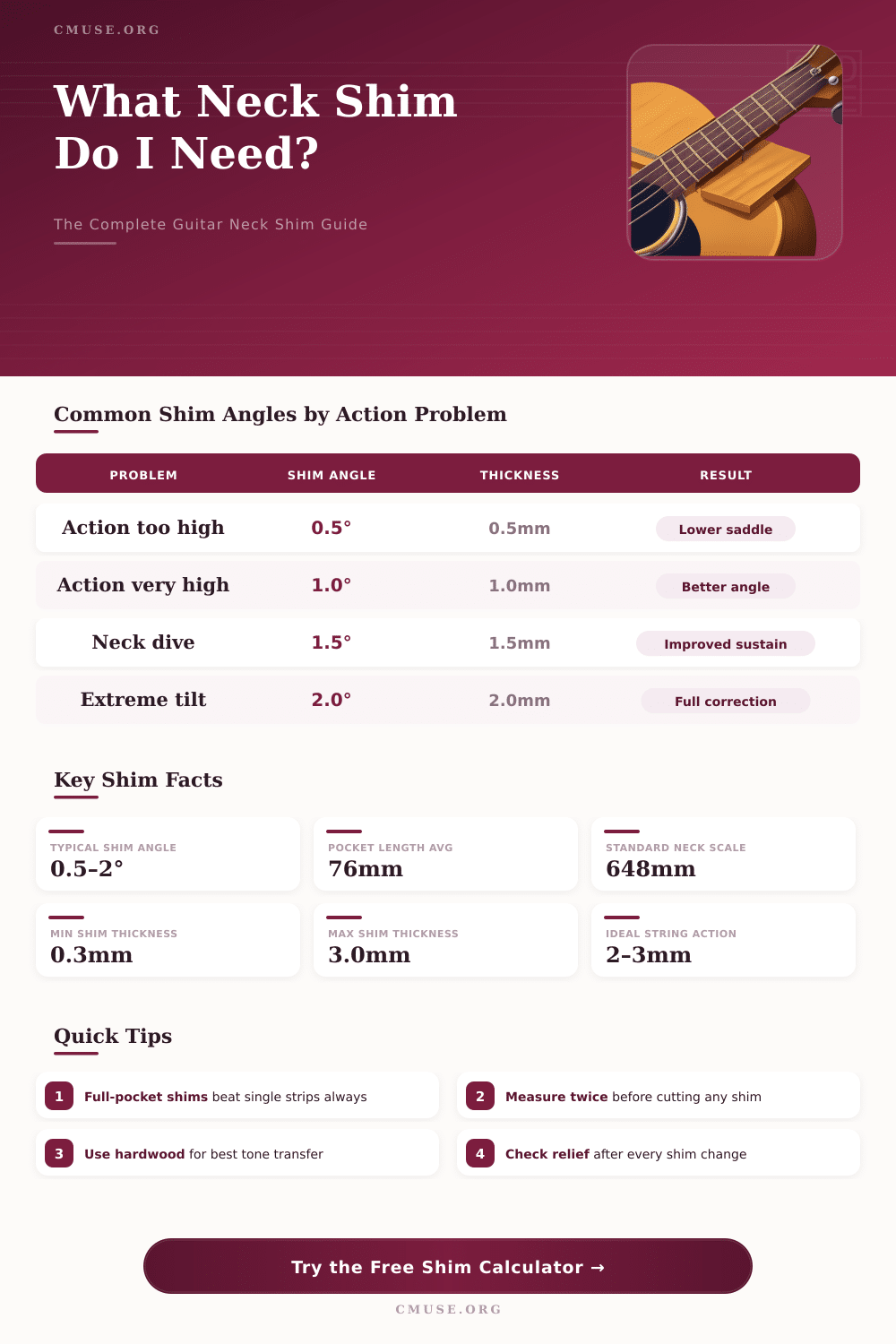
Calculate the exact shim angle and thickness needed to correct your guitar's neck angle and achieve ideal string action.
✅ Shim Calculation Results
| Shim Angle | Approx Thickness at Heel (3" pocket) | Action Change at 12th Fret | Metric Thickness |
|---|---|---|---|
| 0.25° | 0.013" | ~0.010" lower | 0.33mm |
| 0.5° | 0.026" | ~0.020" lower | 0.66mm |
| 0.75° | 0.039" | ~0.030" lower | 1.00mm |
| 1.0° | 0.052" | ~0.040" lower | 1.32mm |
| 1.5° | 0.079" | ~0.060" lower | 2.00mm |
| 2.0° | 0.105" | ~0.080" lower | 2.67mm |
| Guitar Model | Pocket Length | Scale Length | Nut to Pocket |
|---|---|---|---|
| Fender Stratocaster | 3.0" (76.2mm) | 25.5" (648mm) | 17.0" (432mm) |
| Fender Telecaster | 3.0" (76.2mm) | 25.5" (648mm) | 17.0" (432mm) |
| Fender Jazz Bass | 3.0" (76.2mm) | 34.0" (864mm) | 22.5" (572mm) |
| Fender Precision Bass | 3.0" (76.2mm) | 34.0" (864mm) | 22.5" (572mm) |
| Fender Mustang | 2.75" (70mm) | 24.0" (610mm) | 16.0" (406mm) |
| Fender Jazzmaster | 3.0" (76.2mm) | 25.5" (648mm) | 17.0" (432mm) |
| Squier Bullet | 3.0" (76.2mm) | 25.5" (648mm) | 17.0" (432mm) |
| Guitar Type | Low Action (12th Fret) | Medium Action | High Action |
|---|---|---|---|
| Electric Guitar (treble) | 0.046" / 1.2mm | 0.062" / 1.6mm | 0.078" / 2.0mm |
| Electric Guitar (bass side) | 0.062" / 1.6mm | 0.078" / 2.0mm | 0.094" / 2.4mm |
| Bass Guitar (treble) | 0.078" / 2.0mm | 0.094" / 2.4mm | 0.125" / 3.2mm |
| Bass Guitar (bass side) | 0.094" / 2.4mm | 0.125" / 3.2mm | 0.156" / 4.0mm |
| Acoustic Guitar (treble) | 0.078" / 2.0mm | 0.094" / 2.4mm | 0.110" / 2.8mm |
| Acoustic Guitar (bass) | 0.094" / 2.4mm | 0.125" / 3.2mm | 0.156" / 4.0mm |
A full-pocket shim (covering the entire neck pocket floor) provides far better neck-to-body contact than a strip shim at the heel. Better contact means improved sustain, tone transfer, and tuning stability. Cut your shim to match the exact pocket dimensions using a craft knife and ruler.
Before shimming, ensure your truss rod is set correctly. A shim adjusts the neck angle — it cannot fix bow or back-bow. Always set relief first (0.010"–0.015" at 7th fret), then shim for action, then adjust the saddle height for final fine-tuning.
A guitar neck shim is something any material, that one places in the pocket of the neck here where it connects to the body. For some, that never did that, it maybe seems scary, even so truly it is simple fix and well help for fix the instrument, if one does it right.
In bolt-on electric guitars, such shims allow to quickly change the angle, at that the neck meets with the body. That helps to reach the wanted height of the strings. The angle between neck and body sets the plain for the height of the bridge saddle, so it matters in each guitar setup.
What a guitar neck shim is and how to use it
Bolt-on designs offer great chance to adjust this angle fairly easily by means of a proper guitar neck shim.
What so cause wrong angle of the neck? Many musicians do not know, that electric guitars can warp over time. As the instrument ages, the steady pull of the strings can bend the body a bit concave, what changes the angle of the neck.
Too thick paint in the neck pocket also can create troubles. At almost all factory guitars, paint sits on the surface of the pocket, especially at the heel. If it is quite a lot thick, it works as a guitar neck shim, that tilts the neck in the bad direction.
The idea of a guitar neck shim is meant to make up for a neck pocket, that is cut too close to the top plane of the body. Such a guitar neck shim usually raises the heel of the neck a bit. This turns the neck backwards, what gives more pleasant height of strings.
Wholesale-produced guitars commonly need this simple fix too sound best.
A full-pocket guitar neck shim is the best choice. It should have form of wedge, narrowing toward the headstock. Partial shims cause brief spaces, and vibrations can not well pass from one wood part to others, what can hurt the sound.
Using something as coins can warp the neck over time.
Commonly used materials for shims are business cards, old credit cards, guitar picks, slim metal sheet, sandpaper and such stuff. Metal bits well pass vibrations, but have the problem, that the neck joint slips more freely. Pre-cut sanding shims are sold at guitar stores, with angles as 0.25, 0.5 and one degree.
Half-degree angle most works for Fender-style guitars. Surprisingly, it does not need big thickness.
To do the fix, one needs a medium cross-point screwdriver to remove the neck bolts. A capo helps to keep the strings, while one removes the neck. The neck screws usually can exit with the guitar on its side.
A hole punch helps to cut theshim for the neck bolts. Usually no more than two layers of business card is enough.