🎸 Guitar Capo Calculator
Find your transposed key, chord shapes & capo fret position instantly
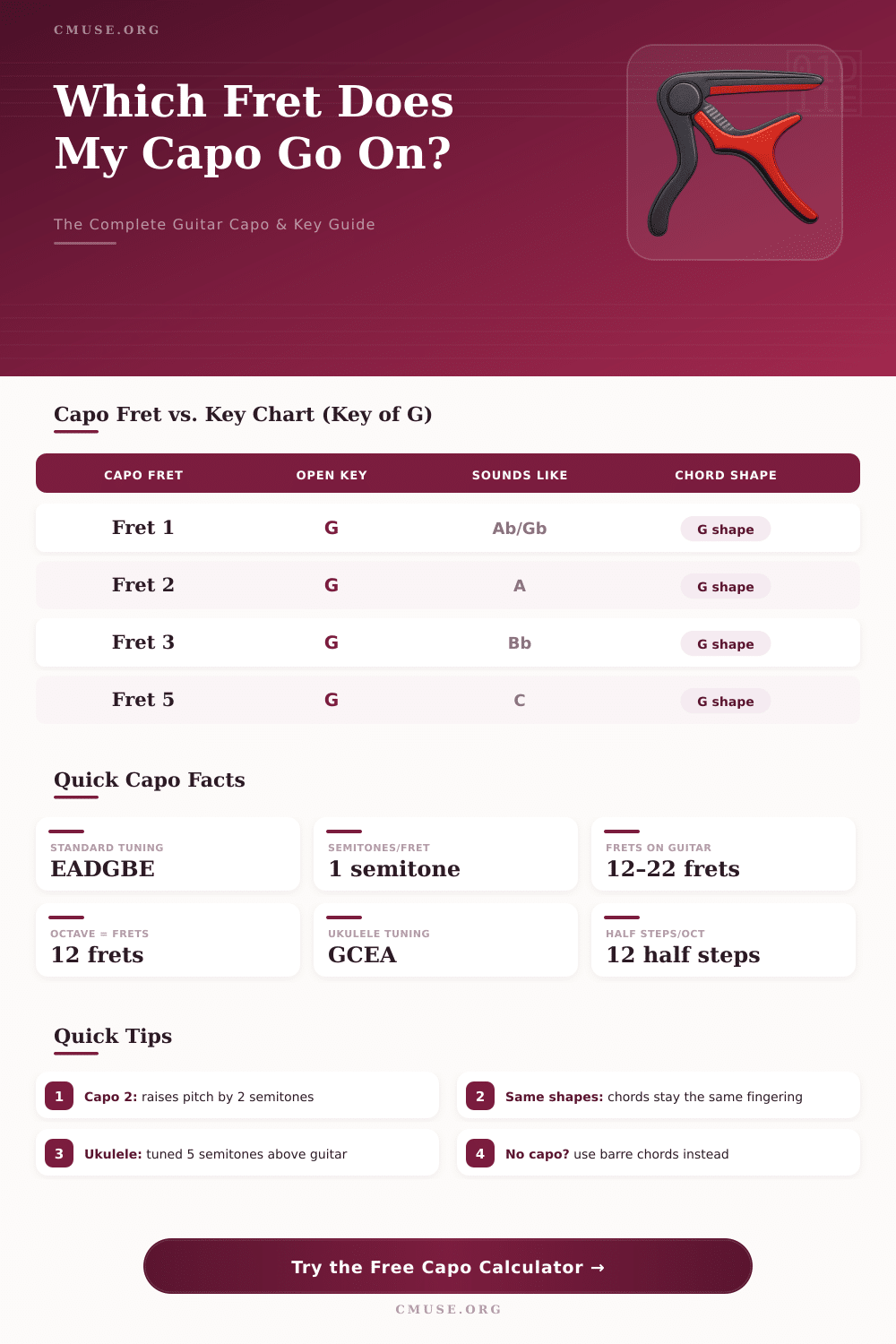
| Capo Fret | G Shape Sounds | C Shape Sounds | D Shape Sounds | A Shape Sounds | E Shape Sounds |
|---|---|---|---|---|---|
| Open (0) | G | C | D | A | E |
| Fret 1 | G# / Ab | C# / Db | D# / Eb | A# / Bb | F |
| Fret 2 | A | D | E | B | F# / Gb |
| Fret 3 | A# / Bb | D# / Eb | F | C | G |
| Fret 4 | B | E | F# / Gb | C# / Db | G# / Ab |
| Fret 5 | C | F | G | D | A |
| Fret 6 | C# / Db | F# / Gb | G# / Ab | D# / Eb | A# / Bb |
| Fret 7 | D | G | A | E | B |
| Fret 8 | D# / Eb | G# / Ab | A# / Bb | F | C |
| Fret 9 | E | A | B | F# / Gb | C# / Db |
| Fret 10 | F | A# / Bb | C | G | D |
| Fret 11 | F# / Gb | B | C# / Db | G# / Ab | D# / Eb |
| Fret 12 | G (octave) | C (octave) | D (octave) | A (octave) | E (octave) |
| Song Key | Capo Fret (G shape) | Chord Shape | Semitones Up | Alternative Option |
|---|---|---|---|---|
| G | Open | G shape | 0 | No capo needed |
| Ab / G# | Fret 1 | G shape | 1 | Fret 4 (E shape) |
| A | Fret 2 | G shape | 2 | Open A shape |
| Bb / A# | Fret 3 | G shape | 3 | Fret 1 (A shape) |
| B | Fret 4 | G shape | 4 | Fret 2 (A shape) |
| C | Fret 5 | G shape | 5 | Open C shape |
| Db / C# | Fret 6 | G shape | 6 | Fret 4 (A shape) |
| D | Fret 7 | G shape | 7 | Open D shape |
| Eb / D# | Fret 8 | G shape | 8 | Fret 1 (D shape) |
| E | Fret 9 | G shape | 9 | Open E shape |
| F | Fret 10 | G shape | 10 | Fret 5 (C shape) |
| F# / Gb | Fret 11 | G shape | 11 | Fret 2 (E shape) |
| Instrument | Open Tuning | String 1 (High) | Fret 1 Note | Fret 5 Note | Fret 12 Note |
|---|---|---|---|---|---|
| Guitar Standard | EADGBE | E4 | F4 | A4 | E5 |
| Guitar Drop D | DADGBE | E4 | F4 | A4 | E5 |
| Guitar Open G | DGDGBD | D4 | D#4 | G4 | D5 |
| Guitar Open D | DADF#AD | D4 | D#4 | G4 | D5 |
| Ukulele (soprano) | GCEA | A4 | A#4 | D5 | A5 |
| Banjo 5-string | gDGBD | D4 | D#4 | G4 | D5 |
| Mandolin | GDAE | E5 | F5 | A5 | E6 |
The Guitar Capo is a kind of clamp that shortens the vibrating part of the strings by pressing them against the frets. This raises the tone of the open strings by a set interval. Guitar musicians commonly use such devices to quickly change the tone of the melody or to play open chords a bit higher along the neck of the instrument.
For every song you probably need to lay the Guitar Capo on a different fret. For instance, if one lays it on the second fret and plays the form of G-chord, one actually gets A-chord. Every fret raises the tone by one half step.
Using and Buying a Guitar Capo
So a Guitar Capo on the first fret matches the setup of the whole guitar in half tone higher. The song “With or Without You” by U2 uses the sequence D… Bm, G, but with a Guitar Capo on the second fret it transforms to C, G. F, which is commonly simpler to play.
Using a Guitar Capo is not cheating. The sound of many guitars sounds fresher when one uses a Guitar Capo for open strings, that otherwise had to be pressed up on the keyboard. Long keeping barre-chords during a whole bit can hurt the hand, hence the Guitar Capo helps hear also.
It absolutely does not damage the guitar or its strings.
There are many brands of Guitar Capos. Those of Shubb cost little, one can use them and they are compact. Even the rubber pad can be exchanged after years of usage.
The model Shubb S1 is made of rustproof steel with a tuning screw for exact position at any fret. It works for most acoustic and electric guitars, as well as for classical and 12-string versions. Because different guitars have different thicknesses of the neck, adjustable Guitar Capos allow you to change the pressure, so that the strings sound clearly without buzzing or too sharp.
The Guitar Capos of D’Addario give correctly the right pressure for pure and clear sound at every fret. They make them for guitars, mandolins, banjos and even ukuleles. The D’Addario NS Classical Professional Capo has a tuning wheel for pressure.
Kyser Guitar Capos have a quick-change system, made by hand in United States, with a lifetime guarantee.
Guitar Capos come in versions for 6-string, 12-string, classical guitars, banjos and mandolins. Some of them come in silver, black color and 18-karat gold. Also partial Guitar Capos for 3-string and 5-string models exist.
Special Guitar Capos that leave certain strings sounding without pressure are useful for different setups. Most companies that make Guitar Capos offer flat or curved options for classical guitars. The Ernie Ball Axis Capo is reliable andpriced friendly, works with flat necks and curved necks, and moves easily with one hand.
The Thalia Capo comes with various rubber pads, so it fits every kind of guitar neck.