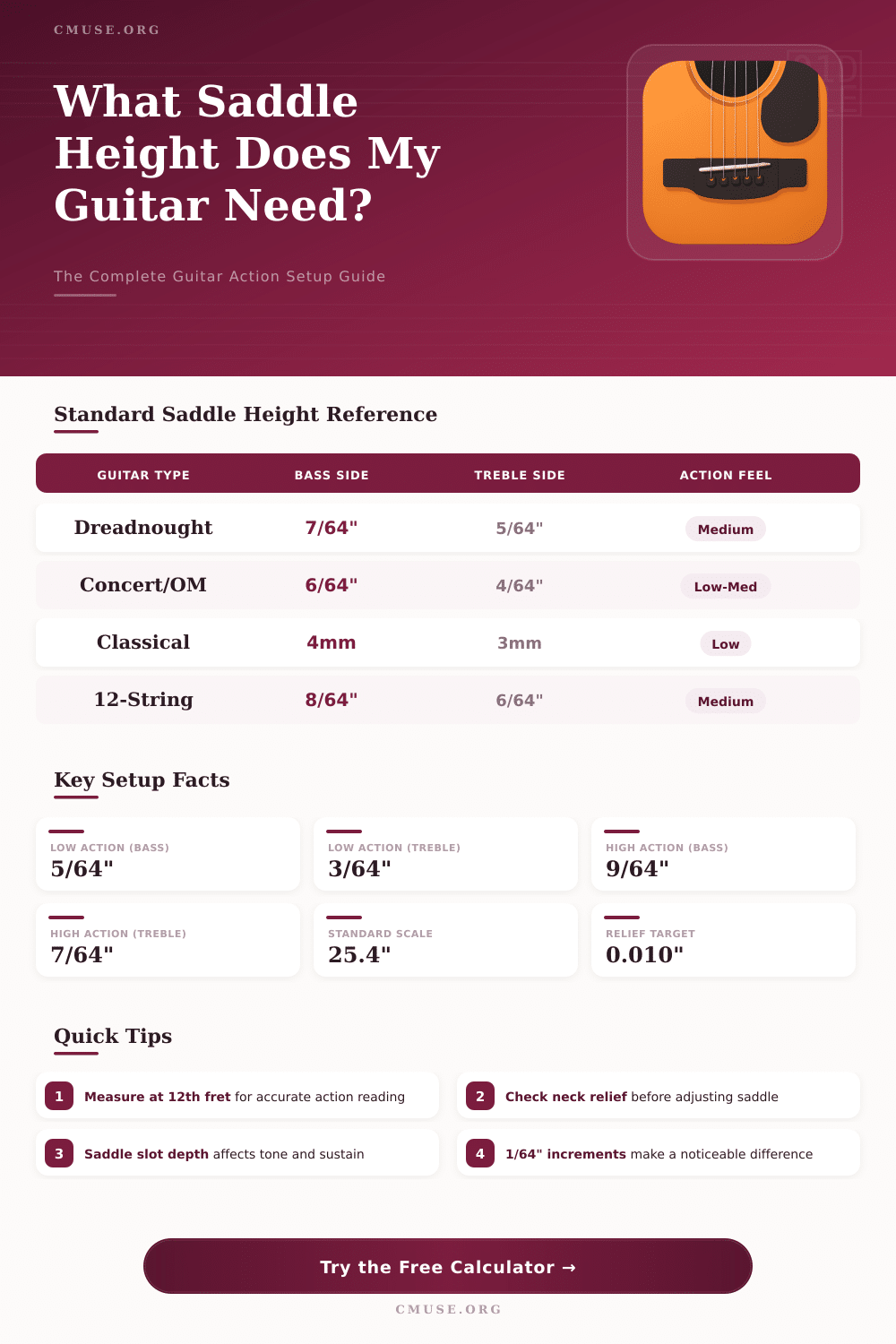
🎸 Acoustic Guitar Saddle Height Calculator
Calculate the ideal saddle height for perfect action — measure at the 12th fret for precision results
| Guitar Type | Bass (Low Action) | Bass (Medium) | Bass (High) | Treble (Med) |
|---|---|---|---|---|
| Dreadnought | 5/64" (2.0mm) | 7/64" (2.8mm) | 9/64" (3.6mm) | 5/64" (2.0mm) |
| Concert / OM | 5/64" (2.0mm) | 6/64" (2.4mm) | 8/64" (3.2mm) | 4/64" (1.6mm) |
| Jumbo | 6/64" (2.4mm) | 7/64" (2.8mm) | 9/64" (3.6mm) | 5/64" (2.0mm) |
| Parlor | 4/64" (1.6mm) | 6/64" (2.4mm) | 8/64" (3.2mm) | 4/64" (1.6mm) |
| Classical | 3.5mm | 4.0mm | 5.0mm | 3.0mm |
| 12-String | 6/64" (2.4mm) | 8/64" (3.2mm) | 10/64" (4.0mm) | 6/64" (2.4mm) |
| Travel / Mini | 4/64" (1.6mm) | 6/64" (2.4mm) | 7/64" (2.8mm) | 4/64" (1.6mm) |
| Scale Length | Guitar Example | Neck Angle Factor | Bass Adj. (approx) |
|---|---|---|---|
| 24.75" (628mm) | Gibson-style | Higher neck angle | +0.5/64" |
| 25.4" (645mm) | Taylor / Martin | Neutral | 0 |
| 25.5" (648mm) | Standard Martin | Neutral / Low angle | -0.25/64" |
| 26.5" (673mm) | Baritone | Low angle | -1/64" |
| 19–21" | Travel / Mini | Variable | Measure directly |
| Material | Tone Character | Workability | Durability |
|---|---|---|---|
| Bone (Genuine) | Bright, clear, resonant | Moderate (sands easily) | Excellent |
| Tusq (Synthetic) | Clear, consistent | Easy | Very Good |
| Corian | Warm, neutral | Very Easy | Good |
| Fossilized Ivory | Warm, vintage | Difficult | Excellent |
| Graph-Tech | Self-lubricating, sustain | Easy | Very Good |
| Plastic (Stock) | Dull, average | Easy | Poor |
The Acoustic Guitar Saddle Height is one of those things that seems simple, but actually depends on several factors. There is not only one standard height for a saddle, even from factories. Because each guitar has a slightly different neck angle, one can reach the wanted action through various mixes of changes.
The Acoustic Guitar Saddle Height helps to set the overall action of the guitar. The action, or height of the strings, is a balance between the neck angle, the depth of the nut slot and the height of the saddle. Most of all the height at the first frets is affected by the depth of the nut slot, that should sit only a hair-height above the first fret.
How Saddle Height Changes How a Guitar Plays and Sounds
If the guitar is hard to play at the first position and barre chords feel tough, probably the nut slots are too deep.
For acoustic guitars with steel strings, typical sizes of saddles are around 70 to 75 mm long, 8 to 11 mm in maximum height and 2.5 to 3.2 mm thick. Ideally the saddle should stick out around 11 mm from the top. The depth of the saddle slot should match or beat the amount of saddle that stands above the bridge.
Quite high saddles are needed to create a good angle of the strnigs at the bridge pins.
On new guitars there are roughly 2 to 3 mm of extra saddle above the slot, especially if the top is lightweight. Some guitars develop slope down between the sound hole and the bridge over time. When one compares guitars, one should not mix up the action and the saddle height.
Everything is connected, but does knot match directly, because the neck angle and the thickness of the bridge vary. The key point stays the height of the strings above the top, not the height of the saddle itself.
Most electric guitars use six separate saddles, one for every string. Usually they are made from stainless steel or brass. The heights of those saddles should follow the curve of the fretboard.
Little screws beside every saddle allow you to change the height for single strings. On some bridge plates, thumb screws on the side change the whole height at once. Acoustic guitars are more tricky, because one commonly replaces their saddles.
To correct the Acoustic Guitar Saddle Height well, first check the depth of the bridge pins and the nut slots. Full work includes adjusting the bridge pins if needed, setting the action and the tuning. During shaping of a saddle, one lays the old above the new and draws a line with a good pencil, to know exactly how much material to remove.
The sharp edge of the new saddle one should lightly sand to smooth it before restringing the guitar. Skipping this step can cause breaking of strings.
Bigger Acoustic Guitar Saddle Height and a stronger break angle can help improve the volume and the tone. Using a shim under the saddle is one way to raise the action, especially when switching to more lightweight strings. If the saddle goes past 12 mm in height on most classical guitars, it puts toomuch strain on the instrument and can cause problems.