🎸 Guitar Slide Size Calculator
Find your perfect slide size by entering your finger measurements — get instant size recommendations with material and length guidance
| Size Label | Inner Dia. (mm) | Inner Dia. (in) | US Ring Size | Outer Dia. (mm) | Best For |
|---|---|---|---|---|---|
| XS / 0 | 15–17mm | 0.59–0.67" | 2–4 | 19–21mm | Very slim fingers / pinky |
| S / 1 | 17–19mm | 0.67–0.75" | 4–7 | 21–23mm | Small hands / pinky |
| M / 2 | 19–21mm | 0.75–0.83" | 7–10 | 23–26mm | Average ring finger |
| L / 3 | 21–23mm | 0.83–0.91" | 10–12 | 26–29mm | Large ring / middle |
| XL / 4 | 23–26mm | 0.91–1.02" | 12–15 | 29–33mm | Very large / bass |
| US Ring Size | Inner Dia. (mm) | Inner Dia. (inches) | Inner Circumference (mm) |
|---|---|---|---|
| 4 | 14.9mm | 0.587" | 46.8mm |
| 5 | 15.7mm | 0.618" | 49.3mm |
| 6 | 16.5mm | 0.650" | 51.9mm |
| 7 | 17.3mm | 0.681" | 54.4mm |
| 8 | 18.2mm | 0.717" | 57.2mm |
| 9 | 19.0mm | 0.748" | 59.7mm |
| 10 | 19.8mm | 0.780" | 62.2mm |
| 11 | 20.6mm | 0.811" | 64.7mm |
| 12 | 21.4mm | 0.843" | 67.2mm |
| 13 | 22.2mm | 0.874" | 69.7mm |
| Length Type | Length (mm) | Length (inches) | Best Guitar Type | Play Style |
|---|---|---|---|---|
| Short | 45–55mm | 1.75–2.2" | Electric | Lead lines, limited strings |
| Medium | 55–65mm | 2.2–2.6" | Acoustic / Electric | All-around, most common |
| Long | 65–75mm | 2.6–3.0" | Acoustic / Lap Steel | Full chord coverage, blues |
| Extra Long | 75mm+ | 3.0"+ | Lap Steel / Dobro | Full neck coverage |
| Wall Thickness | Range (mm) | Weight Feel | Sustain | Tone Character |
|---|---|---|---|---|
| Thin | 2–3mm | Light | Short | Bright, articulate |
| Medium | 3–5mm | Balanced | Moderate | Warm, versatile |
| Thick | 5–8mm | Heavy | Long | Rich, resonant, full |
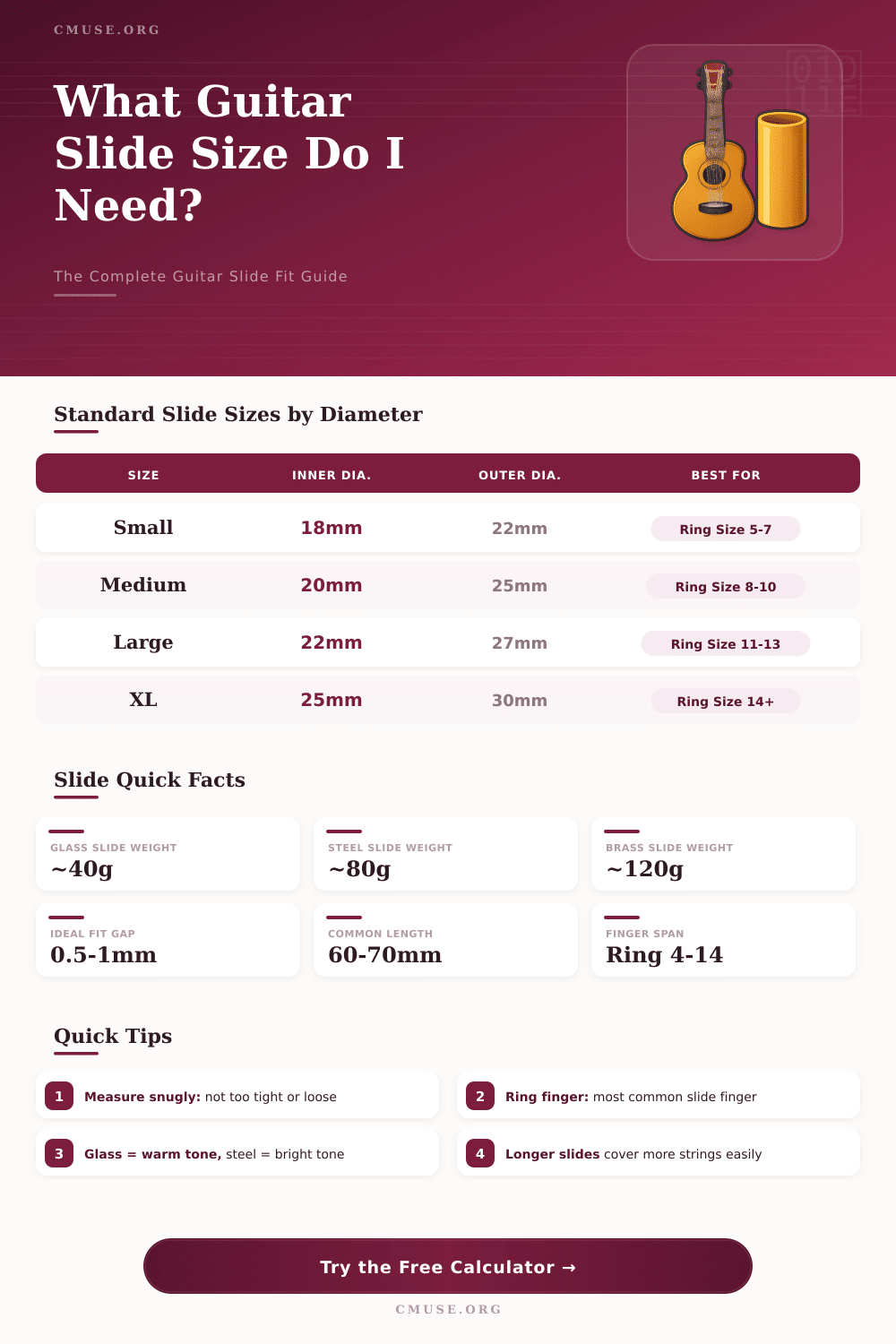
Choosing the right Guitar Slide Size is very important. To find the most precise size measure the finger that it will wear, and then compare that length with the internal diameter of the slide. Most musicians need only one size.
Ring finger and the little finger are the most commonly used for wearing a slide.
How to Choose the Right Guitar Slide Size
If you hesitate between two sizes, choose the bigger one. You can add simple thick tape inside to make up for a little difference, if needed. Too narrow a slide can create trouble during play.
Neoprene bands also help to adjust the size. To measure, take a flexible tape measure and apply it at the thickest part of the finger that you chose.
Slides usually range from small to extra large. Guitar slide shops sometimes offer much more variants than the basic sizes. Some brands even have sizes smaller than size four.
The labels on slides can be hard, because it is not always clear whether they relate to length or to internal diameter. In the end, it depends on samples and misteaks according to your own taste.
The thickness of the walls is another important part. Besides various sizes and lengths, guitar slides come also in different thicknesses. They usually count as lightweight, medium or heavy.
A heavy slide works more for thick strings and high position. A lightweight slide suits lightweight strings and low position. Here is a loose guideline that is useful for choosing the write weight.
Closed slides, made for the little finger, sometimes touch the bottom part inside, if you lay them on another finger. Like this the base of the finger stays too bare. If your fingers are longer than 60 mm, an open type of slide is a better solution.
The materials also affect a lot. Glass gives the richest sound and the shortest echo. Its smooth surface allows it to slip easily above the strings.
Even so glass is fragile and can break, if it falls. Models with thick walls from glass provide bigger volume and echo, which works well on acoustic guitars. Slides from brass tend to be heavy and create a smooth tone.
Starting with cheap glass and metal slides helps to learn the main differences between materials. Later, narrowing the search becomes simpler. Many slides end up too little in diameter even for normal hands, so always check theGuitar Slide Size before purchase.
The position of the strings matters when you play with a slide. If it is too low, there will be drone against the frets, especially with metal slides. Playing with a bit higher position and heavy strings eases the learning of slide.
It replaces the frets on the guitar, so comfortable size and weight makes everything sound more good.