🎸 Guitar Trade-In Value Calculator
Estimate what your guitar is worth at trade-in based on brand tier, condition, age & modifications
🎸 Your Guitar Trade-In Estimate
| Condition | Description | Trade-In Multiplier | Resale Multiplier |
|---|---|---|---|
| Mint | Unplayed, no marks whatsoever | 90–100% of used market | 95–100% |
| Excellent | Minor pick marks, light buckle rash | 75–90% of used market | 85–95% |
| Good | Normal play wear, all original | 60–75% of used market | 70–85% |
| Fair | Heavy wear, dings, scratches | 40–60% of used market | 50–70% |
| Poor | Damage, missing parts, needs repair | 15–40% of used market | 30–50% |
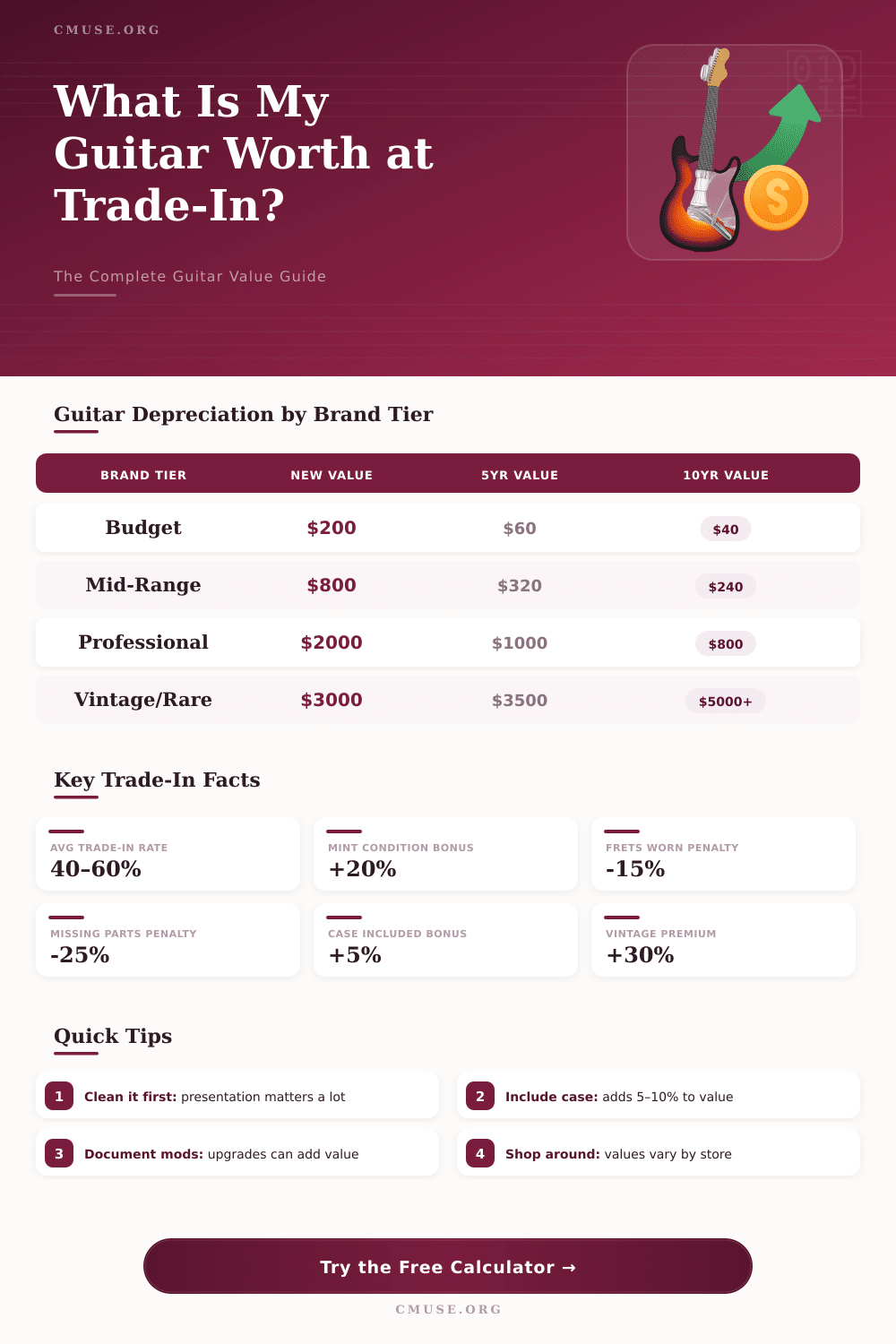
| Age | Budget / Mid | Pro / High-End | Vintage (30yr+) |
|---|---|---|---|
| 1 Year | 55–65% of new | 65–75% of new | — |
| 3 Years | 45–55% of new | 55–70% of new | — |
| 5 Years | 35–50% of new | 50–65% of new | — |
| 10 Years | 25–40% of new | 45–60% of new | 60–80% of new |
| 20 Years | 15–30% of new | 40–55% of new | 80–120% of new |
| 30+ Years | 10–25% of new | 40–60% of new | 100–300%+ of new |
| Factor | Effect on Value | Notes |
|---|---|---|
| Original hard case | +5–10% | Must be original or quality branded case |
| Aftermarket pickups (quality) | +3–8% | Seymour Duncan, DiMarzio, Lollar etc. |
| Heavy fret wear | −10–20% | Refret cost subtracted from offer |
| Neck repair / break | −20–50% | Even repaired breaks reduce value significantly |
| Original paperwork / receipt | +2–5% | Proves provenance and purchase date |
| Refinished body | −15–40% | Especially damaging on vintage instruments |
| Non-original tuners/bridge | −5–10% | Unless premium upgrade with originals included |
| Celebrity provenance | +50–500%+ | Requires verified documentation |
Get good value for a guitar trade-in value needs a bit of prior looking at home. Stores must resell the bought items so they always bid under what the guitar has on the open market. Here is simply how it works.
Guitar trade-in value is a lot like that of a car. The age, state and fame of the brand and model all affect the final price.
How Guitar Trade-Ins Work
Guitar Center ranks between the most used places for trading guitars, amps and pedals. Here one can bid items against something that one wants to buy. The workers that are trained to check used gear prepare a bid.
Who checks the items depends on the quality of the traded item. At Guitar Center one pays up to a thousand dollars in cash for used and vintage items, although in places like Greensboro, Rockville or Saginaw one does not give money because of legal rules. The paymnet happens already on that same day.
One usually offers for trade around 50 to 60 percent of the used market value. Cash offers fall to the bottom part, close to 40 to 50 percent. Credit in the store commonly reaches more, almost 60 percent.
A hard case can genuinely help the deal. The stores mind every mark on the guitar, so cleaning it well helps. A guitar that shines because of cleaning will probably give a bigger amount during the trade.
Trading at Guitar Center brings also bonuses. Besides the value of the trade, one receives an extra 10 percent discount four non-sold, non-unavailable items. Even so that discount does not combine with other bids.
Even trading something tiny, like a pedal worth five dollars, can give that 10 percent for a bigger purchase.
To check before, how much a guitar could be worth, it is useful to check ended auctions on eBay. Mind what items indeed reached, not only what prices the sellers ask. Reverb has a price guide with more than 240,000 products in its database.
It follows sale prices and shows how values change over time. Workers at Guitar Center use Reverb to set trade-in values, aiming at roughly 60 percent of the average pricefound here.
Selling a guitar directly to a private buyer almost always gives more money. Music shops commonly offer around half of what they reckon possible for the item. But sometimes a guitar only takes up space at home without use.
Trading it at least turns it into something useful. If the guitar costs more than a few hundred dollars, then selling it is worth the effort.