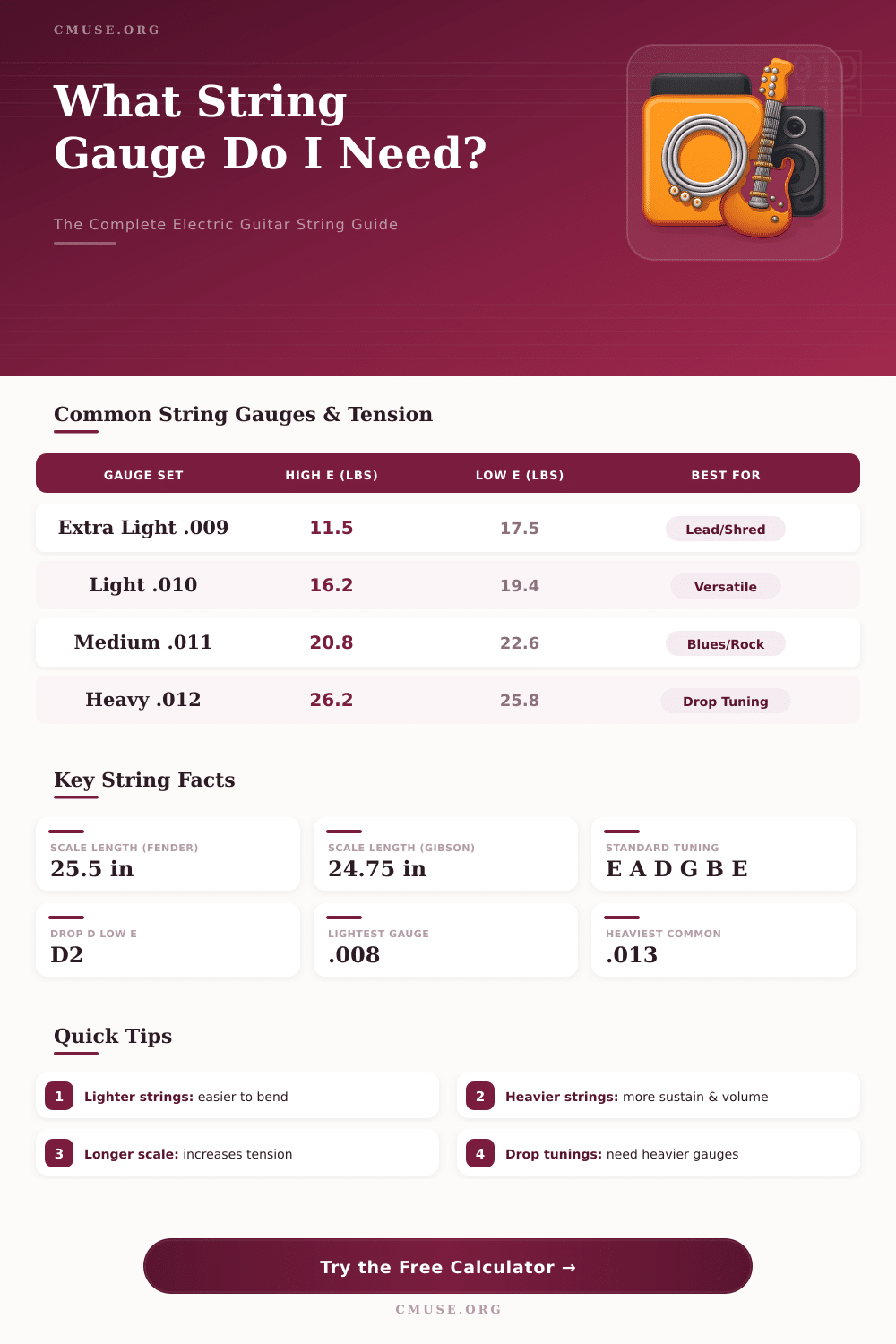
🎸 Electric Guitar String Gauge Calculator
Calculate string tension, find the ideal gauge for your scale length & tuning style
| Gauge Set | 24.75" (Gibson) | 25.5" (Fender) | 27.0" (Baritone) | Best Tuning |
|---|---|---|---|---|
| .008 set | ~87 lbs total | ~93 lbs total | ~104 lbs total | Standard |
| .009 set | ~93 lbs total | ~101 lbs total | ~114 lbs total | Standard / Eb |
| .010 set | ~101 lbs total | ~112 lbs total | ~125 lbs total | Standard |
| .011 set | ~113 lbs total | ~124 lbs total | ~139 lbs total | Eb / Drop D |
| .012 set | ~126 lbs total | ~138 lbs total | ~155 lbs total | D / Drop C |
| .013 set | ~140 lbs total | ~152 lbs total | ~172 lbs total | Drop B / C |
| String | Note | .009 Set | .010 Set | .011 Set | .012 Set |
|---|---|---|---|---|---|
| 1st (e) | E4 | 11.5 lbs | 16.2 lbs | 20.8 lbs | 26.2 lbs |
| 2nd (B) | B3 | 11.4 lbs | 15.4 lbs | 19.7 lbs | 23.3 lbs |
| 3rd (G) | G3 | 13.5 lbs | 16.6 lbs | 19.0 lbs | 20.4 lbs |
| 4th (D) | D3 | 16.0 lbs | 18.4 lbs | 20.0 lbs | 24.9 lbs |
| 5th (A) | A2 | 17.8 lbs | 19.4 lbs | 22.6 lbs | 27.4 lbs |
| 6th (E) | E2 | 17.5 lbs | 19.4 lbs | 22.6 lbs | 25.8 lbs |
| Scale Length | Guitars | Recommended Gauge | Tuning Range |
|---|---|---|---|
| 24.75 in (629 mm) | Gibson Les Paul, SG, ES-335 | .010 – .011 | Eb – Standard |
| 25.0 in (635 mm) | PRS Custom 24, Santana | .010 – .011 | Standard |
| 25.5 in (648 mm) | Fender Strat, Tele, Jazzmaster | .009 – .010 | Eb – Standard |
| 26.5 in (673 mm) | Ibanez RG7, 7-string guitars | .010 – .011 | Drop A – Standard |
| 27.0 in (686 mm) | Baritone guitars | .012 – .013 | B – Drop A |
| 28.625 in (727 mm) | Extended baritone | .013 – .014 | A – Drop G |
| Tuning | Tension Change vs Standard | Recommended Gauge Adjustment | Notes |
|---|---|---|---|
| Standard (E) | Baseline | None | Reference point |
| Half Step Down (Eb) | −5.6% | +1 gauge step up | Popular in classic rock |
| Whole Step Down (D) | −10.9% | +1–2 gauge steps up | Good for rhythm |
| Drop D | Low E: −20.6% | +1 step on low E | Low E detuned only |
| Drop C | −25% overall | +2 gauge steps | Metal / hard rock |
| Drop B | −35% overall | +3 gauge steps | Heavy metal essential |
| Open E | +8% on some strings | Lighten or maintain | Slide guitar |
| DADGAD | Mixed −10% | +1 gauge step | Celtic / acoustic-style |
Electric guitar string gauge simply means the thickness of the string. One measures it in thousandths of an inch. So, a 10-gauge string has a thickness of 0.010 inches.
One usually calls the sets after the lightest string in it. For instance a set of 10s means that the high E-string is 0.010 inches thick.
What Guitar String Gauge Means
The most common electric guitar string gauge for electric guitar strings is.010-.046. One commonly calls them “regular” or “10s”. They offer great balance between tension and sound. Nickel-wound strings for electric guitars form the usual standard in the industry.
Lighter gauges, like.009-.042, give clearer sound and bend more easily, so they work for beginners.
Heavier gauges need bigger tension to reach the right notes. This makes them harder to bend and vibrate. Though, they create stronger tones.
Thinner gauges play more easily and put less pressure on the guitar neck. Even so, thicekr strings give deeper sound.
Really light gauges, like 8s, make bending and vibration feel wonderful. The strings are more loose and stretchy. They need a bit of time to adjust, because the guitar resists less strongly.
Electric guitars most commonly use strings between 9 and 11 gauges. Pickups on electric guitars affect the tone, hence the natural sound of strings matters less then on acoustic.
The length of the scale also matters a lot. Fender-scale have 25.5 inches, while Gibson-scale 24.75 inches. The longer the scale, the more tension on the strings.
Tuning also matters. For Drop D-tuning, changing only the low E to 42 up to 46 gauges, one can get stronger and steady tension. Low tuning is commonly used in metal music, and thicker gauges help that.
On acoustic guitars, 11 and 12 gauges are the standard. A set of 10s exists, but the sound can sound very weak on acoustics. The D’Addario set for acoustic gauges works like this: heavy are 014-059, medium 013-056 and light 012-053.
Classical guitar strings are totally different. One describes them usually by tension instead of gauge. Unlike steel sets, where the diameter grows straight from high E to low E, on classical the diameters are not straight.
The bass strings are much thicker compared to the treble strings. Classical strings use different materials, like clear nylon, red nylon, black nylon, titanium and composites.
Hybrid sets are worth noting. A set of 10-52 gives heavier bass strings, while it keeps light trebles. This works for players that want easy bends on high strings, but more weight below.
It takes some weeks of practice to fully adjust to a new gauge. Choosing gauges yourself, one risks poor balance. Buying awhole set, one has assurance that the gauges match one with the other.