🎸 Classical Guitar String Tension Calculator
Calculate string tension by scale length, gauge, and tuning for any classical guitar setup
| Scale Length | Standard (E) | Eb Tuning | D Tuning | Total (6 str, Normal) |
|---|---|---|---|---|
| 630 mm | ~5.8 kg | ~5.4 kg | ~5.1 kg | ~37.2 kg |
| 640 mm | ~6.1 kg | ~5.7 kg | ~5.4 kg | ~39.0 kg |
| 650 mm | ~6.4 kg | ~6.0 kg | ~5.7 kg | ~41.0 kg |
| 660 mm | ~6.7 kg | ~6.3 kg | ~5.9 kg | ~43.0 kg |
| 664 mm | ~6.8 kg | ~6.4 kg | ~6.0 kg | ~43.8 kg |
| String | Standard Hz | Eb Tuning Hz | D Tuning Hz | MIDI Note |
|---|---|---|---|---|
| 1st – E (High) | 329.63 Hz | 311.13 Hz | 293.66 Hz | 64 |
| 2nd – B | 246.94 Hz | 233.08 Hz | 220.00 Hz | 59 |
| 3rd – G | 196.00 Hz | 185.00 Hz | 174.61 Hz | 55 |
| 4th – D | 146.83 Hz | 138.59 Hz | 130.81 Hz | 50 |
| 5th – A | 110.00 Hz | 103.83 Hz | 98.00 Hz | 45 |
| 6th – E (Low) | 82.41 Hz | 77.78 Hz | 73.42 Hz | 40 |
| Material | Low Tension | Normal Tension | High Tension | Tone Character |
|---|---|---|---|---|
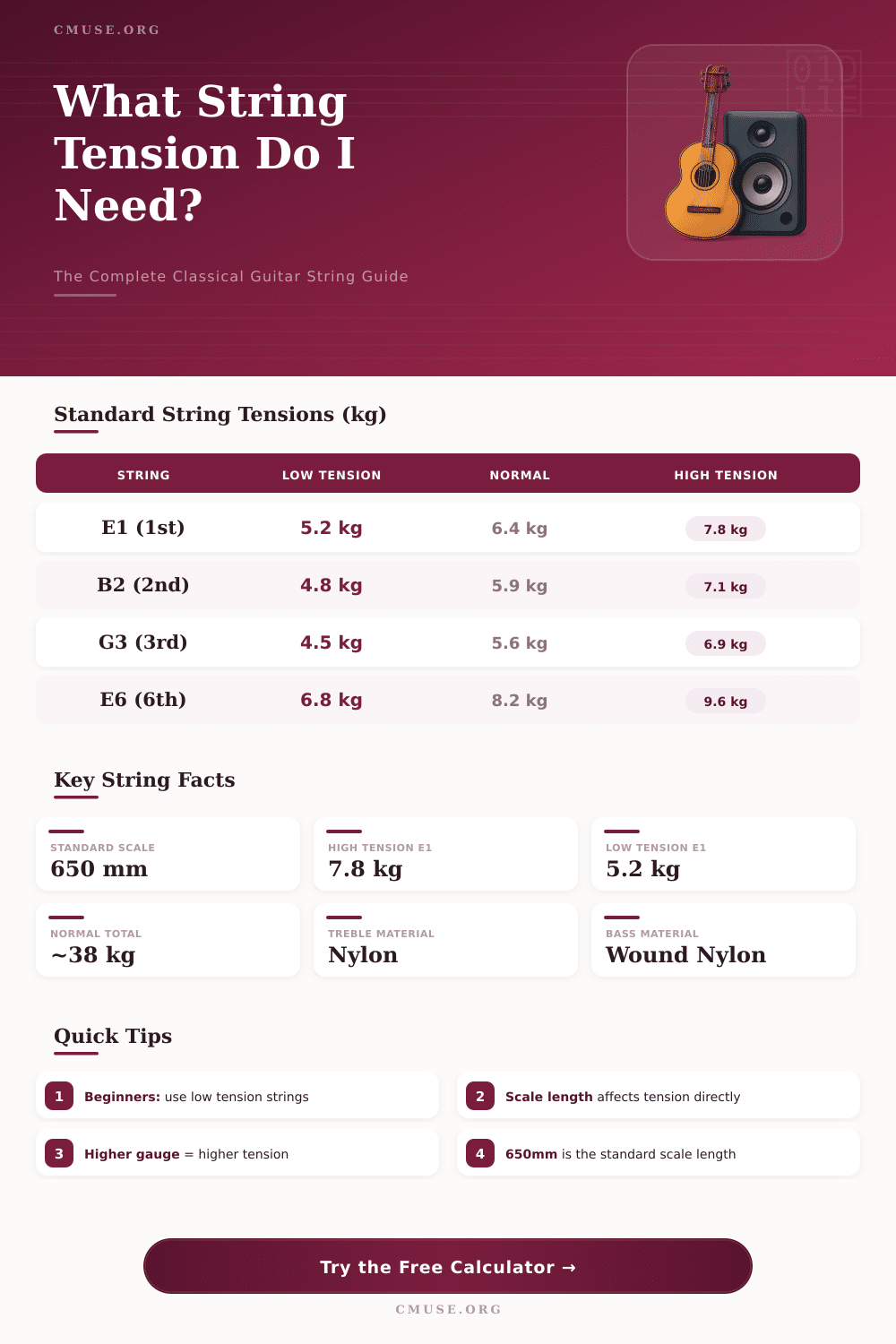
| Clear Nylon | 5.2 kg | 6.4 kg | 7.4 kg | Warm, bright |
| Rectified Nylon | 5.0 kg | 6.2 kg | 7.1 kg | Warm, mellow |
| Fluorocarbon | 5.5 kg | 6.7 kg | 7.8 kg | Clear, projecting |
| Composite | 5.3 kg | 6.5 kg | 7.6 kg | Balanced, stable |
| Silver Wound | 6.5 kg | 8.0 kg | 9.2 kg | Rich, dark |
| Bronze Wound | 6.3 kg | 7.7 kg | 9.0 kg | Bright, articulate |
| Copper Wound | 6.6 kg | 8.1 kg | 9.4 kg | Full, deep |
| Scale Length | Classification | Typical Use | Total Tension (Normal) |
|---|---|---|---|
| 615–625 mm | 3/4 Size | Children, students | ~32–34 kg |
| 628–632 mm | Small Full | Small hands, beginners | ~36–38 kg |
| 648–652 mm | Standard | Most classical guitars | ~40–42 kg |
| 658–662 mm | Long Scale | Concert guitars | ~43–45 kg |
| 664–670 mm | Extra Long | Professional concert | ~44–47 kg |
The tension of guitar strings shows how much force requires one for tuning them correctly, so that they sound the right pitch in enabled state. The bigger the tension the more flat it feels under the fingers. The whole tension for all strings range according to the setup, sometimes only around 60 pounds.
Actual ways for changing the tension of string are only three: take more short bit, lower the tuning or exchange with more lightweight type. Here everything comes down to basic laws of physics.
Guitar String Tension and How to Change It
The length of the scale matters a lot. If the scale is short, the tension of the strings drops. For guessing it, enough to simply measure from the nut until the bridge along the first string.
The same grade of tension seems a bit less heavy on broader scale. No matter small differences, the impact is not too big, even so it shows clearly when one compraes basses with guitars.
Programs like the Stringjoy Calculator for Classical Guitar String Tension help to quickly reach good tension, right for guitar or bass. First choose your instrument, later enter info about the scale length, tuning and thickness of strings. Right away the tool points the tension for each of them, what allows to try and test various combinations.
Strings for acoustic guitars aim at around 30 pounds of tension each unit, what is almost half more than for electric. Classical guitars plan for almost 90 pounds entirely, with nylon strings. If one uses thicker strings with higher tension, that causes stronger vibration on the soundboard, and the more strong swings give bigger sounds.
The real tension, that can be counted, depend on the mass of the string in inch, on the scale length and on the pitch. But the feeling under the hands mixes this with stiffness and other factors. Folks commonly mix all three ideas.
Strings with low tension feel like rubber tape, and high action can make everything feel too tiring, because the string has more space to move.
If you raise the tension, the pitch climbs. Lowering it, the sound sinks. When the tuner points, that string sounds too sharp, lower the tension.
If it is flat, then raise it. If you lower tension without changing the strings themselves, you play in lower pitch, and both the sound and the feeling will adjust. Special sets for low tunings keep good tension, rather than average, that can feel two loose.
That works well for drop to C, to B or even more below, what makes them liked in modern metal music and heavy styles.
Using the same strings, longer scale forces bigger tension. Fresh strings for guitar usually stretch, when one first tunes them. If the nut stays oiled and well cut, that helps for stable tuning, but enough play will still mess everything up.
The tension of strings seems good starting spot, whateverhappens if the thickness and length stays unchanged.