🎸 Guitar String Gauge Tension Calculator
Calculate exact string tension by gauge, scale length & tuning — for electric, acoustic & bass guitar
| Set Name | Gauges (in) | Guitar Type | Playing Feel | Best For |
|---|---|---|---|---|
| Extra Light | .009–.042 | Electric | Very Easy | Beginners, lead |
| Super Light | .009–.046 | Electric | Easy | Versatile electric |
| Light | .010–.046 | Electric | Easy–Med | All-round electric |
| Medium | .011–.049 | Electric | Medium | Blues, rhythm |
| Heavy | .012–.052 | Electric | Firm | Drop tunings |
| Acoustic Light | .012–.053 | Acoustic | Easy | Fingerpicking |
| Acoustic Med | .013–.056 | Acoustic | Medium | Strumming, folk |
| Acoustic Heavy | .014–.059 | Acoustic | Firm | Resonators |
| Bass Light | .040–.095 | Bass | Easy | Fingerstyle bass |
| Bass Medium | .045–.105 | Bass | Standard | All-round bass |
| Bass Heavy | .050–.110 | Bass | Firm | Slap, drop tuning |
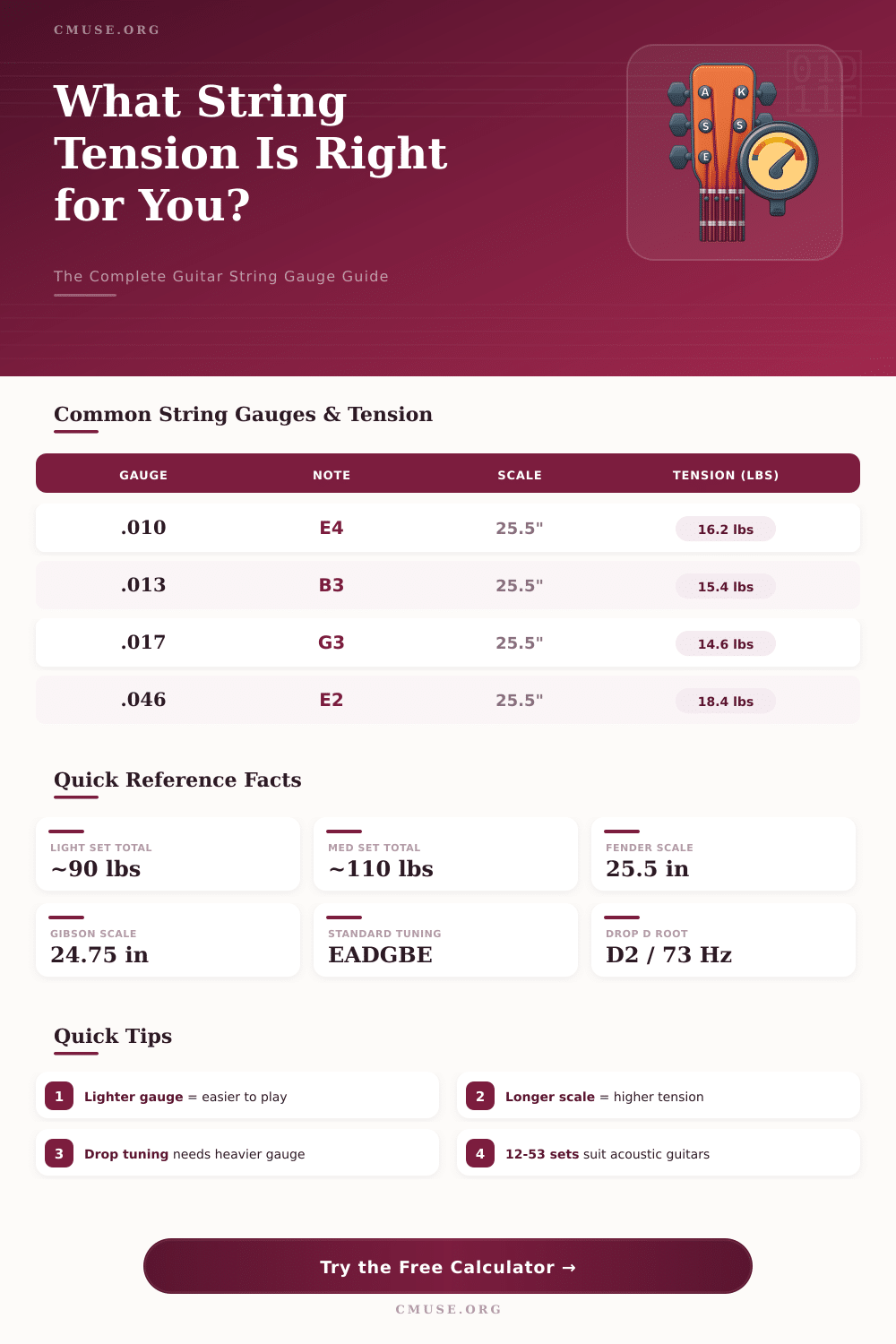
| Scale Length | Guitar | .010 E4 Tension | .013 B3 Tension | .017 G3 Tension | Relative Feel |
|---|---|---|---|---|---|
| 24.0 in (61.0 cm) | Mustang / Jag | 14.7 lbs | 13.9 lbs | 13.1 lbs | Loose |
| 24.75 in (62.9 cm) | Gibson LP/335 | 15.6 lbs | 14.8 lbs | 14.0 lbs | Moderate |
| 25.0 in (63.5 cm) | PRS Custom 24 | 15.9 lbs | 15.1 lbs | 14.2 lbs | Moderate |
| 25.5 in (64.8 cm) | Fender Strat/Tele | 16.6 lbs | 15.8 lbs | 14.9 lbs | Standard |
| 26.5 in (67.3 cm) | Baritone (short) | 17.9 lbs | 17.0 lbs | 16.1 lbs | Tight |
| 27.0 in (68.6 cm) | Baritone / 7-str | 18.6 lbs | 17.7 lbs | 16.7 lbs | Very Tight |
| Tuning | Notation | Recommended Gauge | Avg Total Tension | Notes |
|---|---|---|---|---|
| Standard | EADGBE | .009–.042 or .010–.046 | ~90–105 lbs | Universal baseline |
| Drop D | DADGBE | .010–.046 or .011–.049 | ~88–100 lbs | Low 6th string |
| Half Step Down | Eb Ab Db Gb Bb Eb | .010–.046 | ~88–100 lbs | Slightly lower tension |
| Full Step Down | DGCFAD | .011–.049 or .012 | ~95–108 lbs | Heavier gauge needed |
| Drop C | CADGBE | .012–.052 or .013 | ~92–110 lbs | Metal/hardcore |
| Open G | DGDGBD | .011–.052 | ~90–105 lbs | Slide guitar |
| DADGAD | DADGAD | .011–.052 | ~90–102 lbs | Celtic / fingerstyle |
Guitar String Gauge Tension in short words shows how much force you need for pulling the string so that it sounds at the right pitch when you play it on the instrument. Strings with higher tension seem more stiff under your fingers. The whole range of tension through all six strings can go to only around 60 pounds whether depending on how you set the upper part.
Classical guitars that use nylon strings usually have around 90 pounds through the whole instrument.
How Guitar String Tension Works
Really only three things change the tension of a string: use shorter length, lower the tuning or choose different thicknesses. That is everything that affects it when you strip the physics. The real tension depends on three main causes; the mass of the string each inch, the length of the scale and the pitch to which it is set.
Here is where it gets interesting: how tight the string feels in your hands is a totally different cause. It mixes the real tension with stiffness and many other factors. Folks commonly confuse these things.
The length of the scale has a big impact. A shorter scale needs less tension to reach the wanted state. If you measure from the nut to the saddle on your first string, you get that number.
Interestingly, same tension will feel more loose on a longer scale, no huge change just because of some inches, but when you go from guitar too bass, the difference shows. If you extend the scale with same strings, the tension will grow.
Strings with low tension act soft, almost like rubber tape, while high thicknesses give less stiff feeling, because there is more flexibility in the string itself. Bigger tension helps to reach higher pitch. Less tension lowers it.
When your tuner points too high, you loosen the string. Too low? Turn the head of the machine to add a bit.
Loosening strings without changing them means that you play more below (and yes), the sound and the feeling adjust together.
Sets of strings for acoustic guitars are usually made to give around 30 pounds of tension each string. That is roughly 50% more than on electric guitars. Thicker strings under higher tension vibrate strong against the sound board, which makes more sound.
That is why the choice of strings is so important for an acoustic instrument.
Calculators for tension are really lifesavers if you want to change your setup. For example, the calculator of Stringjoy lets you enter details about your instrument, the scale length, setup and thicknesses of strings, and right away shows what tension will be for every string while you change things. It helps to try different mixes before buying.
Now, some calculators are based on a 25.5-inch scale in standard setup, while others take 24.75 inches as base.
Sets for low setups keep the tension even when you play in Drop C or lower, which otherwise would feel too loose with average strings. That is why they are popular in metal and heavy styles right now. The type of the wound also can affect slightly thefeeling of tension.
New strings usually stretch a bit when you first pull them hard.