🎸 Guitar String Gauge Calculator
Calculate string tension by gauge, scale length & tuning — find the perfect setup for your playing style
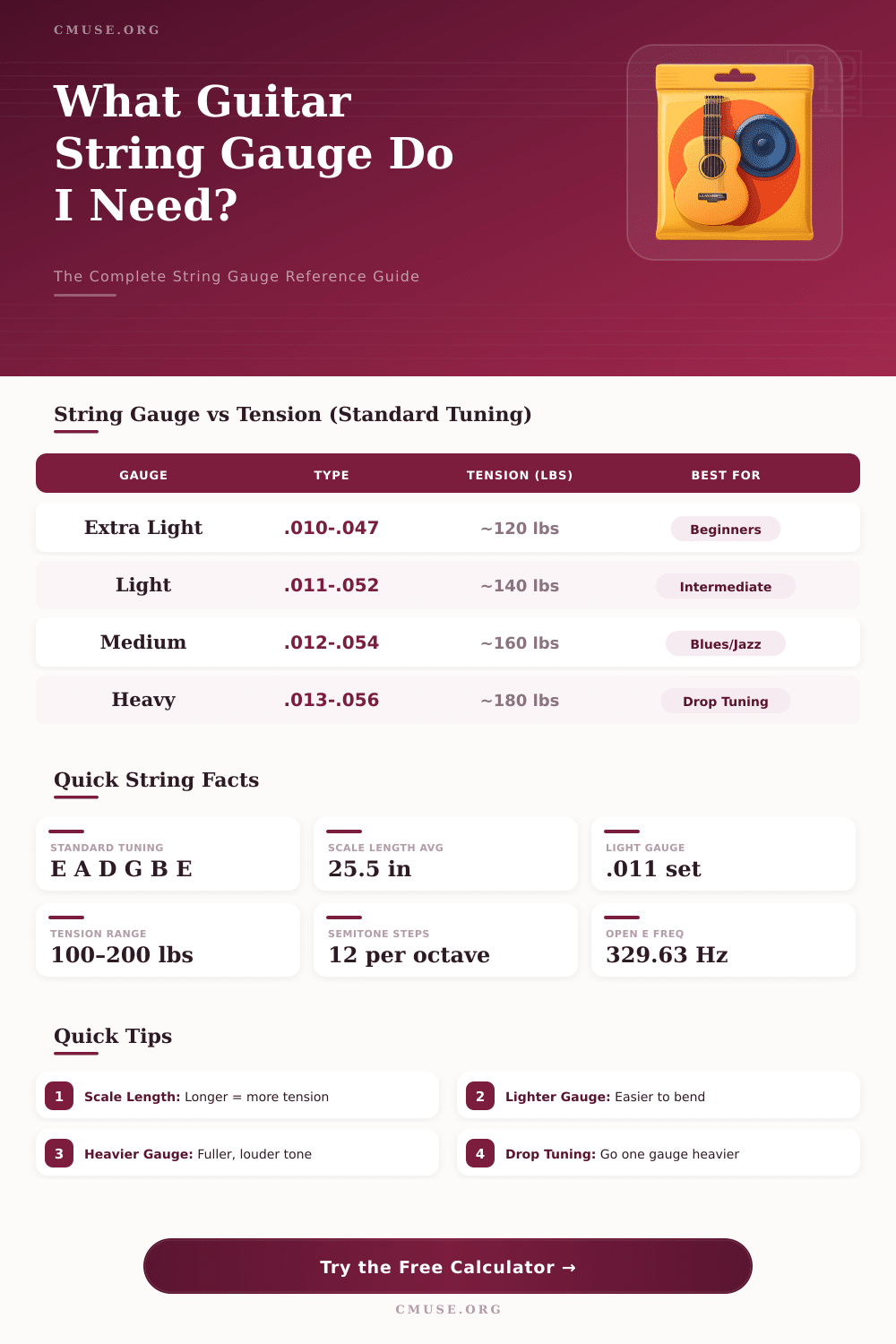
| Gauge Name | String Set (in) | Total Tension* (lbs) | Best Use |
|---|---|---|---|
| Super Light | .009 .011 .016 .024 .032 .042 | ~108 lbs | Shred, Beginners, Light Touch |
| Light | .010 .013 .017 .026 .036 .046 | ~123 lbs | All-round Electric, Rock |
| Light-Medium | .011 .014 .018 .028 .038 .049 | ~138 lbs | Blues, Country, Classic Rock |
| Medium | .012 .016 .020 .032 .042 .054 | ~152 lbs | Acoustic, Jazz, Blues Bends |
| Heavy | .013 .017 .026 .034 .046 .056 | ~171 lbs | Drop Tuning, Slide, Heavy Rock |
| Extra Heavy | .014 .018 .028 .038 .050 .060 | ~188 lbs | Baritone, 7-String, Very Low Tuning |
*Approximate total tension for all 6 strings on a 25.5" scale in standard tuning.
| Scale Length | Instrument | Light .010 Tension | Medium .012 Tension |
|---|---|---|---|
| 24.0" (61 cm) | Short Scale Electric | ~115 lbs total | ~142 lbs total |
| 24.75" (62.9 cm) | Gibson Les Paul / SG | ~120 lbs total | ~148 lbs total |
| 25.5" (64.8 cm) | Fender Strat / Tele | ~123 lbs total | ~152 lbs total |
| 26.5" (67.3 cm) | Baritone Guitar | ~133 lbs total | ~164 lbs total |
| 27.0" (68.6 cm) | 7-String / Extended | ~138 lbs total | ~170 lbs total |
| 30.0" (76.2 cm) | Bass Short Scale | N/A | N/A |
| 34.0" (86.4 cm) | Bass Standard Scale | N/A | N/A |
| String | Std Frequency (Hz) | Unit Weight (.010 set) | Tension @ 25.5" (lbs) |
|---|---|---|---|
| High E (.010) | 329.63 Hz | 0.00002215 lb/in | 16.2 lbs |
| B (.013) | 246.94 Hz | 0.00003748 lb/in | 15.4 lbs |
| G (.017) | 196.00 Hz | 0.00006402 lb/in | 17.5 lbs |
| D (.026w) | 146.83 Hz | 0.00018837 lb/in | 24.0 lbs |
| A (.036w) | 110.00 Hz | 0.00035976 lb/in | 24.2 lbs |
| Low E (.046w) | 82.41 Hz | 0.00058801 lb/in | 26.2 lbs |
When one talks about guitar string gauge, the rating is simply another word for thickness. One measures it in thousandths of an inch, so a 10-gauge string has literally 0.010 inches of thickness. The sets of strings get their name from the thinnest string.
Hence, when some mention “10s” for their set, it means the high E-string with 10-gauge thickness.
What Guitar String Gauge Means
Here the main point about ratings: the bigger the number the thicker is the string. Thick strings need more tension to reach the right pitch, which helps them resist vibration and bending. On the other hand, they give richer and full sound.
What about thin ratings? Here everything flips, less pressure on the fingers, easier bending and speed in the upper range. This explains why beginners commonly choose lighter ones.
Electric guitarists usually use sets of.010-.046, that one marks as “average” or “10-gauge” strings. They offer good balance between playability and sound. Nickel-wound strings form the main industry standard.
One also finds.009-.042 sets quite commonly. Almost all electric musicians choose between 9 and 11 raitings. Because electric guitars pass through pedal effects and amplifiers, the natural sound of strings matters less than on acoustic instruments.
Acoustic guitars work differently. The usual rating is 11 or 12. It is possible to get 10-gauge sets for acoustics, but honestly, the sound sounds a bit poor.
The guitar string gauge range of D’Addario for acoustic guitars splits thus: heavy at 014-059, average at 013-056 and lightweight at 012-053.
The length of the scale adds another twist to the cause. Long scales strengthen the tension of your strings. Fender-scale usually has 25.5 inches, while Gibson-style reach 24.75 inches.
Your play style, the setup that you use, and how the guitar feels in your hands, everything affects what rating works four you.
Low setups need stronger strings. For Drop D, if you change the bottom E from 42 to 46 ratings, that keeps the tension right and delivers better response. Hybrid sets, like 10-52 or 10-54, work well for musicians that want light and easy high notes, but want body in the low strings.
Choosing a heavier set, for instance 11-56, allows to use something like C in standard setup.
Changing to higher rating commonly means fixing the nut slot. The mix of thick strings with extra tension can bend the neck and raise the action. On the other hand, a small increase in rating does not necessarily need a fullrework of the instrument.
Playing with classical strings follows other rules. They mark them by tension instead of rating. Rather than steel strings, that grow straight from high to deep, the widths of classical strings vary.
The high strings are quite thick compared to their steel fellows. The chosen materials also change the tension, so two ratings with same number can feel entirely different.
At the end, the rating stays a matter of taste. Some famous musicians liked great sounds with 7s or 8s. Ultra-lightweight ratings make bending and vibrato easy, although there is a learning curve. Honestly, the ratings decide more than anything else, how the guitar feels under your hands.