🎸 Acoustic Guitar String Tension Calculator
Calculate precise string tension for any gauge, scale length, and tuning — in pounds and kilograms
Enter gauge and note for each string. Gauges are in inches (e.g. 0.013) or mm if metric selected.
| String | Note | Extra Light | Light (.012) | Medium (.013) | Heavy (.014) |
|---|---|---|---|---|---|
| 1st | E4 | 10.8 lbs | 16.2 lbs | 19.0 lbs | 22.0 lbs |
| 2nd | B3 | 11.4 lbs | 14.7 lbs | 17.0 lbs | 19.8 lbs |
| 3rd | G3 | 16.9 lbs | 16.5 lbs | 22.9 lbs | 26.5 lbs |
| 4th | D3 | 18.4 lbs | 18.4 lbs | 22.4 lbs | 23.8 lbs |
| 5th | A2 | 19.5 lbs | 21.1 lbs | 24.9 lbs | 27.4 lbs |
| 6th | E2 | 17.5 lbs | 24.0 lbs | 28.2 lbs | 30.9 lbs |
| Guitar Type | Scale (in) | Scale (mm) | Total Tension (lbs) | Total Tension (kg) |
|---|---|---|---|---|
| Parlor | 24.75" | 628.7 mm | ~141 lbs | ~64 kg |
| Concert | 25.0" | 635.0 mm | ~144 lbs | ~65 kg |
| Dreadnought | 25.4" | 645.2 mm | ~151 lbs | ~68 kg |
| Jumbo | 25.625" | 651.0 mm | ~154 lbs | ~70 kg |
| Baritone | 27.0" | 685.8 mm | ~170 lbs | ~77 kg |
| Tuning | String Order (6–1) | Tension vs Standard | Common Uses |
|---|---|---|---|
| Standard | E A D G B e | Baseline | All styles |
| Drop D | D A D G B e | –2 lbs on 6th | Rock, folk |
| Open G | D G D G B d | –8 to –12 lbs | Slide, blues |
| DADGAD | D A D G A d | –10 to –15 lbs | Celtic, folk |
| Open D | D A D f# A d | –12 to –18 lbs | Slide, blues |
| Open E | E B E G# B e | +10 to +15 lbs | Slide guitar |
| Material | Density Factor | Tone Character | Typical Gauges |
|---|---|---|---|
| Phosphor Bronze | 1.00x (baseline) | Warm, balanced | .010–.059 |
| 80/20 Bronze | 0.98x | Bright, crisp | .010–.056 |
| Silk & Steel | 0.85x | Mellow, soft | .011–.047 |
| Nylon (Classical) | 0.50x (trebles) | Warm, classical | .028–.043 |
| Coated Bronze | 1.02x | Extended life | .011–.056 |
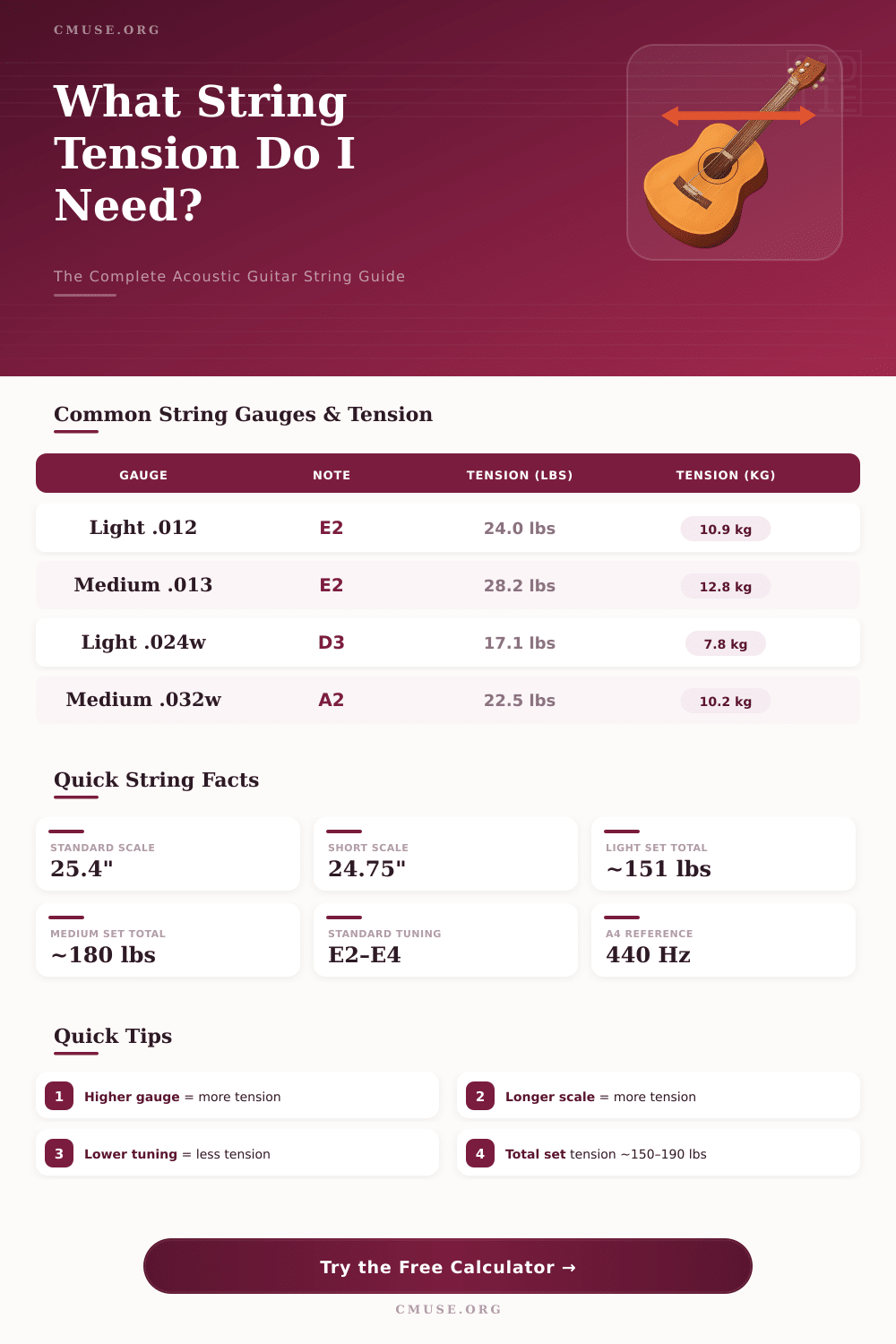
Higher total string tension puts more stress on your guitar top and neck. A light set (.012) on a dreadnought produces about 151 lbs of total tension. Switching to medium (.013) adds roughly 25–30 lbs. Always check your guitar’s recommended gauge range before going heavier.
Tension scales with the square of scale length ratio. Moving from 24.75" to 25.4" increases tension by about 7%. This is why the same gauge feels stiffer on a dreadnought than on a parlor guitar. Use our calculator to compare exact tensions across different scale lengths.
The tension of guitar strings shows by the force that one needs for pulling a string like this, that it sounds the right pitch in tuned state. The more tension a string has the more stiff it feels during play. Total tension for a whole set ranges up to 60 pounds, depending on the setup.
Three main ways to alter tension of strings exist: choose shorter string, lower the tuning or use less heavy gauges. Here the point. Everything is based on basic physics laws.
Guitar String Tension Basics
Even so on guitar with low set head, tension can feel a bit less heavy.
Length of the scale matters a lot. Shorter scale results in less Guitar String Tension. To measure it, simply measure from the nut to the saddle along the first string.
It is that easy. Long scale does tension feel more intense. The impact is not huge in one inch, but it shows clearly when one compares bass scales with those of guitars.
Longer strings usually curve more in the centre, so that their vibration range grows when one picks them. Lower tension or extend the scale, both expand that wave distance. Bass strings, although with fairly high tension, vibrate more widely then those of guitars.
Increase tension raises the pitch. Reduce it lowers the pitch. When tuning shows that string sounds too high, one lowers its tension.
When it shows too low, turn the tuning key to raise tension.
Special string sets exist, designed for low tuning, that keeps firm tension. Standard set commonly feels too loose in drop tunings. Those separate sets give good tuning and stability for Drop C, Drop B or even lower.
That makesthem liked in modern metal music and other heavy styles.
Classical guitars are built for around 90 pounds of total tension with nylon strings. Acoustic guitar string sets aim to reach around 30 pounds of tension each string, what is about 150 percent more than on electric guitars. Tension of electric guitar strings usually stays around 22 pounds for one string.
Strings with low tension feel like rubber bands. High action also can seem loose, because there is more space for string movement. Acoustic guitar needs string vibration to drive the sound board.
Heavier gauges and higher tension creates more vibration, what brings bigger volume.
Calculators for string tension help a lot. One enters details about scale length, tuning and string gauges. The tool right away shows tension for every string, what makes it easy to try different setups and compare values between strings.
Change of the truss rod can also affect string tension. When one installs strings with higher tension, the neck can curve and need adjustment of the rod to return to normal state.
Lower tension without changing strings means to play in lower pitch. It changes also the sound and the feeling. The more tension one reduces, the less the instrument sounds like a standard guitar.