🎵 Chord Transpose Calculator
Instantly transpose any chord progression to a new key — enter chords, pick your semitone shift, and get results
| Interval Name | Semitones | Example (from C) | Common Use |
|---|---|---|---|
| Unison | 0 | C → C | No change |
| Minor 2nd | +1 | C → C# / Db | Half step up |
| Major 2nd | +2 | C → D | Whole step up |
| Minor 3rd | +3 | C → Eb | Relative minor |
| Major 3rd | +4 | C → E | Tertian harmony |
| Perfect 4th | +5 | C → F | Common capo use |
| Tritone | +6 | C → F# / Gb | Dissonance |
| Perfect 5th | +7 | C → G | Power chords |
| Minor 6th | +8 | C → Ab | Ab key songs |
| Major 6th | +9 | C → A | A major songs |
| Minor 7th | +10 | C → Bb | Bb key songs |
| Major 7th | +11 | C → B | B major songs |
| Octave | +12 | C → C | Same key, higher |
| Key | Sharps / Flats | Relative Minor | Guitar-Friendly? |
|---|---|---|---|
| C Major | None | A minor | ✅ Yes |
| G Major | 1 Sharp (F#) | E minor | ✅ Yes |
| D Major | 2 Sharps | B minor | ✅ Yes |
| A Major | 3 Sharps | F# minor | ✅ Yes |
| E Major | 4 Sharps | C# minor | ✅ Yes |
| F Major | 1 Flat (Bb) | D minor | ✅ Yes |
| Bb Major | 2 Flats | G minor | ⚠ Barre chords |
| Eb Major | 3 Flats | C minor | ⚠ Barre chords |
| Ab Major | 4 Flats | F minor | ❌ Difficult |
| Capo Fret | Play C → Sounds Like | Play G → Sounds Like | Play Am → Sounds Like |
|---|---|---|---|
| Capo 1 | Db / C# | Ab / G# | Bbm |
| Capo 2 | D | A | Bm |
| Capo 3 | Eb | Bb | Cm |
| Capo 4 | E | B | C#m |
| Capo 5 | F | C | Dm |
| Capo 6 | F# / Gb | Db / C# | Ebm |
| Capo 7 | G | D | Em |
| Original Key | Voice Type | Transpose To | Semitones |
|---|---|---|---|
| G Major | Male vocal | Bb Major | +3 |
| C Major | Female vocal | Eb Major | +3 |
| E Major | Guitar original | G Major | +3 |
| A Major | Higher voice | C Major | +3 |
| Bb Major | Standard piano | G Major | -3 |
| F Major | Easier for guitar | G Major | +2 (capo 2) |
| Eb Major | Easier for guitar | C Major | -3 (capo 3) |
Chord Transpose is made up of simple move of the strings in song from one tone to another, by this change one moves all them upward or down by the same amount of half steps. Think about it like this: the whole progression of strings slips to new tone but the relations between those strings stay the same. Yes, the names of individual strings adjust, but the basic structures stay unchanged.
Here clear sample. Consider progression in C major: C major, A minor, F major, G major. It matches with I, vi, IV, V according to roman numerals.
How to Change Chords to a New Key
After you memorized that formula, you simply apply it to any major tone and right away know, what strings in it are used. The Nashville number system uses the same idea, you write 1 above C string, 4 above F, 5 above G, and quickly you can alter tone in a moment easily.
On guitar, one half step matches one fret. So, while you Chord Transpose strings in a set amount of half steps, those sounds simply move up or down by that many frets on the fretboard. Every string glides together to keep the original sequence, only in higher sound.
But here the main point: also teh melodic notes must adapt, so that they fit well in the new tone. Singers, guitarists or anyone, that cares about the melody, will have to change their notes for that.
Internet made that hearing a lot easier. Free tools for Chord Transpose allow you to choose, how many half steps or sounds you want to move, enter the names of your strings and receive the changed version right away. It is possible also simply enter the wanted tone directly.
Some programs even take guitar chords and strings… You only add them and click Chord Transpose. Ready.
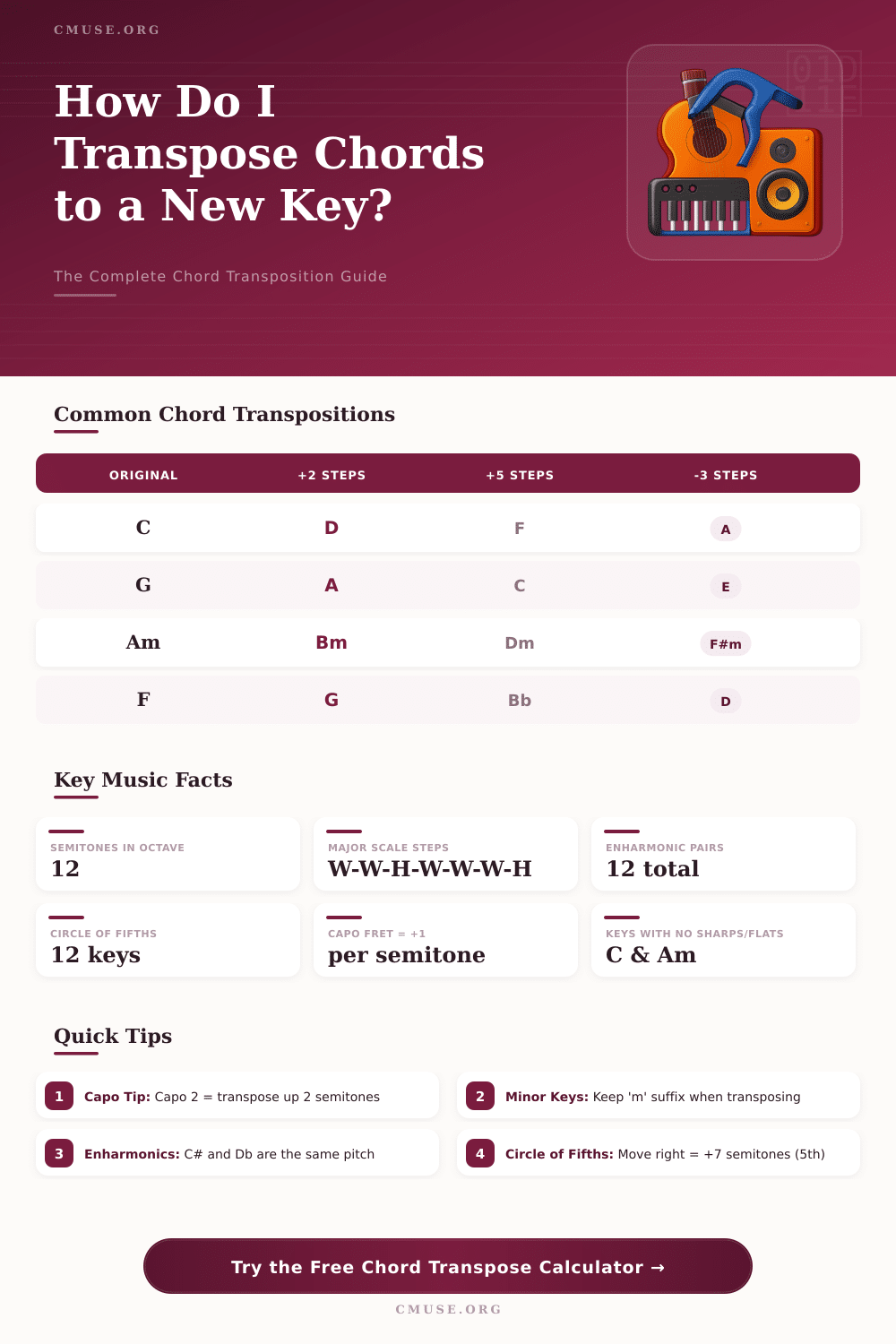
Another useful thing deserves a mention: the capo. Lay a capo on the second fret, play the same forms as for C major, and you sound actually in D major. That helps, because you do not need too learn entirely new finger positions for the changed tone.
Chord Transpose of instruments makes things a bit harder. Clarinet in B-flat sounds whole tone lower than what is written in the notes. Like this C string in the sheet music makes B-flat, when the player plays it.
On classical guitar it becomes even more tricky; one must think whole strings instead of single notes, and sometimes the changed notes do not have position, that truly works in the new tone. But here the secret: practice changes everything. Do Chord Transpose quite a lot often, and it becomes natural.
Quickly it goes without thoughts about it. Practice of scales also helps to set that, because it burns in, that notes and patterns belongto every tone.
Non-diatonic strings, those, that fall outside the basic scale, need a bit different approach. Practice well with the seven diatonic strings in your basic tone, before you struggle with those more unusual.