🎺 Instrument Transposition Calculator
Convert notes between transposing instruments and concert pitch instantly
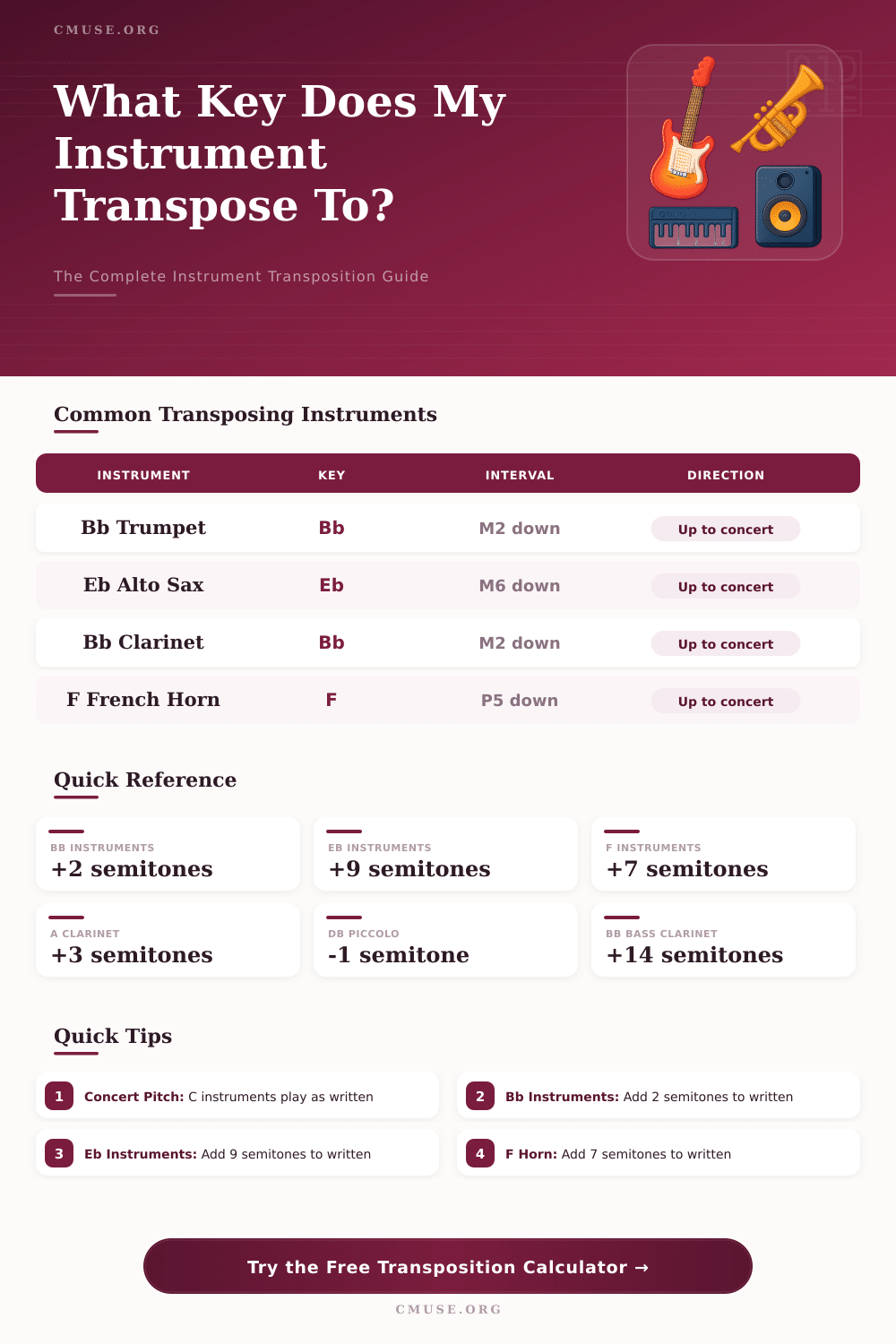
| Instrument | Key | Semitones (Concert→Written) | Written C Sounds As | Interval |
|---|---|---|---|---|
| Bb Trumpet / Cornet | Bb | +2 | Bb4 | Maj 2nd up |
| Bb Clarinet | Bb | +2 | Bb4 | Maj 2nd up |
| A Clarinet | A | +3 | A4 | Min 3rd up |
| Bb Bass Clarinet | Bb | +14 | Bb3 | Maj 9th up |
| Contrabass Bb Clarinet | Bb | +26 | Bb2 | Maj 16th up |
| Eb Alto Clarinet | Eb | +9 | Eb4 | Maj 6th up |
| Eb Soprano Saxophone | Eb | +9 | Eb5 | Maj 6th up |
| Eb Alto Saxophone | Eb | +9 | Eb4 | Maj 6th up |
| Bb Tenor Saxophone | Bb | +14 | Bb3 | Maj 9th up |
| Eb Baritone Saxophone | Eb | +21 | Eb3 | Maj 13th up |
| F French Horn | F | +7 | F4 | Perf 5th up |
| English Horn (F) | F | +7 | F4 | Perf 5th up |
| Bb Flugelhorn | Bb | +2 | Bb4 | Maj 2nd up |
| Db Piccolo | Db | −1 | Db5 | Min 2nd down |
| C Soprano Saxophone | C | 0 | C5 | Unison (8va) |
| Concert Pitch (C) | C | 0 | C4 | Unison |
| Concert Pitch | Bb Instruments (+2) | Eb Instruments (+9) | F Instruments (+7) | A Clarinet (+3) |
|---|---|---|---|---|
| C | D | A | G | Eb |
| D | E | B | A | F |
| E | F# | C# | B | G |
| F | G | D | C | Ab |
| G | A | E | D | Bb |
| A | B | F# | E | C |
| B | C# | G# | F# | D |
| Bb | C | G | F | Db |
| Eb | F | C | Bb | Gb |
| Ab | Bb | F | Eb | B |
| Concert Key | Bb Instruments | Eb Instruments | F Instruments | A Clarinet |
|---|---|---|---|---|
| C Major | D Major (2#) | A Major (3#) | G Major (1#) | Eb Major (3b) |
| G Major (1#) | A Major (3#) | E Major (4#) | D Major (2#) | Bb Major (2b) |
| D Major (2#) | E Major (4#) | B Major (5#) | A Major (3#) | F Major (1b) |
| F Major (1b) | G Major (1#) | D Major (2#) | C Major | Ab Major (4b) |
| Bb Major (2b) | C Major | G Major (1#) | F Major (1b) | Db Major (5b) |
| Eb Major (3b) | F Major (1b) | C Major | Bb Major (2b) | Gb Major (6b) |
| Ab Major (4b) | Bb Major (2b) | F Major (1b) | Eb Major (3b) | Cb Major (7b) |
instrument transposition is a kind of musical tool, where the written notes do not match with the heard sound. The concert pitch is that height that one hears from a non-transposing instrument, for example the piano. If a musician reads middle C on a transposing instrument, the real sound that comes out is not truly middle C.
Here is an easy way to understand that. On a B-flat clarinet, when the player reads C and plays it, the truly heard note is B-flat. The key of the instrument shows by means of what one hears when the player reads and plays C. Most transposing tools show the instrument transposition directly in their name.
Why Some Instruments Sound Different From Their Written Notes
For instance the E-flat horn tells you the instrument transposition. Even so, sometimes the name does not show it clearly.
The instrument transposition grew in the 18th century. It was seen as a way for publishers to win more money selling clarinet parts writen for that system. Before, clarinet players had to read only at pitches that depended heavily on the key of their instrument.
A big reason for the existence of transposing instruments is to simplify the fingering. A saxophonist simply needs to learn one single series of fingers. When the saxophonist sees a written note, it points to exact fingering, no matter which saxophone is used.
Without instrument transposition, the player would need to recall a whole fresh set of fingers for every different saxophone. That is not simple for all. Thanks to instrument transposition, a saxophonist can play all saxophones with easier fingers.
The same thought counts for clarinets. Typical clarinets are the B-flat, E-flat and the bass clarinet. Thanks too instrument transposition, the player only must learn one finger system for each of them.
Recorders well show what happens without instrument transposition. They are made almost the same, except the size, but their finger charts all differ, because instrument transposition never was used for them.
There is also octave instrument transposition. The piccolo sounds an octave higher than written, so its music is written an octave lower than the real sound. The double bass and the electric bass guitar are the opposite.
They sound an octave lower than what is shown. Guitars also belong to transposing instruments, because the sound is an octave under the noted height. Even so, octave instrument transposition mostly helps practically, so that the notes stay on the staff without too many extra lines.
It is not as hard inusage as the non-octave transpositions.
The B-flat trumpet sounds a big second lower than written. So, when band melodies are in concert B-flat, the trumpets play their written C. In the past, before valves existed, the players had to exchange instruments or tubes to reach certain notes. That resulted in lots of sheet music written for various transpositions.