🎸 Guitar Nut String Spacing Calculator
Calculate precise string spacing at the nut for any guitar — 4, 6, 7, 8, or 12 strings
⚡ Quick Presets
📏 Calculator Inputs
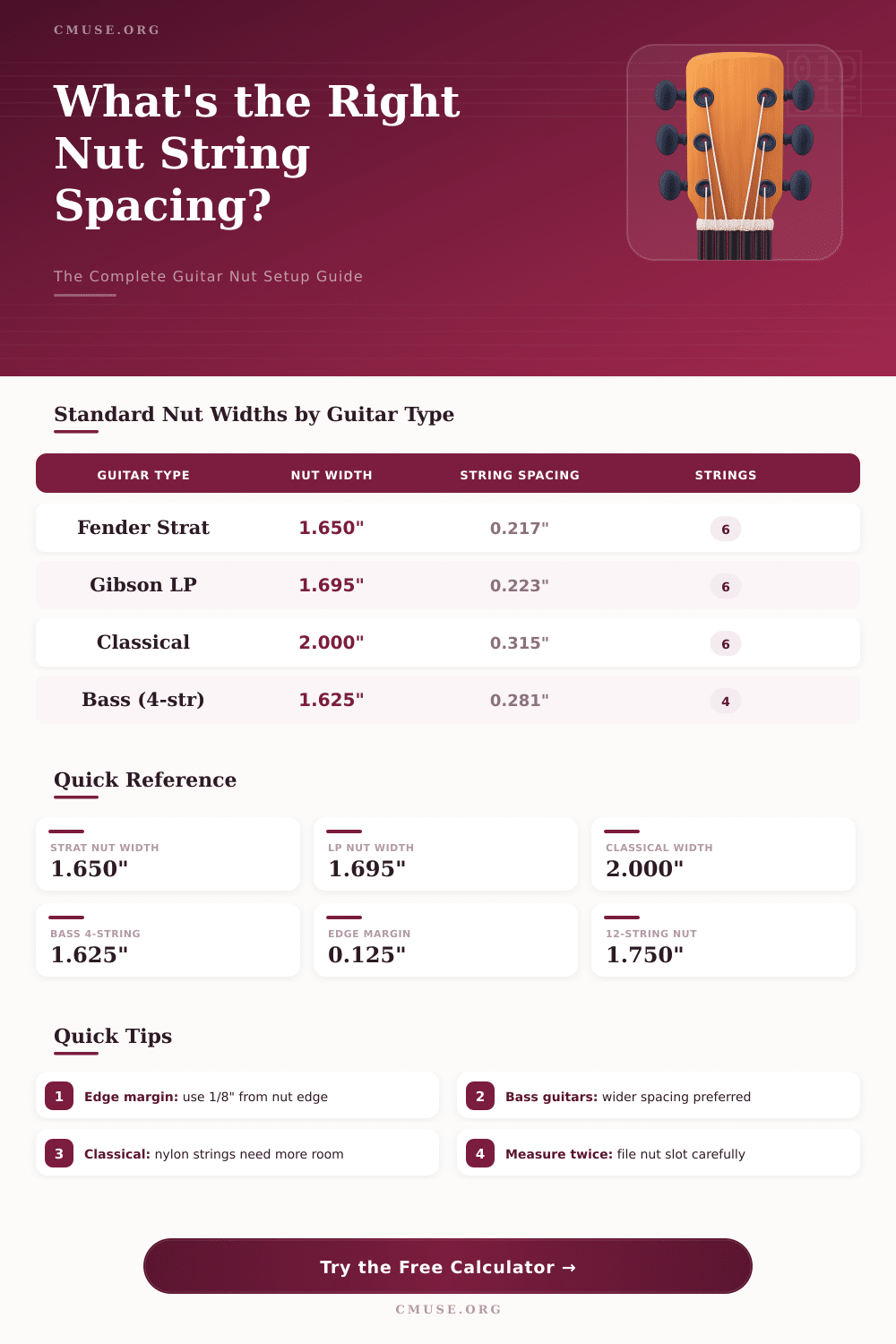
📐 Standard Nut Widths by Guitar Type
📊 Center-to-Center Spacing Reference Table
| Guitar Type | Nut Width | Strings | Edge Margin | C-to-C Spacing | Spacing (mm) |
|---|---|---|---|---|---|
| Fender Stratocaster | 1.650" | 6 | 0.125" | 0.280" | 7.11 mm |
| Gibson Les Paul | 1.695" | 6 | 0.125" | 0.289" | 7.34 mm |
| Gibson SG | 1.695" | 6 | 0.125" | 0.289" | 7.34 mm |
| Acoustic Dreadnought | 1.685" | 6 | 0.125" | 0.287" | 7.29 mm |
| Classical Guitar | 2.000" | 6 | 0.156" | 0.338" | 8.58 mm |
| Bass Guitar (4-str) | 1.625" | 4 | 0.188" | 0.416" | 10.57 mm |
| Bass Guitar (5-str) | 1.750" | 5 | 0.188" | 0.344" | 8.73 mm |
| 7-String Electric | 1.890" | 7 | 0.125" | 0.273" | 6.94 mm |
| 8-String Electric | 2.050" | 8 | 0.125" | 0.257" | 6.53 mm |
| 12-String Guitar | 1.750" | 12 | 0.125" | 0.136" | 3.45 mm |
🎺 String Gauge Reference by Guitar Type
| Guitar Type | Light Gauge | Medium Gauge | Heavy Gauge | Recommended |
|---|---|---|---|---|
| Electric (6-str) | .009–.042 | .010–.046 | .011–.052 | .010–.046 |
| Acoustic (6-str) | .011–.052 | .012–.054 | .013–.056 | .012–.054 |
| Classical Nylon | Light Tension | Normal Tension | High Tension | Normal |
| Bass (4-str) | .040–.095 | .045–.100 | .050–.105 | .045–.105 |
| Bass (5-str) | .040–.120 | .045–.130 | .050–.135 | .045–.130 |
| 7-String Electric | .009–.052 | .010–.056 | .011–.060 | .010–.056 |
🔧 Nut Slot Width vs String Gauge
| String Gauge (in) | String Gauge (mm) | Slot Width (in) | Slot Width (mm) | String Position |
|---|---|---|---|---|
| .008 | 0.20 mm | .009 | 0.23 mm | High E (electric) |
| .010 | 0.25 mm | .011 | 0.28 mm | High E (electric) |
| .016 | 0.41 mm | .017 | 0.43 mm | B String |
| .024 | 0.61 mm | .025 | 0.64 mm | G String |
| .032 | 0.81 mm | .033 | 0.84 mm | D String |
| .042 | 1.07 mm | .043 | 1.09 mm | A String |
| .046 | 1.17 mm | .047 | 1.19 mm | Low E |
| .056 | 1.42 mm | .057 | 1.45 mm | Low B (7-str) |
| .100 | 2.54 mm | .102 | 2.59 mm | Bass Low E |
The standard edge margin for electric guitars is 1/8" (0.125") on each side. Classical guitars typically use 5/32" (0.156"). Too little margin causes strings to fall off the fretboard during bending.
Center-to-center spacing is measured from the middle of one string to the middle of the next. Edge-to-edge spacing is the actual gap between string surfaces. For consistent feel, use center-to-center for layout and edge-to-edge to verify playability.
The spacing of the strings at the nut of a guitar is one of those things that really changes the feeling during play. At the nut, the distance between strings always stays smaller than at the bridge. Even so along the whole neck, at any position, that spacing should stay the same.
Classical guitars usually have a bit bigger spacing between strings than most acoustic or electric guitars with steel strings. That extra space on the fretboard helps to form difficult chords with the left hand and leaves more room for the right hand during picking. Guitars with steel strings have strings closer to one another.
Guitar Nut Width and String Spacing
Close to the nut, the strings are almost together, because that eases the vibration of the strings, while bigger spacing above the body allows better picking of separate strings with a pick or fingers.
For many years, the standard width of nut for classical guitars was either 1 and 13/16 inches, or 1 and 7/8 inches. Those instruments were fairly small, and most had 12 frets until the body, designed mainly for play with fingers. A standard classical guitar does not always need a full 2-inch width for the nut.
Many believe that a broader nut eases the play. Typical widths of nuts are 1.69 inches, 1.75 inches and 1.80 inches. But what really matters is the Guitar Nut String Spacing itself, not only the whole width of teh nut.
A guitar can have a nut of 1 11/16 inches with different spacings for strings. Whether strumming or playing with fingers, both the width of the nut and the spacing of strings affect how comfortable the instrument feels. For guitars used in fingerstyle, a good difference between the spacing at the saddle of the bridge and that at the nut matters.
When that difference is too small, everything feels too close for play with fingers.
One common way to measure the spacing is to use the formula called B minus C divided by D, where D is the hole width of the fretboard at the nut. A simple way is to divide the distance between the outer strings by the number of spaces between strings. For a six-string guitar, that means to divide by five.
For a four-string bass, divide by three.
For classical guitar, the most commonly used spacing of strings at the saddle is around 57 to 58 millimeters, measured between the centers of strings. Guitars of the early 19th century had 39 millimeters at the nut and 59 millimeters at the bridge. Strings from nylon do not grow slowly in width past the nut, as do those from steel, so rules for spacing made for steel strings do not apply perfectly to classical guitars.
Guitars from Ibanez normally have a nut width between 42 and 43 millimeters, but the real spacing of E to E strings ranges from 35 to 37 millimeters. Locking nuts commonly have 37 millimeters for the spacing. Custom nuts can be made in any size, as long as the width is enough to properly separate the strings.
Getting the right spacingdepends really on the style of play and on personal comfort.