🎸 Guitar Scale Length Calculator
Calculate precise fret positions, nut-to-fret distances, and spacing for any guitar scale length
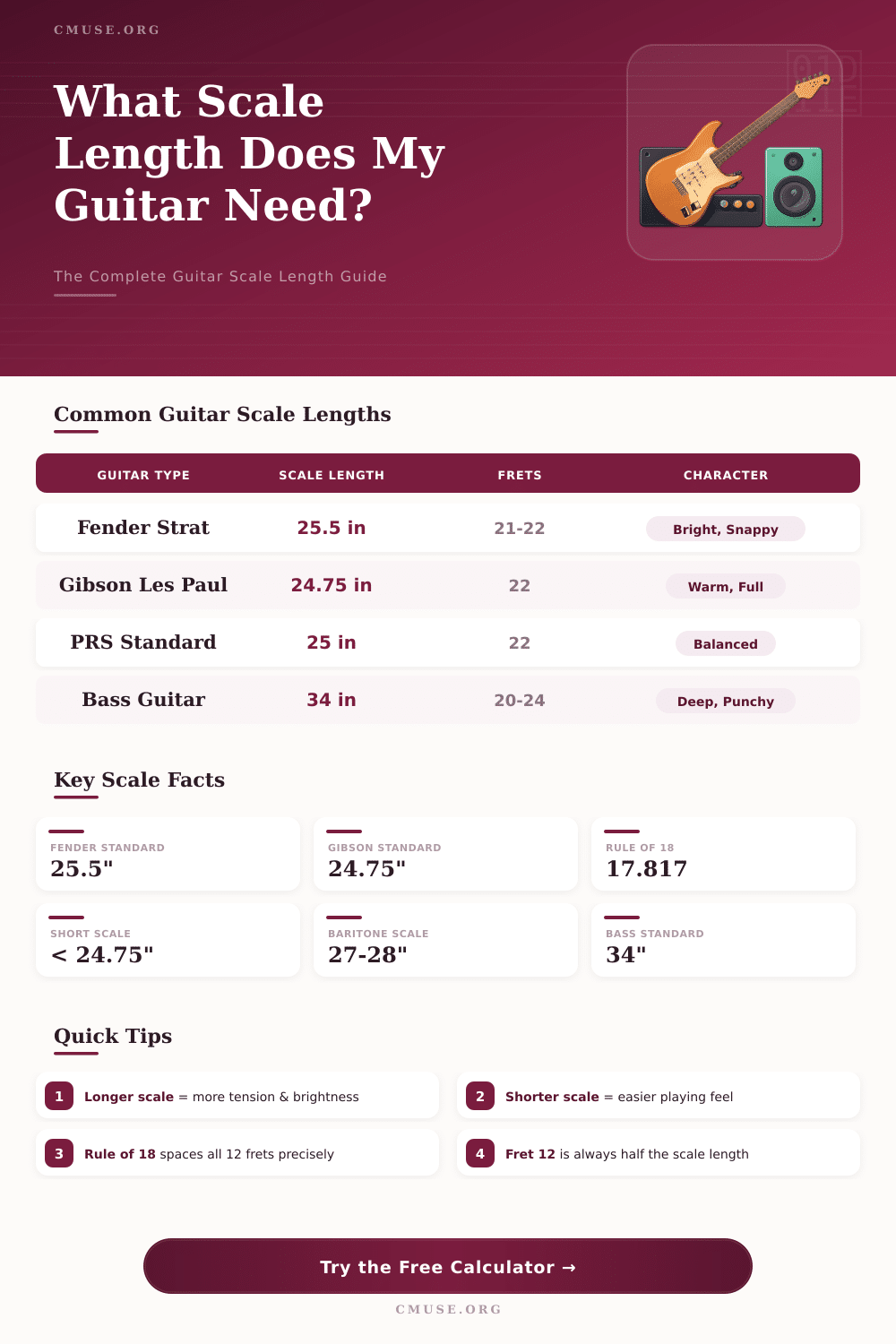
| Guitar Model / Type | Scale Length (in) | Scale Length (mm) | Fret 12 Distance | Character |
|---|---|---|---|---|
| Fender Stratocaster / Telecaster | 25.5" | 648mm | 12.75" | Bright, Snappy, High Tension |
| Gibson Les Paul / SG | 24.75" | 628.65mm | 12.375" | Warm, Dark, Easier Bends |
| PRS Custom 24 | 25" | 635mm | 12.5" | Balanced Tone & Feel |
| Baritone Guitar | 27" | 686mm | 13.5" | Extended Low Range |
| Standard Bass | 34" | 864mm | 17" | Full, Punchy Low End |
| Short-Scale Bass | 30" | 762mm | 15" | Warmer, Easier Reach |
| Classical Guitar | 25.6" | 650mm | 12.8" | Nylon String Standard |
| 3/4 Acoustic | 22.75" | 578mm | 11.375" | Travel / Student Size |
| Ukulele (Tenor) | 17" | 432mm | 8.5" | Bright, Light Tension |
| 7-String Extended | 26.5" | 673mm | 13.25" | Extended Low B Range |
| Fret # | Divisor (Rule of 18) | % of Scale Length | Distance from Nut (25.5" scale) | Distance from Nut (24.75" scale) |
|---|---|---|---|---|
| 1 | 17.817 | 5.613% | 1.431" | 1.389" |
| 2 | — | 10.911% | 2.782" | 2.700" |
| 3 | — | 15.910% | 4.057" | 3.938" |
| 4 | — | 20.630% | 5.261" | 5.106" |
| 5 | — | 25.085% | 6.397" | 6.208" |
| 7 | — | 33.333% | 8.500" | 8.250" |
| 9 | — | 40.825% | 10.410" | 10.104" |
| 12 | — | 50.000% | 12.750" | 12.375" |
| 17 | — | 66.667% | 17.000" | 16.500" |
| 24 | — | 75.000% | 19.125" | 18.563" |
| Tuning | String 6 (Low) | String 5 | String 4 | String 3 | String 2 | String 1 (High) |
|---|---|---|---|---|---|---|
| Standard (E A D G B E) | E2 / 82.4Hz | A2 / 110Hz | D3 / 146.8Hz | G3 / 196Hz | B3 / 246.9Hz | E4 / 329.6Hz |
| Drop D (D A D G B E) | D2 / 73.4Hz | A2 / 110Hz | D3 / 146.8Hz | G3 / 196Hz | B3 / 246.9Hz | E4 / 329.6Hz |
| Eb (Half Step Down) | Eb2 / 77.8Hz | Ab2 / 103.8Hz | Db3 / 138.6Hz | Gb3 / 185Hz | Bb3 / 233.1Hz | Eb4 / 311.1Hz |
| D Standard (Full Down) | D2 / 73.4Hz | G2 / 98Hz | C3 / 130.8Hz | F3 / 174.6Hz | A3 / 220Hz | D4 / 293.7Hz |
| Open G (D G D G B D) | D2 / 73.4Hz | G2 / 98Hz | D3 / 146.8Hz | G3 / 196Hz | B3 / 246.9Hz | D4 / 293.7Hz |
| DADGAD | D2 / 73.4Hz | A2 / 110Hz | D3 / 146.8Hz | G3 / 196Hz | A3 / 220Hz | D4 / 293.7Hz |
The guitar scale length simply consists of the distance from the nut to the bridge behind it. To be more clear, it represents the actual vibrating part of the string. When you pick a note the section between nut and saddle will vibrate actively.
Here is how to measure it: take a ruler and measure from the front edge of the nut to the center of the 12th fret, then double what you found. The 12th fret sits exactly in the middle, play here, and you will hear the octave of your open string. Know that: the distance from nut to saddle is bigger than the real scale, because the saddle must compensate for the thickness of the strings.
Guitar Scale Length: What It Is and Why It Matters
Most guitars have a scale between 24 and 26.5 inches. In the range of electric guitars, the two main ones are 25.5 inches and 24.75 inches. Not too big a diffrence, only three quarters of an inch separates them, which matches around 3 percent when you spread that through all frets.
Gibson uses 24.75 inches as its standard. And Fender? It stays at 25.5 inches for the Stratocaster and Telecaster.
PRS acts in its own way, offering 25, 25.25 and 25.5 inches in various models. Instruments with shorter scale, like the Mustang or Duo Sonic, give a more compact feeling and allow your hand to move less to reach the first fret.
Using shorter scale, you get lower tension in the strings and tighter spacing between frets. This really is useful if you have smaller hands or still develop your reach. Also the sound changes, short scales make the tone warmer.
Long scales do the reverse: they feel more rigid and sound brighter. To reach the same pitch requires more tension, which forces the strings to bend with moor force from the muscles.
Each guitar scale length gets its own sound character, no matter what you pass through effects, pedals or amplifiers. Long scales let you strike same chords with slimmer strings, while you keep the attack sharp and the tone clean. If you lower the setup on shorter scale, the sound can become dirty and lose clarity; because of that heavy music favors long instruments.
Classical guitarists work with 650 mm as the modern standard. Some builders make models with short scale at 640 mm. During the 60s and 80s, Spanish guitars commonly had 660 mm.
Instruments from Ramirez reached even more, around 664 or 665 mm. The difference between 640 mm and 630 mm becomes important if your hands are smaller or you have physical limits. Charts for hand size indeed tie the distance from index finger to pinky with advice about scale, from 615 mm for the smallest hands to 664 mm forbigger musicians.
Also the radius of the fretboard matters. The guitar scale length affects how everything feels, but your style of play and the curved radius completes the whole picture.