🎸 Guitar String Spacing Calculator
Calculate precise string spacing for nut, bridge & fretboard — imperial & metric
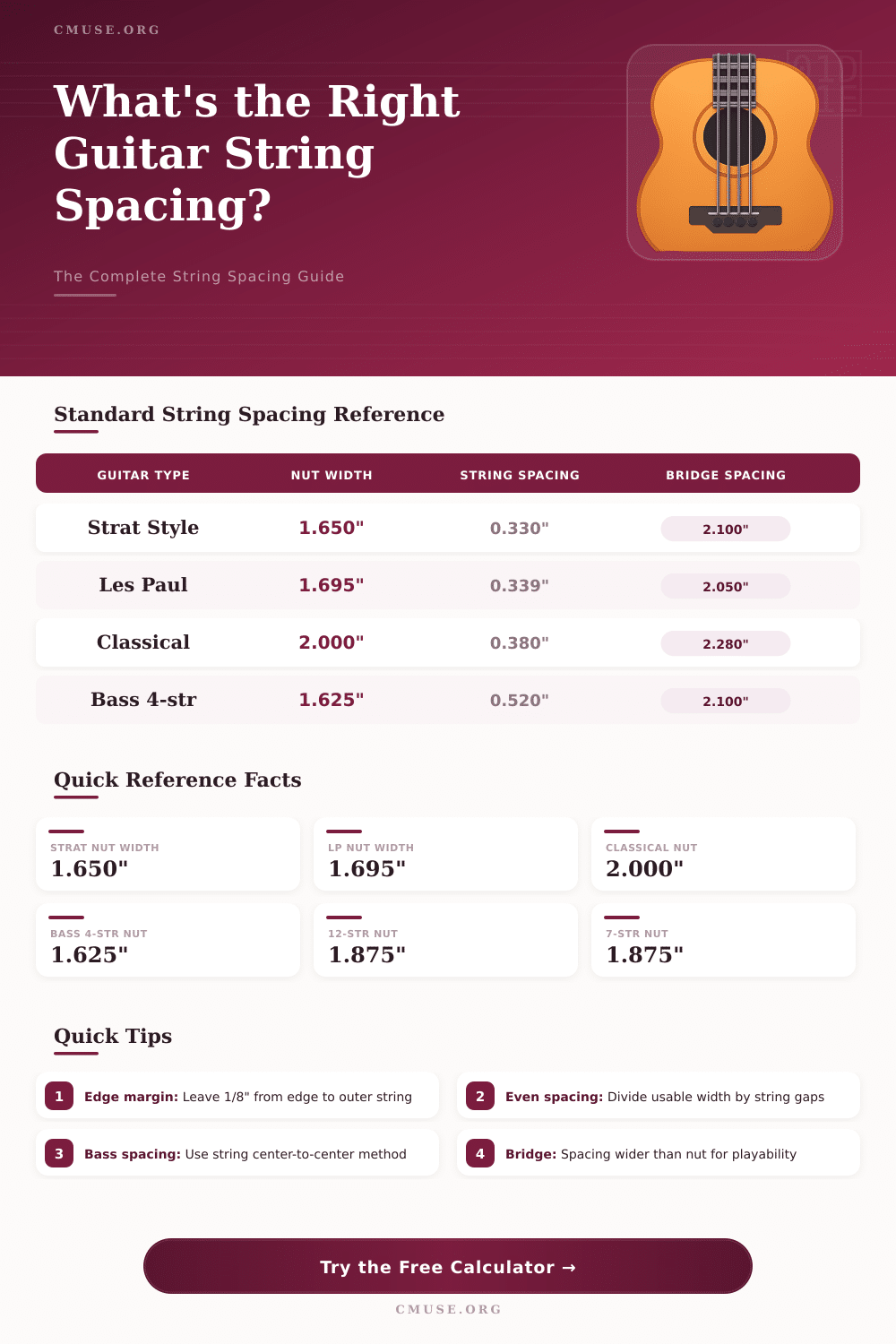
| Guitar Type | Nut Width | Strings | Edge Margin | C-to-C Spacing | Bridge Spacing |
|---|---|---|---|---|---|
| Stratocaster | 1.650" / 41.9mm | 6 | 1/8" | 0.280" / 7.1mm | 2.077" / 52.8mm |
| Les Paul | 1.695" / 43.1mm | 6 | 1/8" | 0.289" / 7.3mm | 2.050" / 52.1mm |
| Telecaster | 1.650" / 41.9mm | 6 | 1/8" | 0.280" / 7.1mm | 2.100" / 53.3mm |
| Classical Guitar | 2.000" / 50.8mm | 6 | 3/16" | 0.325" / 8.3mm | 2.280" / 57.9mm |
| Bass 4-String | 1.625" / 41.3mm | 4 | 1/8" | 0.458" / 11.6mm | 2.100" / 53.3mm |
| Bass 5-String | 1.750" / 44.5mm | 5 | 1/8" | 0.375" / 9.5mm | 2.350" / 59.7mm |
| 7-String Guitar | 1.875" / 47.6mm | 7 | 1/8" | 0.271" / 6.9mm | 2.200" / 55.9mm |
| 12-String Guitar | 1.875" / 47.6mm | 12 | 1/8" | 0.148" / 3.8mm | 2.200" / 55.9mm |
| Mandolin | 1.375" / 34.9mm | 8 | 3/32" | 0.185" / 4.7mm | 1.250" / 31.8mm |
| Formula | When to Use | Result Type | Notes |
|---|---|---|---|
| Usable Width ÷ (Strings − 1) | Standard equal spacing | Center-to-center | Most common method |
| (Usable Width − Gauge) ÷ (Strings − 1) | Edge-to-edge spacing | String edge gap | Add gauge back for C-to-C |
| Nut Width − (2 × Edge Margin) | Finding usable width | Inches / mm | Typical margin 1/8" each side |
| C-to-C × 25.4 | Imperial to metric | Millimeters | Multiply inches by 25.4 |
| mm ÷ 25.4 | Metric to imperial | Inches | Divide mm by 25.4 |
| Inches | Millimeters | Common Use | Guitar Context |
|---|---|---|---|
| 0.125" | 3.18mm | Edge margin (small neck) | Mandolin, narrow nut |
| 0.156" | 3.97mm | 5/32" margin | Electric bass nut |
| 0.250" | 6.35mm | Narrow string spacing | Fast-play electric guitars |
| 0.280" | 7.11mm | Strat C-to-C spacing | Most common electric spacing |
| 0.330" | 8.38mm | Wide string spacing | Acoustic fingerstyle guitars |
| 0.375" | 9.53mm | Bass 5-string C-to-C | Medium bass spacing |
| 0.460" | 11.68mm | Bass 4-string C-to-C | Standard bass nut spacing |
| 0.500" | 12.70mm | Wide bass spacing | Bass bridge, wide format |
Guitar String Spacing is the distance between the strings of a guitar. That affects the comfort during play and the ease to choose separate strings. At almost every guitar the spacing is bigger at the bridge than at the nut.
This way one can more easily separate them during picking. Because of narrowing of the neck the space between the outer strings and the edge of the fretboard stays the same.
Guitar String Spacing Guide
Makers choose different Guitar String Spacing. Gibson and PRS use 2-1/16 inches from the bottom E to the upper E, while Fender guitars have 2-3/16 inches. One measures the Guitar String Spacing from the center of one to the center of the next.
On modern guitars the Guitar String Spacing at the bridge is smaller than on old models. Older Fender-tremolo have 2-7/32 inches while the current version is 2-1/16 inches.
The width of the nut matters for the spacing. With a wider nut, playing is usually simpler, because it leaves more room between the strings. Those range from 1-5/8 to 1-3/4 inches.
Electric guitars favor the less wide option, while acoustic tend to bigger nuts. The necks come in three common widths: 1.625 inches for vintage style, 1.650 inches for something close to real vintage and 1.685 inches for current models. Finding guitars with steel strings and nuts much wider then 1.75 inches is rare, unless they are oversized.
Classical guitars have bigger Guitar String Spacing than most steel string or electric guitars. These spaces help with hard chords and finger picking. On steel strings the diameters differ more than on classical, so the spacing can seem uneven even if the strings are center to center equally spaced.
The outer strings usually are 2.5 to 3.5 millimeters away from the edge of the fretboard. If they are too close, one risks that they will slip out during play. A common method is to lay them around 1/8 inch from the neck edge.
The guide for Guitar String Spacing helps to place the strings so that the thick one gets a bit more space. Each gap differs from the next by exactly 0.004 inches.
Nut spacing and bridge spacing do not always match. For instance a guitar with a 1-11/16-inch nut can have 2-1/16-inch Guitar String Spacing at the bridge. Online one finds free calculators for Guitar String Spacing, that show edge to edge and center to center measures.
When the grooves do not line up with the Guitar String Spacing, one can tilt them to fix that. To change the Guitar String Spacing one can replace the nut, but the option depends on theguitar itself.
Twelve-string guitars have around 1-7/8 inches at the nut. Concert-size guitars can feel more tight in the spacing than dreadnoughts. Learning with less space between strings can actually help you become a better player.