🌊 Wavelength to Frequency Calculator
Convert wavelength to frequency (or frequency to wavelength) for sound, light, and radio waves
| Note / Source | Frequency (Hz) | Wavelength in Air | Category |
|---|---|---|---|
| Bass Guitar Low E | 41.2 Hz | 8.33 m / 27.3 ft | Sub-Bass |
| Kick Drum Fundamental | 60 Hz | 5.72 m / 18.8 ft | Bass |
| Middle C (C4) | 261.6 Hz | 1.31 m / 4.31 ft | Midrange |
| Concert A (A4) | 440 Hz | 0.780 m / 2.56 ft | Midrange |
| Guitar High E | 329.6 Hz | 1.04 m / 3.41 ft | Midrange |
| Soprano Vocal Peak | 1,047 Hz | 0.328 m / 12.9 in | Upper Mid |
| Cymbal Presence | 8,000 Hz | 42.9 mm / 1.69 in | High |
| Upper Hearing Limit | 20,000 Hz | 17.2 mm / 0.68 in | Ultrasonic Edge |
| Wave Type | Wavelength Range | Frequency Range | Example |
|---|---|---|---|
| AM Radio | 100 m – 1 km | 300 kHz – 3 MHz | AM Broadcast |
| FM Radio | 2.8 m – 3.4 m | 88 – 108 MHz | FM Broadcast |
| WiFi (2.4 GHz) | 12.5 cm | 2.4 GHz | Wireless Router |
| WiFi (5 GHz) | 6.0 cm | 5.0 GHz | Wireless Router |
| Infrared | 700 nm – 1 mm | 300 GHz – 430 THz | TV Remote |
| Red Light | 625 – 740 nm | 405 – 480 THz | Red Laser |
| Green Light | 520 – 565 nm | 530 – 580 THz | Green LED |
| Blue Light | 450 – 495 nm | 606 – 668 THz | Blue Laser |
| UV Light | 10 – 400 nm | 750 THz – 30 PHz | Black Light |
| X-Rays | 0.01 – 10 nm | 30 PHz – 30 EHz | Medical Imaging |
| Frequency | Wavelength (m) | Wavelength (ft) | Wavelength (in / cm) |
|---|---|---|---|
| 20 Hz | 17.15 m | 56.3 ft | 675.6 in |
| 50 Hz | 6.86 m | 22.5 ft | 270.1 in |
| 100 Hz | 3.43 m | 11.25 ft | 135.0 in |
| 250 Hz | 1.372 m | 4.50 ft | 54.0 in |
| 500 Hz | 0.686 m | 2.25 ft | 68.6 cm |
| 1,000 Hz | 0.343 m | 1.125 ft | 34.3 cm |
| 2,000 Hz | 0.172 m | 6.75 in | 17.2 cm |
| 5,000 Hz | 68.6 mm | 2.7 in | 6.86 cm |
| 10,000 Hz | 34.3 mm | 1.35 in | 3.43 cm |
| 20,000 Hz | 17.2 mm | 0.68 in | 1.72 cm |
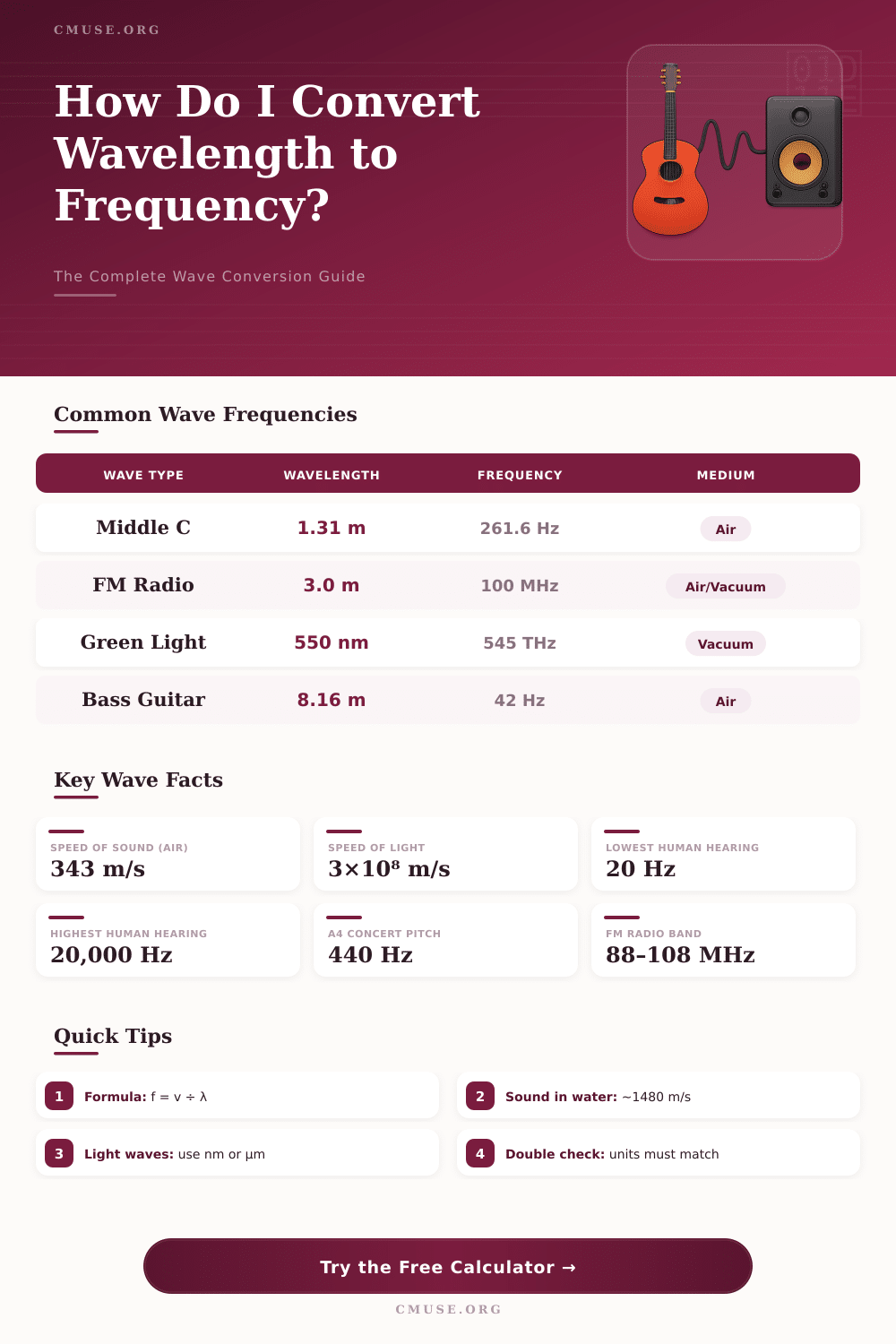
Frequency (f) = Wave Speed (v) ÷ Wavelength (λ). Wavelength (λ) = Wave Speed (v) ÷ Frequency (f). The speed changes depending on the medium — always use the correct wave speed for accurate results. Sound travels ~4x faster in water than in air.
Light and radio wavelengths are often expressed in nanometers (nm) or micrometers (µm). 1 nm = 0.000000001 m (10⁻⁹ m). For radio waves, MHz and GHz are standard. The calculator automatically handles unit conversions — just select the correct unit from the dropdown.
Waves really depend on two main ideas: the wavelength and the frequency. Wavelength is the distance between the same spot of one wave and the same spot of the next cycle. On the other hand the frequency shows how many waves pass through a given place during one second.
They two are linked by a simple relation.
How Wavelength and Frequency Work
Here is where it becomes interesting. The frequency equals the wave speed divided by wavelength… That is the link between them.
If one raises the frequency, the wavelength shrinks. When the frequency drops, the wavelength grwos more long. They adjust in opposite ways, what makes them inverse proportions one to the other.
So if the wavelength doubles, the frequency halves, and vice versa.
One whole wave cycle goes from one peak to the next peak or from one valley too the next valley. This distance is simply the wavelength, and one measures it in metres. The frequency shows how many full cycles happen in one second…
It is measured in hertz. One hertz means that one single cycle happens during one second.
For electromagnetic waves especially, something nice happens: if one multiplies the frequency by the wavelength, one gets the speed of light. So if you know the frequency, finding the wavelength is only dividing the speed of light by that frequency. Short wavelength matches with higher frequency, because more wave peaks pass by any fixed spot in the same time.
Here is something important to note: when waves move from one material into another, the frequency stays the same. Because the frequency depends only on what creates the wave initially. The wave speed depends on the material through which it travels, and because the frequency does not adjust, the wavelength must adapt so that everything stays in balance.
The speed and wavelength adjust together, while the frequency stays the same.
The frequency is actually part of the wave itself. But the wavelength? It depends on the frequency and on the speed at which the wave travels through any material around it.
In vacuum everything is simple, but when light enters other materials, its speed adjusts, which forces the wavelength to adapt with it.
When the frequency grows higher, the wavelength drops and every photon carries more energy. Low frequencies mean fewer vibrations each second, because the wavelength gets more long. Low tones have long wavelengths and low frequencies, while high pitched sounds have short wavelengths and high frequencies.
Long wavelength simply shows fewer peaks passing by a spot each second. Wave shapes split into wave parts, each of them moving according to its ownmode with its own wavelength and frequency.