🎧 Acoustics Room Calculator
Calculate acoustic material volume, bag counts & weight for any room shape
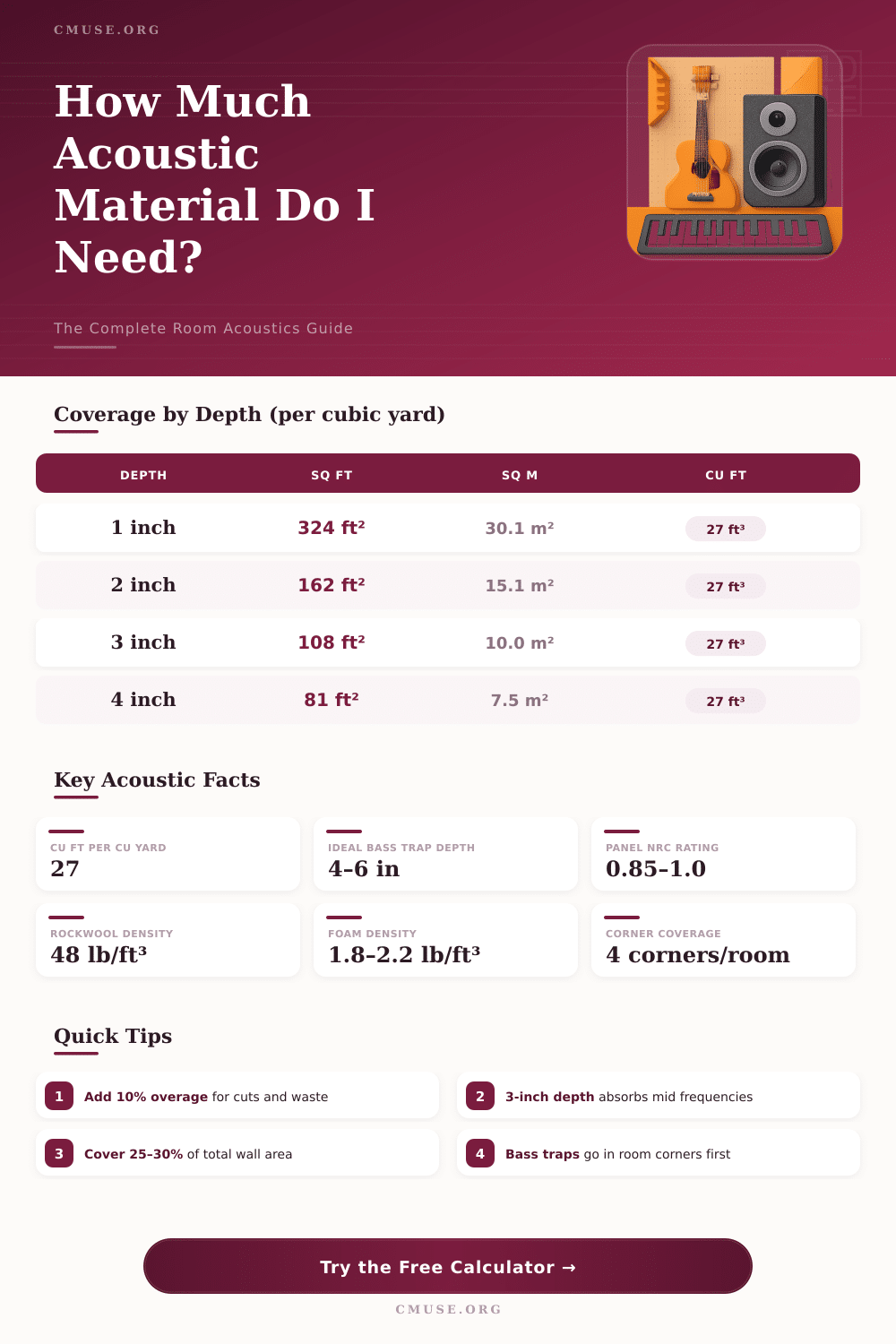
| Depth | Sq Ft per Cu Yd | Sq M per Cu M | Cu Ft per Cu Yd | Panels (24x24 in) |
|---|---|---|---|---|
| 1 inch | 324 ft² | 100 m² | 27 | ~324 panels |
| 2 inches | 162 ft² | 50 m² | 27 | ~162 panels |
| 3 inches | 108 ft² | 33.3 m² | 27 | ~108 panels |
| 4 inches | 81 ft² | 25 m² | 27 | ~81 panels |
| 6 inches | 54 ft² | 16.7 m² | 27 | ~54 panels |
| Bag Size | Cu Ft per Bag | Bags per Cu Yd | Coverage @ 2 in | Coverage @ 4 in |
|---|---|---|---|---|
| Small (1 cu ft) | 1 ft³ | 27 bags | 6 ft² | 3 ft² |
| Standard (2 cu ft) | 2 ft³ | 13.5 bags | 12 ft² | 6 ft² |
| Large (3 cu ft) | 3 ft³ | 9 bags | 18 ft² | 9 ft² |
| XL (4 cu ft) | 4 ft³ | 6.75 bags | 24 ft² | 12 ft² |
| Project | Area | Cu Yds @ 3 in | 2 cu ft Bags | 3 cu ft Bags |
|---|---|---|---|---|
| Vocal Booth 5x5 | 25 ft² | 0.23 yd³ | 4 bags | 3 bags |
| DJ Booth 6x4 | 24 ft² | 0.22 yd³ | 4 bags | 3 bags |
| Practice Room 8x8 | 64 ft² | 0.59 yd³ | 9 bags | 6 bags |
| Home Studio 10x12 | 120 ft² | 1.11 yd³ | 16 bags | 11 bags |
| Live Room 14x10 | 140 ft² | 1.30 yd³ | 18 bags | 12 bags |
| Rehearsal Space 18x14 | 252 ft² | 2.33 yd³ | 32 bags | 21 bags |
| Broadcast Room 24x20 | 480 ft² | 4.44 yd³ | 61 bags | 41 bags |
Strong sounds bouncing through the room, here is the core of Room Acoustics. Your hearing experience includes the space itself as element. The size of the room, its shape materials on walls and objects on the floor, everything that determines, does the sound stay clear or become muddy.
The waves bounce, disappear or jump in different directions, which can improve or hurt what you hear, whether during mixing of music or simply enjoying listening at home.
How to Make Your Room Sound Better
Every room has warm and cold places, where the sounds have different energies. The position of your speakers matters much more than many folks believe. Frequencies over 300 Hz?
They come directly from the speaker itself. Under that level, the situation changes, the room itself takes the control. It matters, because in low frequencies the room does almots half of the work.
Two kinds of acoustic treatment exist, and they can not swap. One absorbs energy of low frequencies, while the second cares about middles and highs. They work entirely different, so your method must adapt according to what you bother to correct.
Absorption and expansion are the main tools here, although the reflection also affects how the sounds move through your space.
In small rooms, the bass commonly causes the biggest problems. Without clean bass sound first, it swallows the upper details and makes everything unclear. Start with the corners; here belong the bass traps.
Later, control the side walls and the back. Mineral wool reaches good balance between cost and impact. Panels in six inches thick or deeper grab a broad range and help to smooth the frequency response.
If shallower then eight inches? Use rigid fiberglass for better results. For thick traps, loose woolly insulation becomes your friend.
The objects that you already have in the room are also useful. Bookshelves with air between them and the wall grab a bit of sound, especially if they are high and quite deep so that the sound moves between the books. Lay carpet on the floor, hang heavy curtains on bare walls, and you already reduce the reflections without taking too much space.
Here is the main point, a good room with normal speakers commonly beats a big one in average space. You want to escape strong resonances and ensure that possible resonances spread through various frequencies. The shape of the room matters for that.
Square or round rooms both cause troubles. In a rectangular room, the ideal listening position faces the short wall, placed around 38 to 40 percent along thelength of the longer side.
Small rooms give fewer options for placing speakers or finding the perfect listening place. Try different setups and measure how the sound truly behaves, that requires patience, but it pays off a lot. A calibrated microphone and software for Room Acoustics show exactly how your speakers interact with the room around them.
Long reverb times work well for classical music, they capture the full concert hall.