🔊 JBL Speaker Placement Calculator
Calculate optimal speaker distance, coverage area, and placement angles for your room or venue
Horizontal
Vertical
Horizontal
Vertical
Horizontal
Omnidirectional
Dispersion
Horizontal
| Room Size | Area (sq ft) | Ideal Distance (ft) | Ideal Distance (m) | Recommended Type |
|---|---|---|---|---|
| Small Studio 8x8 | 64 | 3 – 5 ft | 0.9 – 1.5 m | Nearfield Monitor |
| Home Studio 10x12 | 120 | 4 – 6 ft | 1.2 – 1.8 m | Nearfield Monitor |
| Practice Room 12x14 | 168 | 5 – 8 ft | 1.5 – 2.4 m | Stereo Passive |
| Medium Studio 14x16 | 224 | 6 – 10 ft | 1.8 – 3.0 m | Stereo Passive |
| Small Venue 20x25 | 500 | 10 – 18 ft | 3.0 – 5.5 m | Powered PA |
| Club/Stage 30x40 | 1200 | 15 – 30 ft | 4.6 – 9.1 m | Line Array / PA |
| Speaker Spacing | Listening Distance | Triangle Type | Toe-In Angle | Best For |
|---|---|---|---|---|
| 3 ft (0.9 m) | 3 ft (0.9 m) | Equilateral | 30° | Small nearfield |
| 5 ft (1.5 m) | 5 ft (1.5 m) | Equilateral | 30° | Home studio |
| 6 ft (1.8 m) | 7 ft (2.1 m) | Slightly obtuse | 20° | Living room |
| 8 ft (2.4 m) | 10 ft (3.0 m) | Obtuse | 15° | Large studio |
| 10 ft (3.0 m) | 12 ft (3.7 m) | Wide stage | 10° | Small venue |
| Speaker Type | Mount Height | Coverage Radius (ft) | Coverage Area (sq ft) | H-Angle |
|---|---|---|---|---|
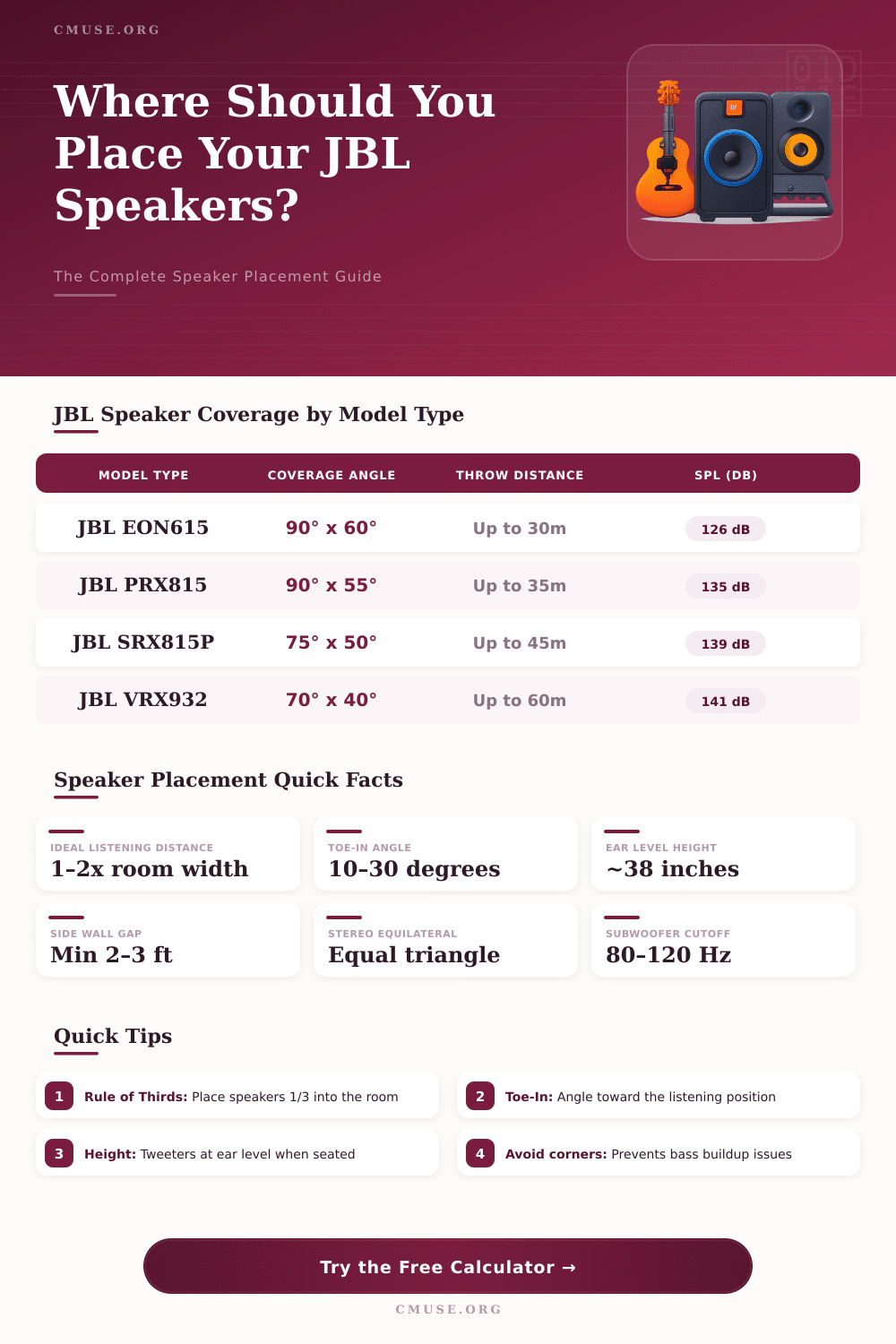
| JBL EON615 | 8 ft (2.4 m) | ~8 ft | ~200 | 90° |
| JBL PRX815 | 10 ft (3.0 m) | ~10 ft | ~314 | 90° |
| JBL SRX815P | 12 ft (3.7 m) | ~13 ft | ~530 | 75° |
| JBL VRX932 | 20 ft (6.1 m) | ~20 ft | ~1256 | 70° |
| JBL Control 67 | 9 ft (2.7 m) | ~12 ft | ~452 | 120° |
| JBL 308P Nearfield | Desk 3 ft | ~4 ft | ~50 | 90° |
Getting the speakers in the right place could be the best and cheapest way to improve your listening experience. It has bigger impact than many people think, even the most expensive speakers will sound average if you place them somewhere where they do not work.
Balance really changes the results. You must place every speaker equally distant from the side walls and centered on the front wall. Think of that as a triangle: the two speakers and yourself form the three corners.
Where to Put Your Speakers
The raised speakers should reach level with your ears when you sit. Surprisingly easy, but this basic triangular position changes the whole sound.
Corners and walls always create troubles. Place the speakers at least three feet away from the corners and between one and two feet from the walls. If you place a speaker in a corner, it gives too heavy bass compared with one in the centre of the room, taht throws off the balance.
The reflections from walls, floor and back surfaces add color or make the sound too thin. Every nearby surface affects something.
There is one unusual exception for moving speakers from walls. In small rooms, you can move them more toward the front wall, and it works well. That helps to control the frequency of interference between speaker and wall, which smooths the sound in tight spaces.
Some folks even place acoustic panels behind the speaker, if enough space keeps it from the wall.
Pointing the speakers toward the center, some call that toe-in, sends the sound directly to you. Aim them to spot a bit behind the back of your head. Want more wide JBL Speaker Placement for listening?
Pull the angle a bit. When the sound comes directly too your ears, it sounds richer and clear.
Because it surrounds the sound, the 5.1 setup uses five speakers plus a bass unit. You have left, center and right front, with surround speakers on every side. The center channel stands directly before your seat, with the speaker at ear height.
Those surround speakers spread equally as the front or maybe a bit more broadly, reaching between 110 and 120 degrees around you. If you add a 7.1 system, you get two extra back speakers, placed behind your seat.
Your speakers need room to breathe. Putting them on a tiny shelf, surrounded by clutter, does not help. They need free space to work.
The size and shape of the room affects everything. Odd corners and bumps are very important. Whether you place speakers along the long or the short wall, that changes the whole sound.
I tried setups that sounded average on the long wall, then moved them to the short and suddenly everything sounded great. Every place has its own sweet spot forlistening, so try out different positions.