🔊 2-Channel Speaker Placement Calculator
Find ideal stereo speaker distances, angles, and listening positions for accurate audio reproduction
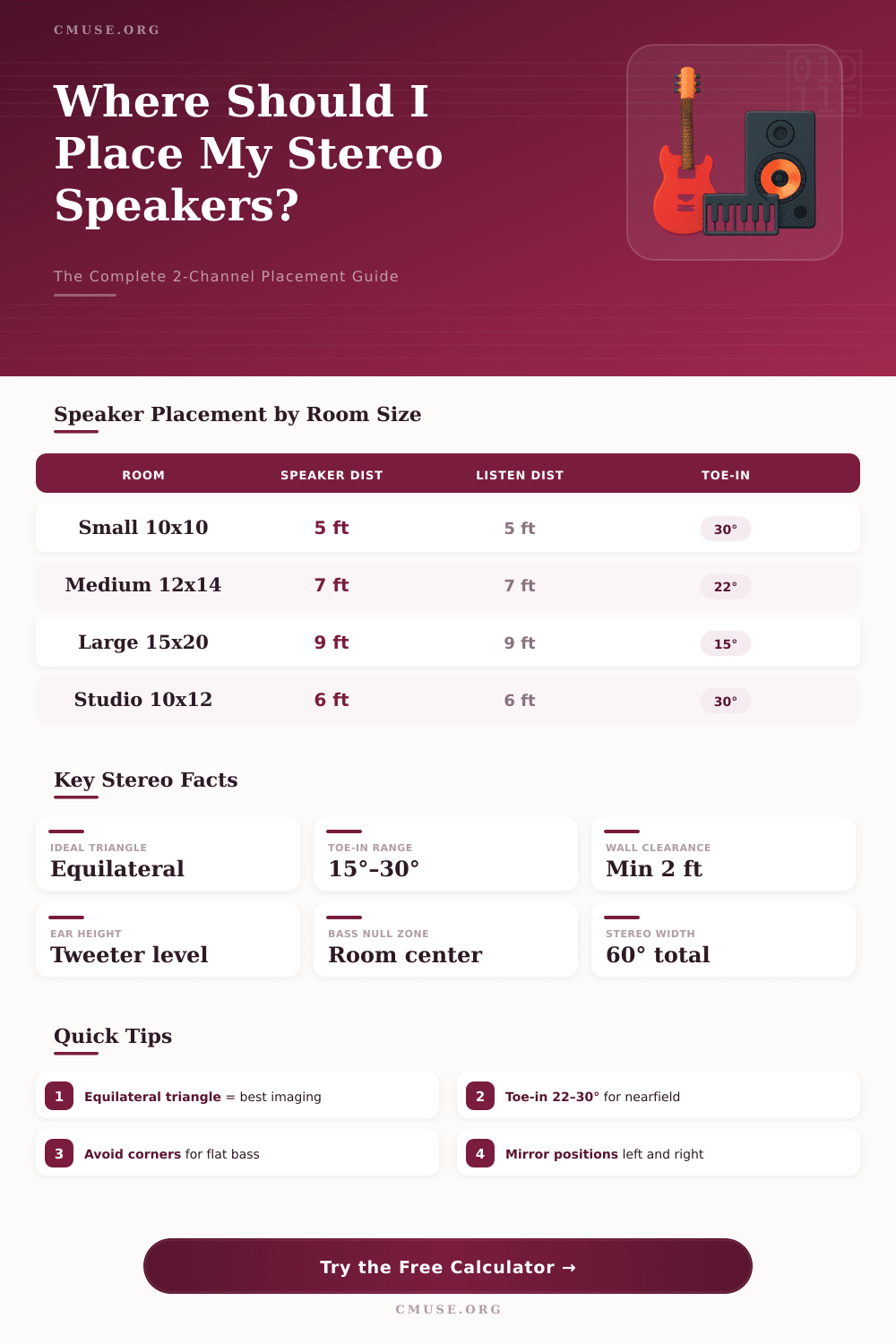
Equilateral triangle: all three sides equal. Each speaker and listener form a 60° angle.
| Room Type | Room Size | Speaker Span | Listen Distance | Toe-In | Rear Wall Gap |
|---|---|---|---|---|---|
| Micro Studio | 8x8 ft (2.4x2.4 m) | 4–5 ft (1.2–1.5 m) | 4–5 ft | 30° | 12–18 in |
| Small Studio | 10x12 ft (3x3.7 m) | 5–6 ft (1.5–1.8 m) | 5–6 ft | 25–30° | 18–24 in |
| Medium Studio | 12x14 ft (3.7x4.3 m) | 6–8 ft (1.8–2.4 m) | 6–8 ft | 22–25° | 24 in |
| Large Studio | 15x20 ft (4.6x6.1 m) | 8–10 ft (2.4–3 m) | 8–10 ft | 15–22° | 24–36 in |
| Home Theater | 16x20 ft (4.9x6.1 m) | 9–12 ft (2.7–3.7 m) | 10–14 ft | 22–30° | 12–18 in |
| Mastering Suite | 12x16 ft (3.7x4.9 m) | 7–8 ft (2.1–2.4 m) | 7–8 ft | 22° | 24–36 in |
| Speaker Type | Recommended Toe-In | Use Case | Sweet Spot Width | Imaging Precision |
|---|---|---|---|---|
| Nearfield Studio Monitor | 22–30° | Mixing & Mastering | Narrow | Very High |
| Midfield Monitor | 15–22° | Professional Studio | Medium | High |
| Farfield Monitor | 0–15° | Large Control Room | Wide | Medium |
| Bookshelf / HiFi | 15–20° | Home Listening | Medium–Wide | High |
| Floorstanding Tower | 10–20° | Home Listening / HiFi | Wide | Medium |
| Coaxial / Point Source | 22–30° | Studio / Audiophile | Narrow | Excellent |
| Distance from Rear Wall | Bass Effect | Recommended For | Low-End Boost |
|---|---|---|---|
| 0–6 in (0–15 cm) | Severe bass buildup | Avoid for monitoring | +6–10 dB |
| 6–12 in (15–30 cm) | Significant boost | Not recommended | +4–6 dB |
| 12–24 in (30–61 cm) | Moderate boost | Acceptable minimum | +2–4 dB |
| 24–36 in (61–91 cm) | Slight warmth | Good studio practice | +1–2 dB |
| 36 in+ (91 cm+) | Minimal coloration | Ideal for accuracy | <1 dB |
Well, 2-channel speaker placement really is one of the simplest and most useful ways to get better sound. That method is much more effective than most folks think, and honestly even small changes can seriously affect the way your music sounds.
Balance helps to keep everything even. The two speakers should be centered against the wall, equally far from the side walls. The best position is centering them before the longest wall of your room.
How to Place Speakers for Better Sound
This way you create an even and balanced sound image, wherever you listen. In the classic setup, the speakers form a triangle, they at two corners, you at the third. The speaker should reach the level of your ears, when you sit.
The distance to walls and corners matters more than one thinks. I noticed that starting around three feet from the corners and one to two feet from the wall makes a clear difference. Simply shove a speaker in a corner, and the bass becomes too strong compared with one that stands a bit away, that spreads everthing well.
Here the thing; in a small room, moving speakers more near to the front wall can help, raising some problem frequencies and controlling the weak bass.
Experiment with toe-in angles is worth it. When you turn speakers inward, so that they point only to the place where your head sits, you get that precise and clear sound. If you want good spread over a broad listening area, even so, one suggests a gentle angle.
Pointing them straight at your ears gives a fuller and rich tone compared with pointing sum other place.
Reflections also shape your sound. The direct sound waves from the speakers create the stereo image, but bounces off walls, floor and back of the room change the whole tone and create a sense of space. Many near surfaces send a lot of reflections to you, so everything matters.
Pressing speakers on a full shelf or wedging them between objects only hurts the sound. They need room to breathe.
In surround systems like 5.1 you have five speakers. Left, center, right, left surround and right surround, plus a subwoofer that handles the low frequencies. The center channel should be at the same height as your main listening spot, with the speaker near ear height.
Surround speakers flank the listening area to the left and to the right, spaced the same as the front or a bit more broadly, angled to you. Those same ideas about placement count, when you add systems like Dolby Atmos or move to 7.1 setups.
The shape and size of the room matters more than only the position of speakers. Reflections and odd room shapes change how everything reaches you. In a dedicated listening room, set first the position of speakers, then choose where to sit.
In a multipurpose space you usually work the other way, the listening spot is fixed, so you move speakers around it. Every speaker position has its ownideal spot for listening, so fixing everything is always worth it.