🔊 Speaker Box Volume Calculator
Calculate internal enclosure volume for any speaker driver & box shape
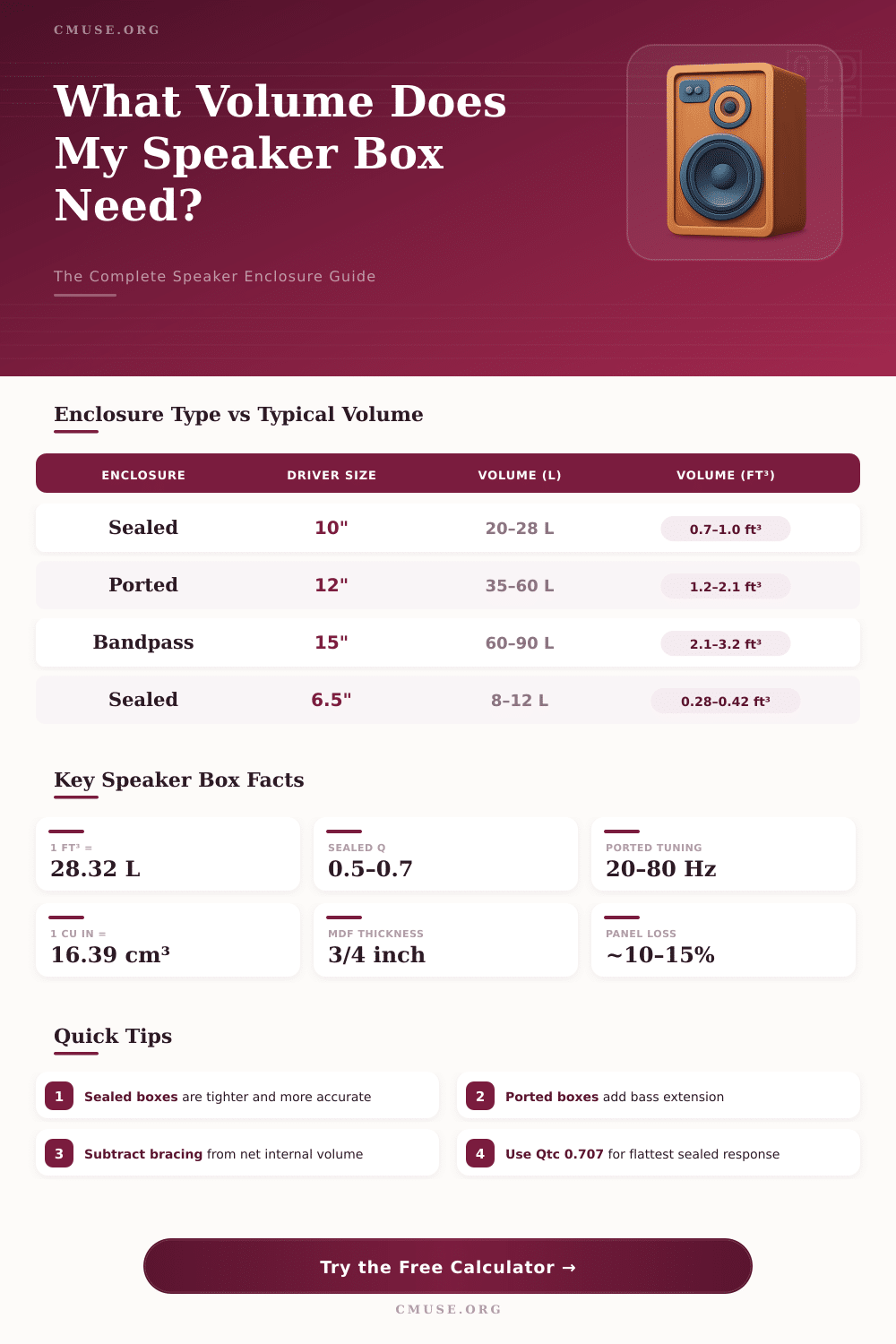
| Driver Size | Sealed Vol (L) | Ported Vol (L) | Sealed Vol (ft³) | Ported Vol (ft³) |
|---|---|---|---|---|
| 4" | 3–6 L | 5–10 L | 0.11–0.21 | 0.18–0.35 |
| 5.25" | 5–10 L | 8–16 L | 0.18–0.35 | 0.28–0.57 |
| 6.5" | 8–14 L | 12–22 L | 0.28–0.49 | 0.42–0.78 |
| 8" | 14–25 L | 20–40 L | 0.49–0.88 | 0.71–1.41 |
| 10" | 20–35 L | 28–55 L | 0.71–1.24 | 0.99–1.94 |
| 12" | 28–50 L | 40–75 L | 0.99–1.77 | 1.41–2.65 |
| 15" | 50–80 L | 65–110 L | 1.77–2.83 | 2.30–3.89 |
| 18" | 80–130 L | 100–160 L | 2.83–4.59 | 3.53–5.65 |
| Cubic Inches (in³) | Cubic Feet (ft³) | Liters (L) | Cubic Cm (cm³) |
|---|---|---|---|
| 100 in³ | 0.058 ft³ | 1.639 L | 1,639 cm³ |
| 250 in³ | 0.145 ft³ | 4.097 L | 4,097 cm³ |
| 500 in³ | 0.289 ft³ | 8.194 L | 8,194 cm³ |
| 1,000 in³ | 0.579 ft³ | 16.387 L | 16,387 cm³ |
| 1,728 in³ | 1.000 ft³ | 28.317 L | 28,317 cm³ |
| 2,500 in³ | 1.447 ft³ | 40.968 L | 40,968 cm³ |
| 3,456 in³ | 2.000 ft³ | 56.634 L | 56,634 cm³ |
| 5,000 in³ | 2.894 ft³ | 81.935 L | 81,935 cm³ |
| Box Size (L x W x H) | Panel Thick | Gross Vol (in³) | Net Vol (in³) | Net Vol (L) |
|---|---|---|---|---|
| 12 x 10 x 12 in | 3/4" | 1,440 | ~1,055 | ~17.3 |
| 15 x 13 x 14 in | 3/4" | 2,730 | ~2,197 | ~36.0 |
| 18 x 16 x 16 in | 3/4" | 4,608 | ~3,826 | ~62.7 |
| 22 x 20 x 22 in | 3/4" | 9,680 | ~8,396 | ~137.6 |
| 14 x 12 x 13 in | 3/4" | 2,184 | ~1,658 | ~27.2 |
The Speaker Box Volume is one of the main spots that one must exactly find during building of the box for a speaker. It seriously affects the quality of the sounds made by the speaker. Use a calculator for speakers to easily guess the needed sizes of the boards during building of the box.
That tool works also as a computer of the internal space that counts it based on the main sizes of the box, the thickness of the wood, the shift of the speaker driver and even the port from tubes, if one wants that included.
How to Calculate Speaker Box Volume
The way to count the internal volume is fairly easy. From the width of the box take away twice the thickness of the boards, later multiply that by the height taken away the same, and finally multiply by the depth handled equally. Like this one gets the space full of air.
When the shape of the box is unusual for instance triangular without straight corners, most simply one splits the section in two triangles with right corners and keeps the count from that.
Correct rating of the Speaker Box Volume is important. In too big a box the internal air spring becomes too weak. The driver hardly resets himself to the resting position, and loss of sound can happen.
One calls that an overdamped state. Too big a box reduces the skill of the speaker to handle power, because it lacks enough resistance of the air, so strong deep push does not force the driver past his maximum motion. On the contrary, too little volume of the box raises the resonant frequency of the cone and limits the answer too good bass.
Sealed boxes handle quite a lot, if the size a bit strays from the ideal. Filling materials from polyester can correct the situation. When the box is done too big, one can simply place objects inside to take up part of the space.
But if it is too tiny, such a solution does not exist.
General advice is to avoid changes of any size or volume more than ten percent. The width and depth usually matter more than the height. Smaller volumes in the boxes raise the resonant frequency, and in sealed cases that practically doubles it.
Ports, angled bits and drivers all take place in the main box. One takes their part from the whole volume of the box. The final space, usually called Vb, shows the internal volume after removal of the part used by the speaker and other parts.
If one adds more drivers in the box, the final volume drops, and the port acts relatively more heavily because of that trait. This changes the whole setup. Double the number of drivers requires to double also the Speaker Box Volume.
Vas is a spec of the speaker, that links to the volume of the box. It points to the size of box that would give the same spring stiffness as the flex of the speaker itself. For speakers used in guitars, a box in double the size of the Vas commonly works well.
Online available calculators forsubwoofer boxes help to plan both ported and sealed boxes, computing the volume together with the length of the port.